Water activity meter
Measures how much of the water in a food is free to support microbial growth and chemical change, as the ratio of the food's vapour pressure to that of pure water. Read on a scale from 0 to 1.
- Food & beverage
- Confectionery and bakery
- Meat and dairy
- Pet food
- Pharmaceutical
- Cosmetics
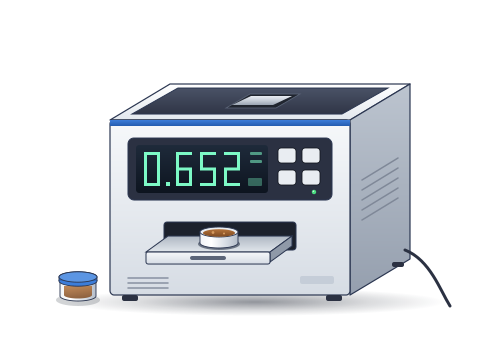
How aw meter works
Water activity is the ratio of the water vapour pressure over the sample (p) to the vapour pressure of pure water (p₀) at the same temperature: aw = p ÷ p₀. In a sealed chamber the headspace reaches equilibrium with the sample, and its relative humidity (ERH, %) equals 100 × aw. The meter measures that humidity by dew point or by a humidity sensor.
The path of a sample
- 01
Load sample
Fill a clean disposable cup about half full, covering the base.
- 02
Seal chamber
Place the cup in the chamber and close the lid.
- 03
Equilibrate
Water exchanges between sample and headspace at a controlled temperature (commonly 25 °C).
- 04
Measure humidity
Dew point on a chilled mirror, or capacitance change of a humidity sensor, is measured.
- 05
Read aw
The instrument reports aw and temperature once the reading is stable.
Main parts and what they do
Sample chamber
Sealed, temperature-controlled space where the sample and headspace reach equilibrium.
Sensor (chilled mirror or capacitance)
Measures the dew point or relative humidity of the headspace.
Infrared or contact thermometer
Measures sample temperature so aw can be calculated correctly.
Temperature control (Peltier)
Holds chamber and sample at the set temperature, commonly 25 °C.
Fan
Circulates headspace air to speed equilibrium (chilled-mirror instruments).
Sample cups and lids
Disposable cups that hold the sample and allow storage before testing.
Display and data output
Shows aw and temperature; stores results with time and user.
Terms every analyst should know
Water activity (aw)
p ÷ p₀ at the same temperature. Pure water is 1.000; completely dry material is 0.
Equilibrium relative humidity (ERH)
The humidity of air in equilibrium with the sample. ERH (%) = aw × 100.
Chilled-mirror dew point
A mirror is cooled until dew forms. The dew point temperature and sample temperature give the vapour pressures and so aw.
Capacitance sensor
A polymer film whose capacitance changes as it absorbs water vapour. Simpler but slower and more prone to drift.
Sorption isotherm
The curve of moisture content against aw at constant temperature. It links moisture and water activity for a given food.
Temperature effect
aw changes with temperature, so results must always be reported with the measurement temperature.
Keep every aw meter in control: usage logs, calibration and maintenance schedules, and automatic blocking of overdue instruments.