Food & proximate analysis
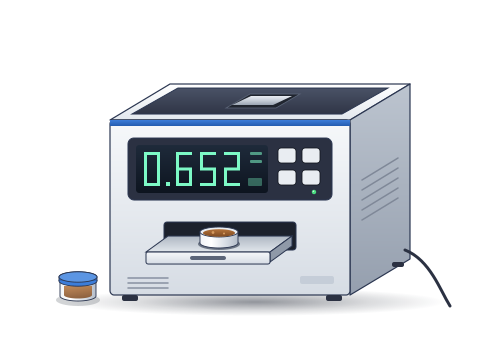
Water activity meter
Measures how much of the water in a food is free to support microbial growth and chemical change, as the ratio of the food's vapour pressure to that of pure water. Read on a scale from 0 to 1.
- Food & beverage
- Confectionery and bakery
- Meat and dairy
- Pet food
- Pharmaceutical
- Cosmetics
Follow your site SOP
This is a typical operating sequence for learning. Your instrument model and approved SOP take precedence.
STAGE 1
Before you start
- 1Switch on the instrument and let it reach its set temperature.
- 2Verify with at least one salt standard near the expected sample aw (and a second standard bracketing it) before testing.
- 3Bring samples to about the measurement temperature in sealed containers, so they do not lose or gain water.
- Do not test samples that are much warmer than the chamber; condensation on the sensor gives wrong readings.
STAGE 2
Measurement
- 1Fill a clean cup about half full; do not overfill and keep the rim clean.
- 2Place the cup in the chamber, close it and start the reading.
- 3Wait for the stable reading and record aw and temperature.
- 4Run duplicates. Agreement within about ±0.003–0.01 aw (depending on the instrument) is typical.
- Samples with alcohol or other volatiles can poison capacitance sensors. Use a volatile-resistant sensor or a filter as advised by the supplier.
STAGE 3
After use
- 1Remove the sample and keep the chamber closed with an empty clean cup to keep it dust-free.
- 2Clean the chamber with the supplied wipes if any sample spilled.
- 3Record results and complete the log.
In LimsPulse · Calibration Management
Keep every aw meter in control: usage logs, calibration and maintenance schedules, and automatic blocking of overdue instruments.