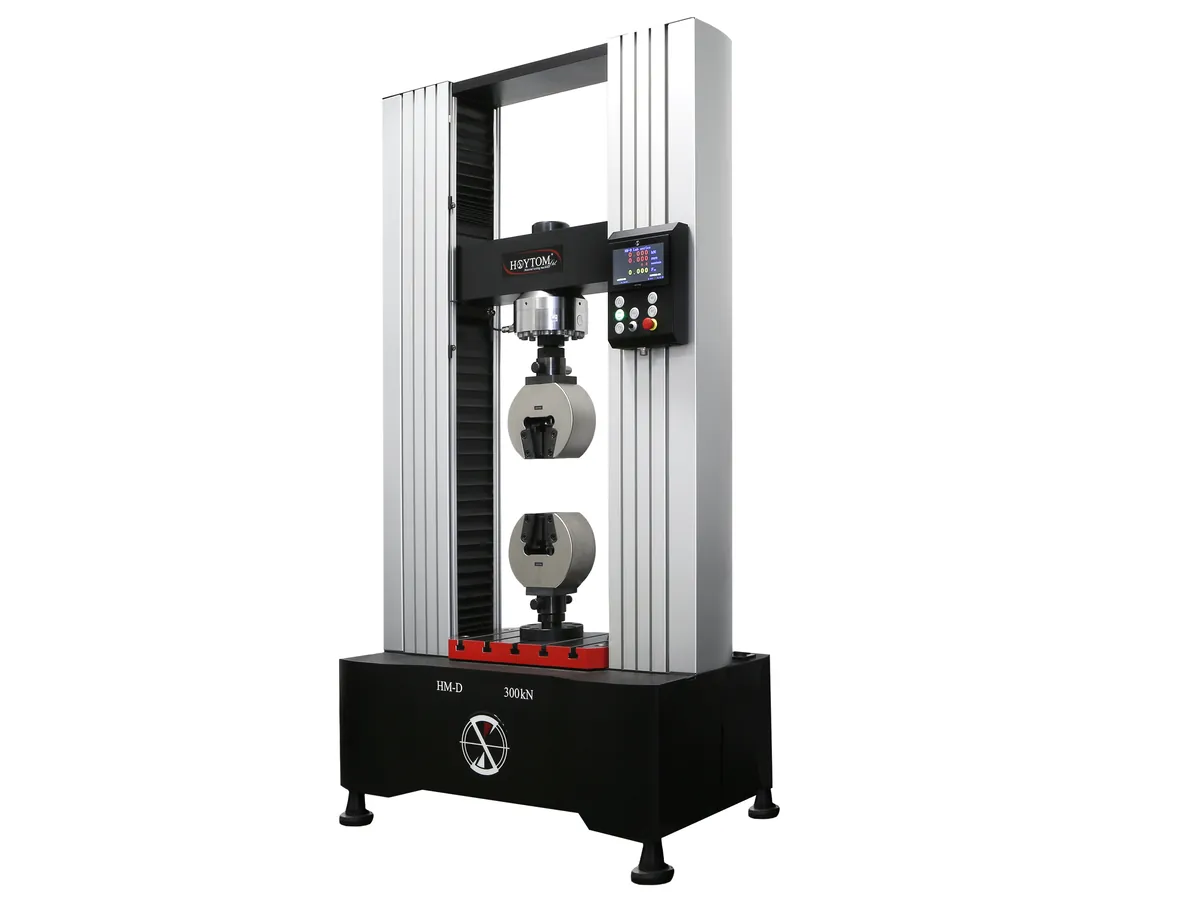
Universal Testing Machine (UTM)
A versatile machine that pulls, compresses or bends specimens while measuring force and extension. In construction labs it is mainly used for tensile testing of reinforcement bars to find yield strength, tensile strength and elongation.
- Construction materials testing
- Steel plants and rolling mills
- Infrastructure projects
- Fabrication and precast yards
- Academic and research labs
UTM calibration procedures
Force verification
Checks the UTM's force indication in tension (and compression if used) against a traceable reference load cell or proving device at several points across each range.
Open procedureExtensometer verification
Checks that the extensometer reads displacement and gauge length correctly by comparing it with a precision extensometer calibrator at several displacements.
Open procedureInstrument qualification (DQ · IQ · OQ · PQ)
- 01
DQ — Design qualification
Defines capacity (e.g. 600–1,000 kN for rebar up to 40 mm), force class, extensometer class and gauge length, grip range and software requirements such as automatic proof stress and data integrity controls.
- 02
IQ — Installation qualification
Checks the frame is level and anchored, utilities are connected, accessories and serial numbers match the order, and software is installed with user access levels set.
- 03
OQ — Operational qualification
Verifies force indication across the range, extensometer accuracy, crosshead speed and the function of limits and emergency stop.
- 04
PQ — Performance qualification
Tests reference bars or takes part in proficiency testing and trends results to show consistent performance in routine use.
Keep every UTM in control: usage logs, calibration and maintenance schedules, and automatic blocking of overdue instruments.