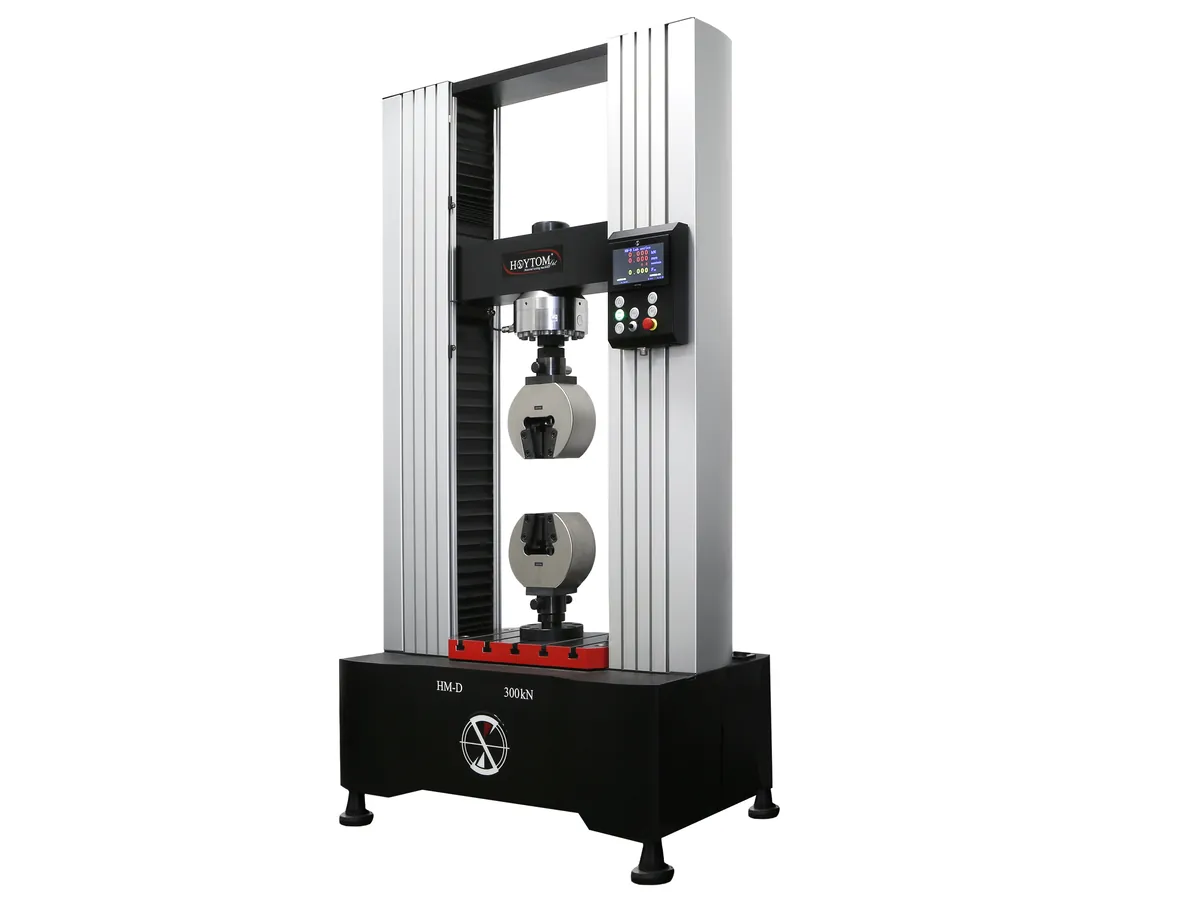
Universal Testing Machine (UTM)
A versatile machine that pulls, compresses or bends specimens while measuring force and extension. In construction labs it is mainly used for tensile testing of reinforcement bars to find yield strength, tensile strength and elongation.
- Construction materials testing
- Steel plants and rolling mills
- Infrastructure projects
- Fabrication and precast yards
- Academic and research labs
Test your UTM knowledge
Multiple-choice questions
Pick an answer to see whether you are right and why.
Q1. What is the main use of a UTM in a construction materials lab?
basicQ2. A 16 mm bar (effective area 201.1 mm²) reaches a maximum force of 124.3 kN. What is its tensile strength?
intermediateQ3. Why is the cross-sectional area of a ribbed TMT bar worked out from its mass per metre?
intermediateQ4. What is the 0.2% proof stress?
intermediateQ5. An extensometer reads 0.0203 mm when the calibrator is set to 0.020 mm. What is its relative error?
advancedQ6. A rebar breaks inside the grips. What is the usual consequence?
advanced
Viva questions
Think of your answer first, then open it to compare.
1. Name the results reported from a rebar tensile test.
0.2% proof stress (or yield stress), ultimate tensile strength, the ratio of tensile strength to proof stress, and percentage elongation (and, for some grades, total elongation at maximum force). These are compared with the IS 1786 requirements for the grade.
2. Why does a UTM need both force verification and extensometer verification?
Force verification confirms the load reading used for proof and tensile strength. Extensometer verification confirms the strain measurement used to locate the 0.2% offset and to find modulus. An error in either gives a wrong proof stress.
3. Why should crosshead displacement not be used instead of an extensometer to find proof stress?
Crosshead movement includes elastic deflection of the frame, slip and bedding in the grips, and stretch of the bar outside the gauge length. These inflate the measured strain, so the elastic slope and the 0.2% offset are wrong.
Keep every UTM in control: usage logs, calibration and maintenance schedules, and automatic blocking of overdue instruments.