Slump Cone (Abrams Cone)
A hollow metal frustum used on site and in the lab to measure the workability of fresh concrete by how much it slumps when the cone is lifted.
- Construction sites
- Ready-mix concrete plants
- Precast concrete
- Construction materials testing
- Academic labs
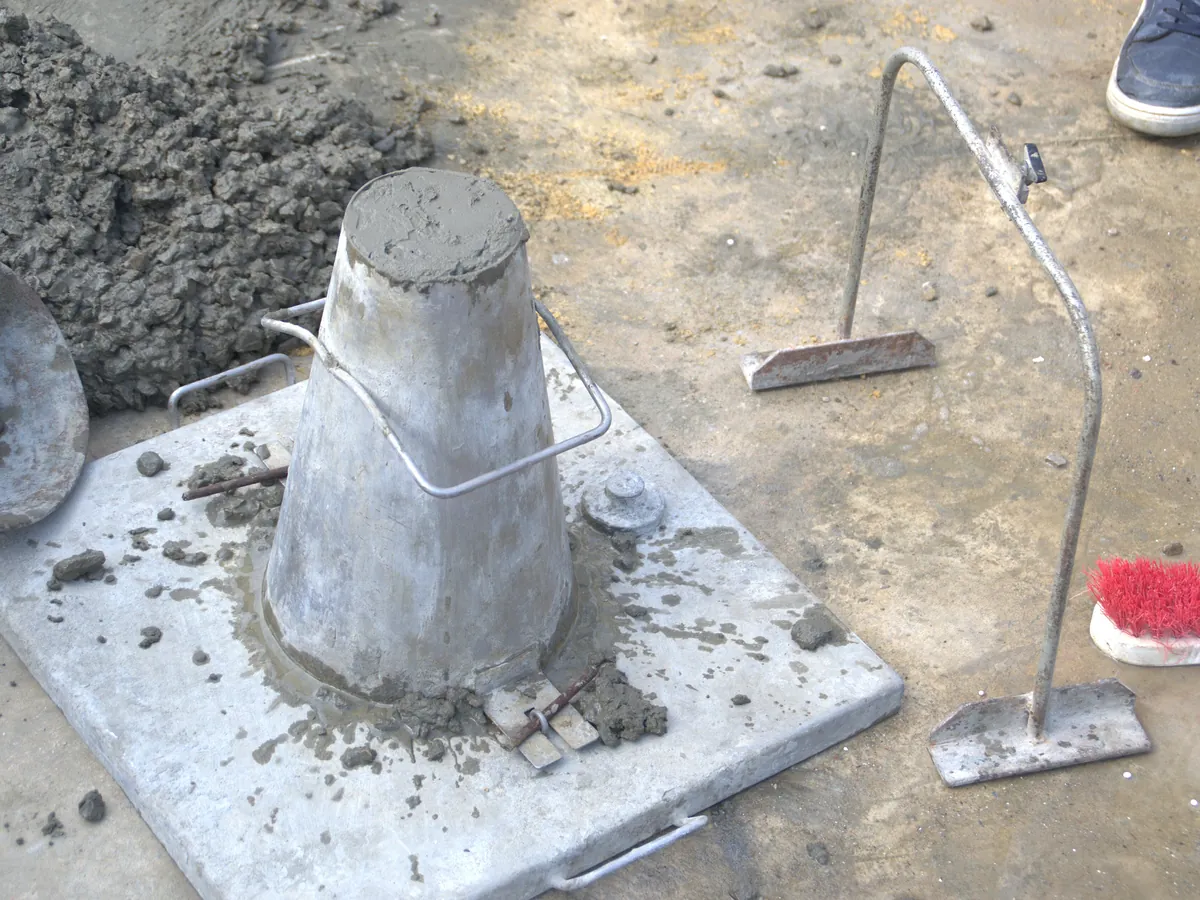
What is Slump cone?
The slump cone is the simplest and most widely used test of fresh concrete. It is a thin metal mould shaped like a cone with the top cut off: typically 200 mm diameter at the base, 100 mm at the top and 300 mm high. It is filled with concrete in three layers, each rodded 25 times with a 16 mm bullet-nosed tamping rod, and then lifted straight up.
Unsupported, the concrete sags. The slump is the drop in height, measured from the top of the mould to the highest point of the slumped concrete. A stiff mix may slump only 25 mm; a flowing mix may slump 150 mm or more. The shape of the slump (true, shear or collapse) also tells you about cohesion.
The test is described in IS 1199 (fresh concrete) and ASTM C143, and the apparatus in IS 7320. It is used for checking batch-to-batch consistency rather than as a full measure of workability; very stiff and self-compacting concretes need other tests.
Used for
- Workability check of every truck or batch of ready-mix concrete on site
- Trial mixes in the lab during mix design
- Checking the effect of water or admixture changes
- Acceptance of concrete against the slump specified in the order or drawing
- Slump flow of self-compacting concrete using the inverted cone and a flow board (a different test)
How it works
- 01
Set up
The damp cone is placed on a flat, rigid, non-absorbent base plate and held down by its foot pieces.
- 02
Fill in layers
Concrete is placed in three layers, each about one third of the height.
- 03
Rod
Each layer is rodded 25 times with the tamping rod, just penetrating into the layer below.
- 04
Strike off
The top is struck off level and spilled concrete removed from the base.
- 05
Lift
The cone is lifted vertically and steadily, typically in about 5 to 10 seconds, without twisting.
- 06
Measure
Slump is measured immediately as the difference between the cone height and the highest point of the concrete.
Advantages
- Very cheap, portable and quick (about 2 minutes)
- Easy to train; used worldwide
- Sensitive to changes in water content between batches
- Slump shape gives a rough indication of cohesion and segregation
Limitations
- Not suitable for very stiff (near-zero slump) or very fluid concretes
- Does not measure workability under vibration directly
- Operator technique (rodding, lifting speed) affects results
- Concrete with aggregate larger than about 40 mm should not be tested without wet-sieving
1 calibration procedure
Methods that use Slump cone
Keep every Slump cone in control: usage logs, calibration and maintenance schedules, and automatic blocking of overdue instruments.