Slump Cone (Abrams Cone)
A hollow metal frustum used on site and in the lab to measure the workability of fresh concrete by how much it slumps when the cone is lifted.
- Construction sites
- Ready-mix concrete plants
- Precast concrete
- Construction materials testing
- Academic labs
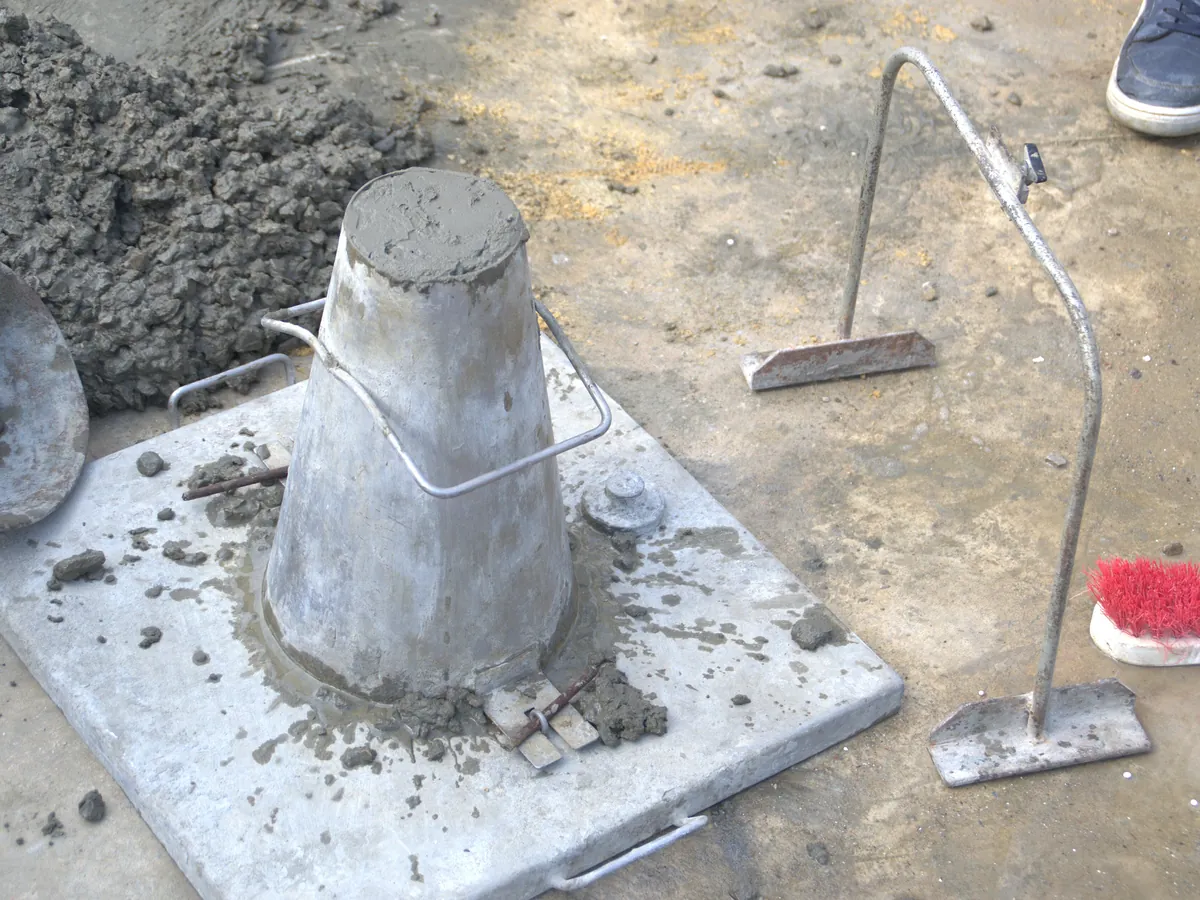
How Slump cone works
Fresh concrete flows under its own weight once the support of the mould is removed. The amount it subsides depends on its yield stress, which is largely controlled by water content, paste volume, aggregate grading and admixtures. A larger slump means a more workable (less stiff) mix.
The path of a sample
- 01
Set up
The damp cone is placed on a flat, rigid, non-absorbent base plate and held down by its foot pieces.
- 02
Fill in layers
Concrete is placed in three layers, each about one third of the height.
- 03
Rod
Each layer is rodded 25 times with the tamping rod, just penetrating into the layer below.
- 04
Strike off
The top is struck off level and spilled concrete removed from the base.
- 05
Lift
The cone is lifted vertically and steadily, typically in about 5 to 10 seconds, without twisting.
- 06
Measure
Slump is measured immediately as the difference between the cone height and the highest point of the concrete.
Main parts and what they do
Cone (mould)
Metal frustum, typically 200 mm base, 100 mm top and 300 mm high, open at both ends, with a smooth inside.
Foot pieces and handles
Let the operator stand on the cone while filling and lift it vertically afterwards.
Tamping rod
Steel rod about 16 mm in diameter and 600 mm long with a rounded (hemispherical) end.
Base plate
Flat, rigid, non-absorbent plate on which the cone stands.
Measuring scale
Steel rule or slump stand to measure slump to the nearest 5 mm (IS) or 5 mm / ¼ inch (ASTM).
Scoop and trowel
Place and level the concrete.
Terms every analyst should know
True slump
The concrete subsides evenly and keeps its shape. Only a true slump is reported as a valid result.
Shear slump
One side shears off and slides down. The test should be repeated; repeated shear indicates a lack of cohesion.
Collapse slump
The concrete collapses completely, typical of very wet or flowing mixes.
Typical ranges
IS 456 guidance gives typical slump of about 25–75 mm for low workability, 50–100 mm for medium and 100–150 mm for high workability, depending on placing conditions.
Time sensitivity
Slump falls with time after mixing (slump loss), so the test should start promptly after sampling.
Keep every Slump cone in control: usage logs, calibration and maintenance schedules, and automatic blocking of overdue instruments.