Shore durometer
Presses a spring-loaded indentor into rubber or plastic and reads how far it goes in on a 0–100 scale. Shore A is used for soft rubbers and elastomers; Shore D for hard rubbers and rigid plastics.
- Rubber & elastomers
- Polymers & plastics
- Automotive
- Footwear
- Packaging
- Medical devices
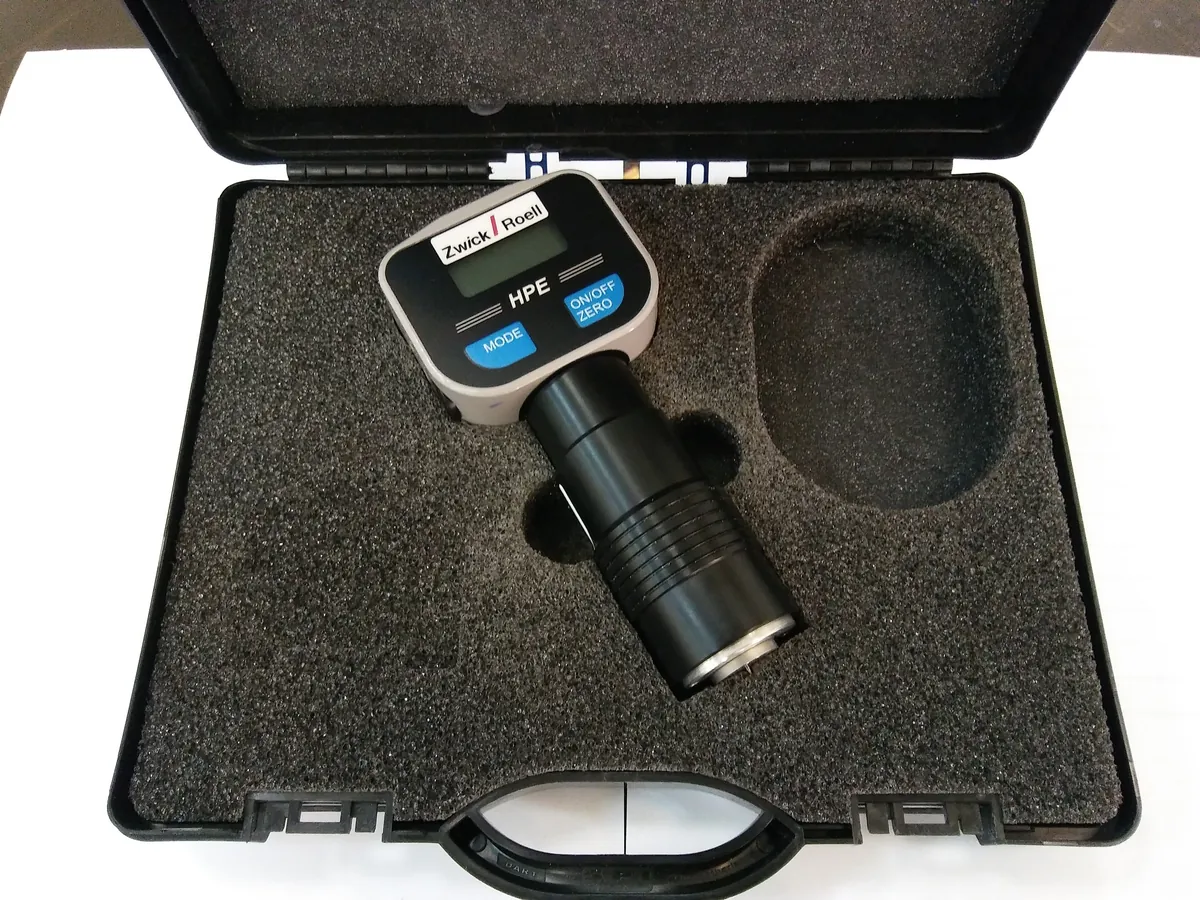
How Durometer works
The indentor is pushed by a calibrated spring. Its depth of penetration into the specimen, from 0 to 2.5 mm, is converted to a scale of 100 to 0. On Shore A the spring force rises from 0.55 N at 0 to 8.05 N at 100; on Shore D it rises from 0 to 44.45 N. The harder the material, the less the indentor goes in and the higher the reading.
The path of a sample
- 01
Condition
The specimen is conditioned at the standard temperature (typically 23 °C) and has the minimum thickness required.
- 02
Place
The specimen sits on a hard, flat surface; the durometer is held vertical with the indentor at least the minimum distance from any edge.
- 03
Apply
The presser foot is applied quickly and without shock until it is in full contact with the surface.
- 04
Read
The reading is taken within 1 s or after a set dwell time (for example 15 s), as the standard specifies.
- 05
Repeat
Several readings are taken at different points spaced apart, and the median or mean is reported.
Main parts and what they do
Indentor
Hardened steel pin: truncated 35° cone for Shore A, 30° cone with rounded tip for Shore D.
Presser foot
Flat foot with a central hole through which the indentor protrudes; it rests on the specimen surface.
Calibrated spring
Applies a force that increases linearly with indentor travel.
Indicator
Analogue dial or digital display reading 0–100, often with a maximum-hold pointer or memory.
Operating stand (optional)
Holds the durometer vertical and applies it with a fixed mass and controlled descent.
Test blocks
Reference rubber blocks of known hardness used for daily checks.
Terms every analyst should know
Scales
Shore A uses a truncated cone indentor and a lighter spring for soft materials. Shore D uses a sharper cone and a stiffer spring for hard materials. Other scales (00, O, M) exist for very soft or thin samples.
Dwell time
Rubber and plastics creep, so the reading falls with time. Always report the dwell time, for example 'Shore A 72 (15 s)'.
Minimum thickness
If the specimen is too thin, the hard surface underneath affects the reading. Plied specimens may be allowed, but readings on plied samples can differ.
Operating stand
A stand applies a fixed total mass (for example 1 kg for Shore A, 5 kg for Shore D) at a controlled speed, removing operator variation.
Indentor extension
At zero load the indentor protrudes 2.5 mm from the foot. Wear or damage changes this and gives false readings.
Keep every Durometer in control: usage logs, calibration and maintenance schedules, and automatic blocking of overdue instruments.