Materials & polymer testing
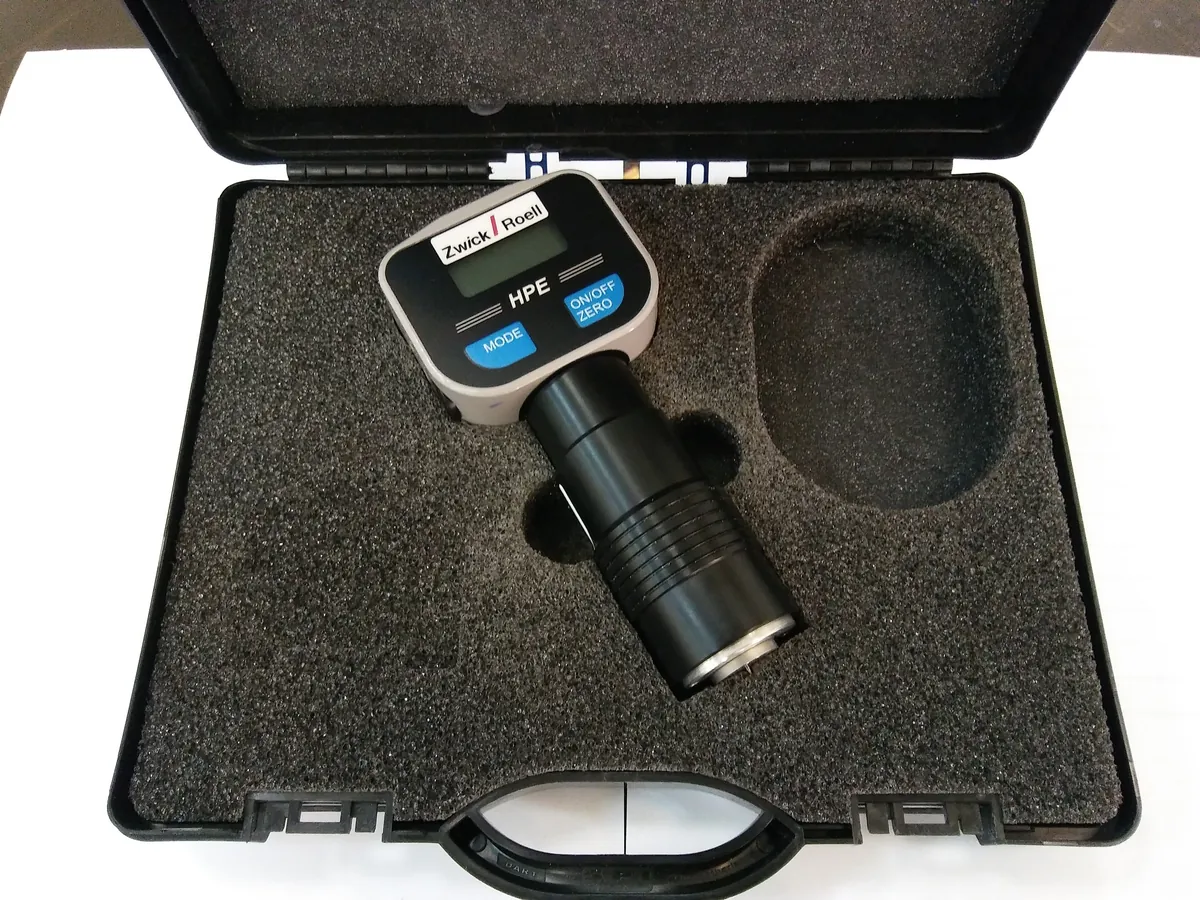
Shore durometer
Presses a spring-loaded indentor into rubber or plastic and reads how far it goes in on a 0–100 scale. Shore A is used for soft rubbers and elastomers; Shore D for hard rubbers and rigid plastics.
- Rubber & elastomers
- Polymers & plastics
- Automotive
- Footwear
- Packaging
- Medical devices
Follow your site SOP
This is a typical operating sequence for learning. Your instrument model and approved SOP take precedence.
STAGE 1
Before you start
- 1Check the calibration status and the scale (A or D) needed by the specification.
- 2Condition specimens at the standard laboratory temperature, typically 23 ± 2 °C, for the time in your SOP.
- 3Check that specimens meet the minimum thickness (typically 4–6 mm, depending on the standard) and are flat and smooth.
- 4Check zero and full-scale: the reading should be 0 with the indentor free, and 100 when pressed on flat glass.
- Do not use the durometer on very hard or sharp surfaces that may damage the indentor tip.
STAGE 2
Measurement
- 1Place the specimen on a hard, flat, horizontal surface.
- 2Hold the durometer vertical, with the indentor at least 9–12 mm from any edge (as your standard requires).
- 3Apply the presser foot smoothly and quickly, without shock, until firmly in contact.
- 4Read the scale within 1 s, or at the dwell time required (for example 15 s for ISO 868).
- 5Take at least five readings at points at least about 6 mm apart.
- Avoid rocking the instrument; any tilt gives a lower reading.
STAGE 3
Reporting
- 1Report the median (or mean) with the scale and dwell time, for example 'Shore A 72, 15 s'.
- 2Record specimen thickness, whether it was plied, and test temperature.
- 3Change to Shore D if Shore A readings exceed about 90, or to Shore A if Shore D readings fall below about 20.
In LimsPulse · Calibration Management
Keep every Durometer in control: usage logs, calibration and maintenance schedules, and automatic blocking of overdue instruments.