Refractometer
Measures the refractive index of a liquid or melted solid, usually at 20 °C and 589 nm. It is a quick identity and purity test for oils, solvents and syrups.
- Pharmaceutical
- Food & beverage
- Flavours & fragrances
- Chemicals
- Petrochemicals
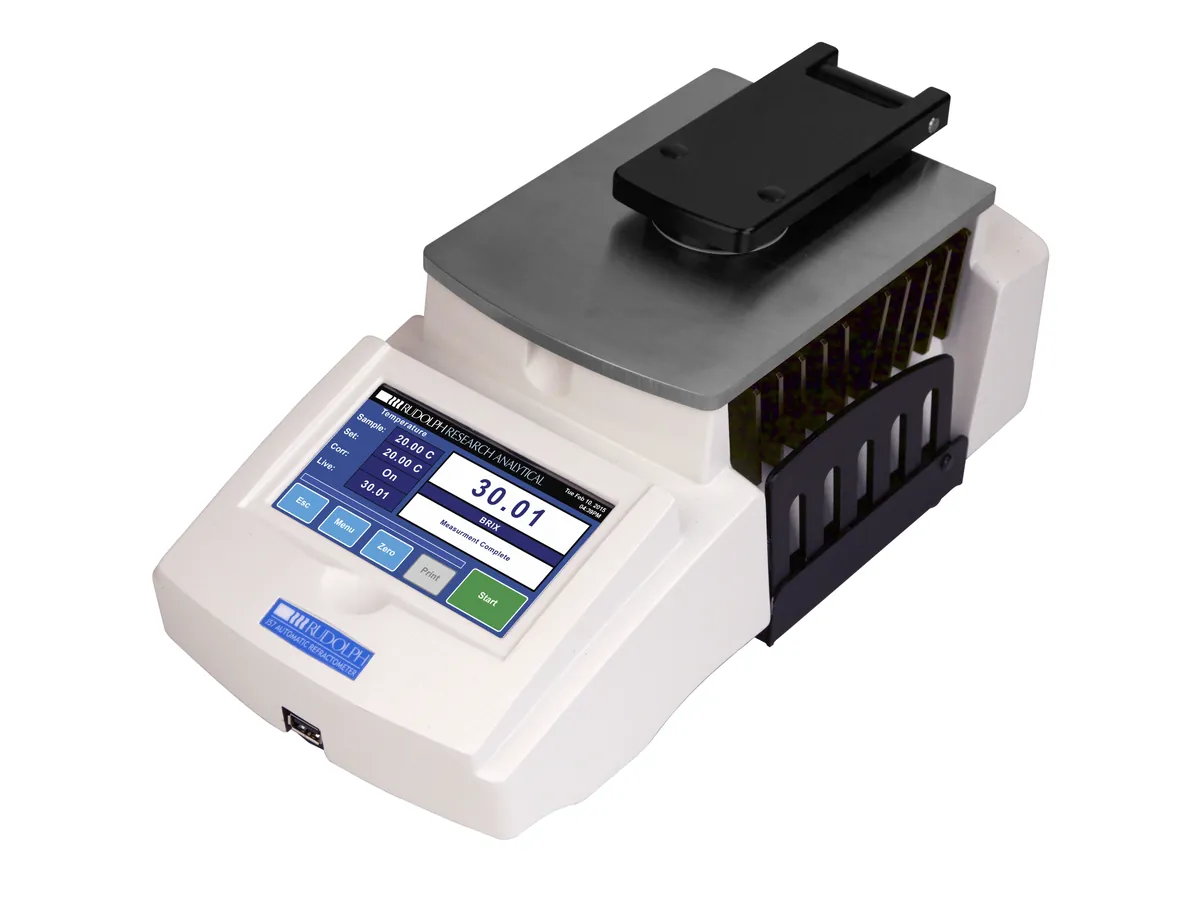
What is Refractometer?
When light passes from one material into another, it bends. The refractive index (n) tells you how much. It depends on the substance, the temperature and the wavelength of light, so it is reported as, for example, n20D: refractive index at 20 °C and the sodium D line (589 nm).
Pharmacopoeias use refractive index to identify and check the purity of liquids such as fixed oils, essential oils, liquid paraffin, glycerol and some solvents. The food and syrup industry uses the same principle to measure sugar content in degrees Brix.
The classic instrument is the Abbe refractometer, where the analyst lines up a light–dark boundary in an eyepiece. Modern digital refractometers find the boundary automatically with a detector array, control the prism temperature with a Peltier element and read to 0.0001 or 0.00001.
Used for
- Identification and purity of oils, fats and essential oils
- Checking incoming solvents such as ethanol, glycerol or propylene glycol
- Sugar concentration of syrups (Brix) in oral liquid manufacture
- Concentration of simple binary solutions using a calibration table
- In-process checks of coating solutions or granulation fluids
How it works
- 01
Sample on prism
A few drops of sample are placed on the measuring prism, which is held at a set temperature (usually 20 °C).
- 02
Illumination
Light at 589 nm (an LED with filter or a sodium lamp) shines on the prism–sample boundary from many angles.
- 03
Total internal reflection
Light above the critical angle is totally reflected; light below it passes into the sample. This makes a sharp light–dark boundary.
- 04
Detection
In an Abbe instrument the analyst aligns the boundary with cross-hairs. In a digital instrument a CCD array finds the boundary position.
- 05
Calculation
The boundary position is converted into refractive index using the known prism index and the instrument's adjustment.
- 06
Result
The instrument shows nD at the measured temperature, or a converted value such as Brix.
Advantages
- Very fast: a reading takes under a minute
- Needs only a few drops of sample
- Simple operation with little sample preparation
- High resolution and automatic temperature control on digital models
- Non-destructive
Limitations
- Not specific: different mixtures can have the same refractive index
- Very sensitive to temperature, so the prism temperature must be controlled
- Opaque, very dark or strongly scattering samples can be hard to read
- Volatile samples evaporate on the prism and change the result
- Only gives a concentration for simple, known mixtures
1 calibration procedure
Keep every Refractometer in control: usage logs, calibration and maintenance schedules, and automatic blocking of overdue instruments.