Refractometer
Measures the refractive index of a liquid or melted solid, usually at 20 °C and 589 nm. It is a quick identity and purity test for oils, solvents and syrups.
- Pharmaceutical
- Food & beverage
- Flavours & fragrances
- Chemicals
- Petrochemicals
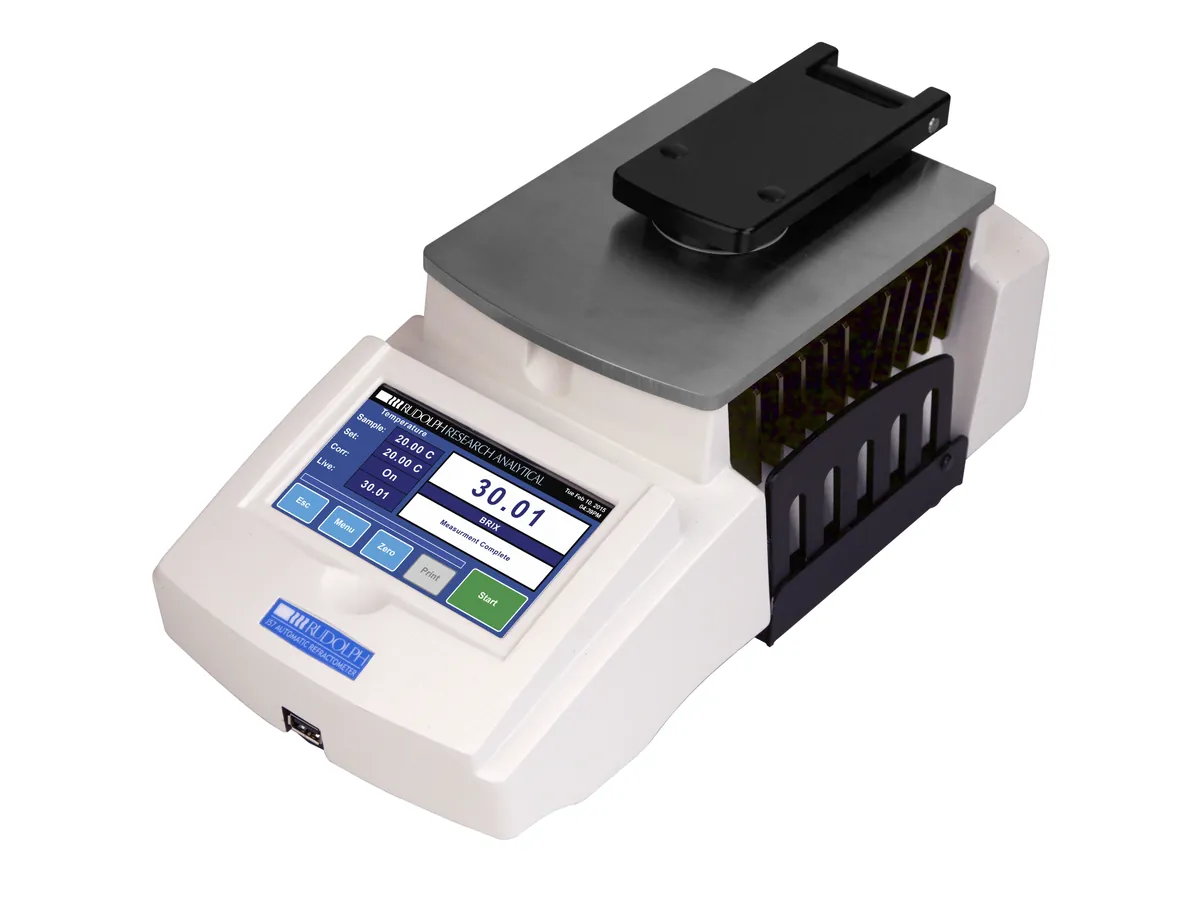
How Refractometer works
Most refractometers use the critical angle method. The sample sits on a prism of high refractive index. Light reaches the boundary between prism and sample at many angles. Above a certain angle, the critical angle, all the light is reflected back into the prism. The position of the boundary between bright and dark areas depends on the sample's refractive index (sin θc = n sample ÷ n prism).
The path of a sample
- 01
Sample on prism
A few drops of sample are placed on the measuring prism, which is held at a set temperature (usually 20 °C).
- 02
Illumination
Light at 589 nm (an LED with filter or a sodium lamp) shines on the prism–sample boundary from many angles.
- 03
Total internal reflection
Light above the critical angle is totally reflected; light below it passes into the sample. This makes a sharp light–dark boundary.
- 04
Detection
In an Abbe instrument the analyst aligns the boundary with cross-hairs. In a digital instrument a CCD array finds the boundary position.
- 05
Calculation
The boundary position is converted into refractive index using the known prism index and the instrument's adjustment.
- 06
Result
The instrument shows nD at the measured temperature, or a converted value such as Brix.
Main parts and what they do
Measuring prism
High-index glass or sapphire prism that the sample sits on. Must be kept clean and free from scratches.
Light source
LED with a filter at 589 nm, or a sodium lamp in older instruments.
Temperature control
Peltier element or circulating water bath that holds the prism at 20 °C (or another set value).
Detector / optics
Eyepiece with cross-hairs (Abbe) or a CCD line sensor (digital) that locates the light–dark boundary.
Compensator
In Abbe instruments using white light, Amici prisms remove colour fringes so the boundary is sharp.
Sample cover / flow cell
Lid that reduces evaporation and stray light; some models have a flow cell for automatic filling.
Display and data interface
Shows nD, temperature and converted units, and sends results to a printer or LIMS.
Terms every analyst should know
Refractive index (n)
The ratio of the speed of light in a vacuum (or air) to its speed in the sample. Water at 20 °C has n about 1.3330.
n20D notation
The superscript is the temperature (20 °C) and the subscript D means the sodium D line (589 nm).
Critical angle
The angle of incidence above which light is totally reflected at the prism–sample boundary. It depends on the sample's refractive index.
Temperature dependence
Refractive index falls as temperature rises. For water the change is roughly 0.0001 per °C; for many organic liquids it is larger, around 0.0004 per °C.
Brix
A scale for sucrose solutions: 1 °Brix is about 1 g of sucrose in 100 g of solution, read from the refractive index.
Keep every Refractometer in control: usage logs, calibration and maintenance schedules, and automatic blocking of overdue instruments.