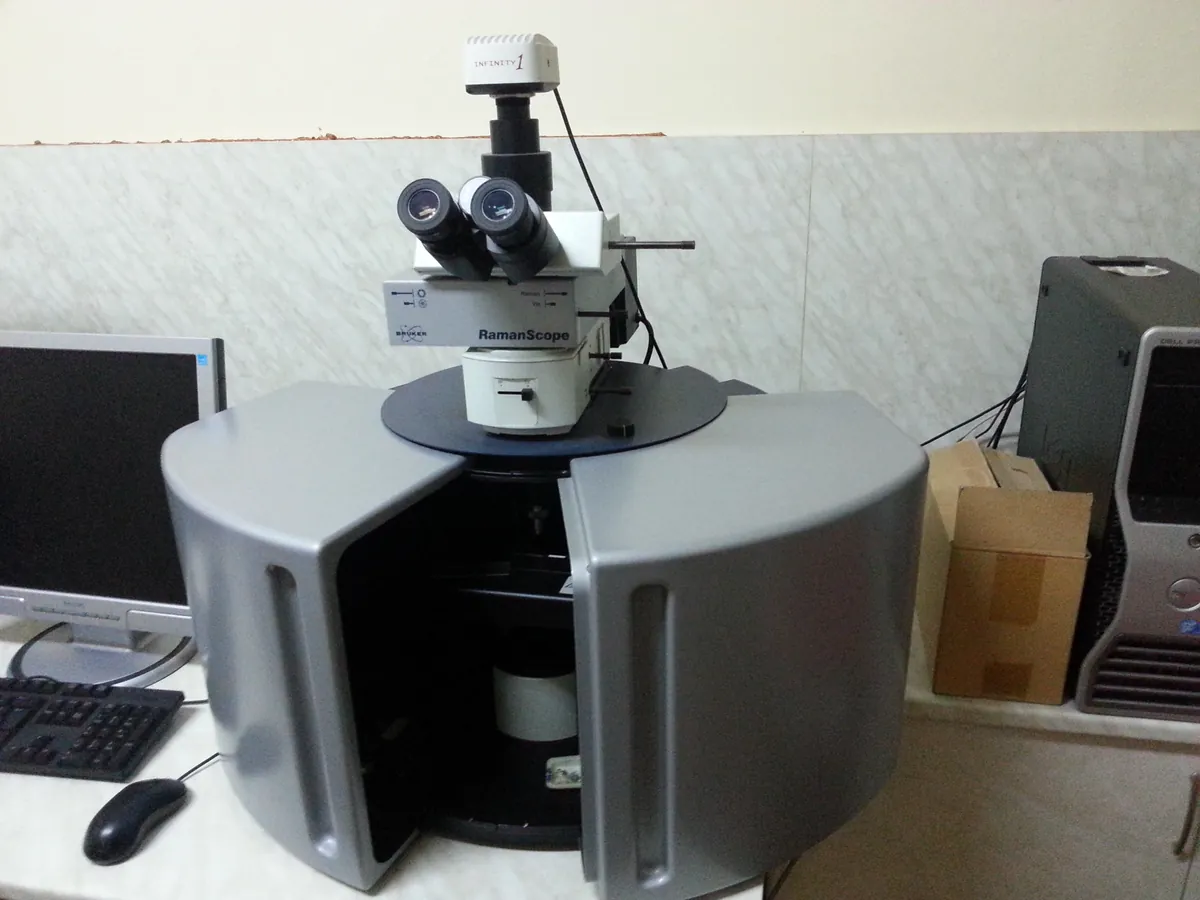
Raman spectrometer
Shines a laser on a sample and measures the tiny fraction of light scattered with a shifted wavelength. Gives a sharp molecular fingerprint through glass and plastic, ideal for raw-material identity and polymorph checks.
- Pharmaceutical
- Biotech
- Forensics & security
- Materials science
- Semiconductors
- Art conservation
Test your Raman knowledge
Multiple-choice questions
Pick an answer to see whether you are right and why.
Q1. Raman spectroscopy measures:
basicQ2. Which laser wavelength is most commonly used in handheld pharmaceutical Raman analysers?
basicQ3. Why can Raman measure aqueous solutions easily?
intermediateQ4. A Raman spectrum shows a large, sloping background with no clear bands. The most likely cause is:
intermediateQ5. A vibration is Raman-active when it causes a change in:
intermediateQ6. Which standard is commonly used to check Raman wavenumber accuracy?
advancedQ7. Which packaging can a handheld Raman analyser usually measure through?
advanced
Viva questions
Think of your answer first, then open it to compare.
1. Compare Raman and NIR for raw-material identity testing at the warehouse.
Both are fast and measure through clear packaging. Raman gives sharp, specific bands and often works with a simple library of one or a few reference spectra, but suffers from fluorescence and can burn dark samples. NIR gives broad bands and needs a chemometric library from many lots, but is insensitive to fluorescence and also senses physical properties such as particle size, which helps distinguish grades. Many sites use both, choosing the technique that works for each material.
2. Why is Raman useful for polymorph identification?
Crystal packing changes the molecular environment, shifting some bands and producing distinct low-wavenumber lattice modes. Raman can therefore distinguish polymorphs, often in intact tablets and through packaging, and can follow form changes in-line during crystallisation. XRPD remains the reference technique for confirming the crystal form.
3. What laser safety precautions apply when using a Raman spectrometer?
Raman lasers are often Class 3B. Only trained users operate them; never look into the beam or point it at people or reflective surfaces; keep interlocks and nose cones in place; wear wavelength-rated safety glasses when the beam is open; and use low power on dark samples that may heat or ignite.
Keep every Raman in control: usage logs, calibration and maintenance schedules, and automatic blocking of overdue instruments.