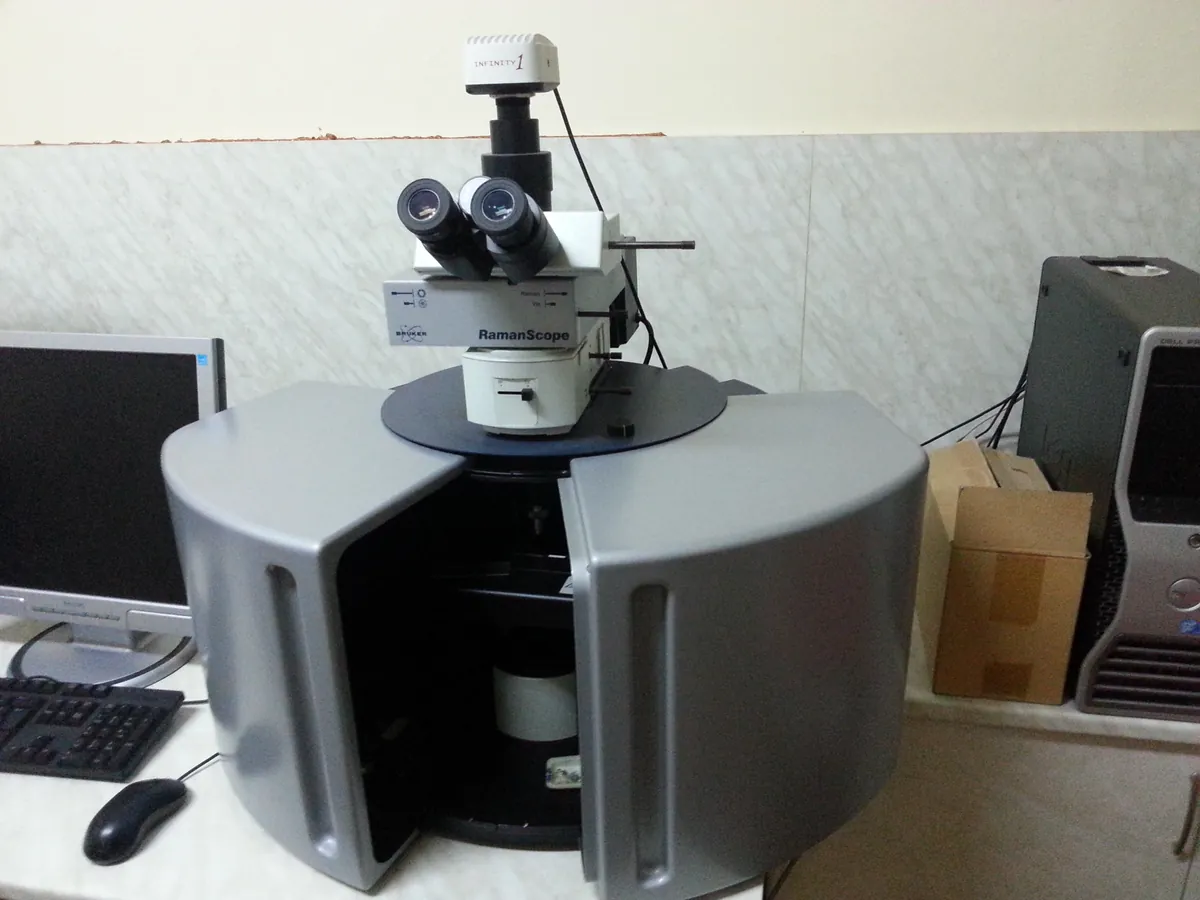
Raman spectrometer
Shines a laser on a sample and measures the tiny fraction of light scattered with a shifted wavelength. Gives a sharp molecular fingerprint through glass and plastic, ideal for raw-material identity and polymorph checks.
- Pharmaceutical
- Biotech
- Forensics & security
- Materials science
- Semiconductors
- Art conservation
What is Raman?
A Raman spectrometer illuminates the sample with a single-wavelength laser, commonly 785 nm in pharma (1064 nm and 532 nm are also used). Almost all of the scattered light has the same wavelength as the laser (Rayleigh scattering), but about one photon in a million loses or gains energy to a molecular vibration. This inelastically scattered light is the Raman signal, and its shift in wavenumber from the laser line is characteristic of the bonds in the molecule.
Raman spectra have sharp, well-resolved bands, unlike NIR. Water is a very weak Raman scatterer and glass gives only a weak signal, so aqueous solutions and samples inside glass vials or clear plastic bags can be measured directly. Strong Raman scatterers include C=C, aromatic rings, S–S and C≡N groups, which makes Raman complementary to mid-IR.
Handheld Raman units are widely used at the warehouse to verify the identity of each container of a raw material through the bag, often against a simple library of reference spectra. Bench and microscope Raman systems are used for polymorph identification, mapping the distribution of API in tablets, and in-line monitoring of crystallisation and reactions.
Used for
- Identity testing of incoming raw materials through clear bags and glass (100% container testing)
- Identification and screening of polymorphs, solvates and salts
- Detecting counterfeit medicines through packaging
- Chemical imaging of tablets (API and excipient distribution)
- In-line monitoring of crystallisation, polymorph conversion and reactions (PAT)
- Identification of particles and contaminants with a Raman microscope
How it works
- 01
Laser
A stable, narrow-line laser (often 785 nm) excites the sample.
- 02
Sampling optics
A probe, vial holder or microscope objective focuses the laser and collects the scattered light.
- 03
Rayleigh filter
A notch or edge filter blocks the intense light at the laser wavelength.
- 04
Spectrograph
A grating (dispersive) or interferometer (FT-Raman) separates the Raman-scattered light by wavelength.
- 05
Detector
A cooled CCD (dispersive) or InGaAs/Ge detector (FT-Raman at 1064 nm) records the spectrum.
- 06
Library comparison
Software corrects the baseline and compares the spectrum with reference spectra to give a pass/fail identity.
Advantages
- Sharp, specific bands give a clear molecular fingerprint
- Measures through glass, clear plastic bags and blister films
- Little interference from water, so aqueous samples are easy
- No sample preparation; non-destructive
- Sensitive to crystal form, so useful for polymorph work
- Handheld units give results at the point of receipt
Limitations
- Fluorescence from the sample or impurities can swamp the weak Raman signal, especially with visible lasers
- Dark or coloured samples may absorb the laser, heat up or burn
- Signal is weak, so minor components are hard to detect
- Cannot see through opaque, coloured or paper packaging
- Some inorganic salts and simple molecules give weak or no useful spectra
- Laser safety controls are needed
1 calibration procedure
Keep every Raman in control: usage logs, calibration and maintenance schedules, and automatic blocking of overdue instruments.