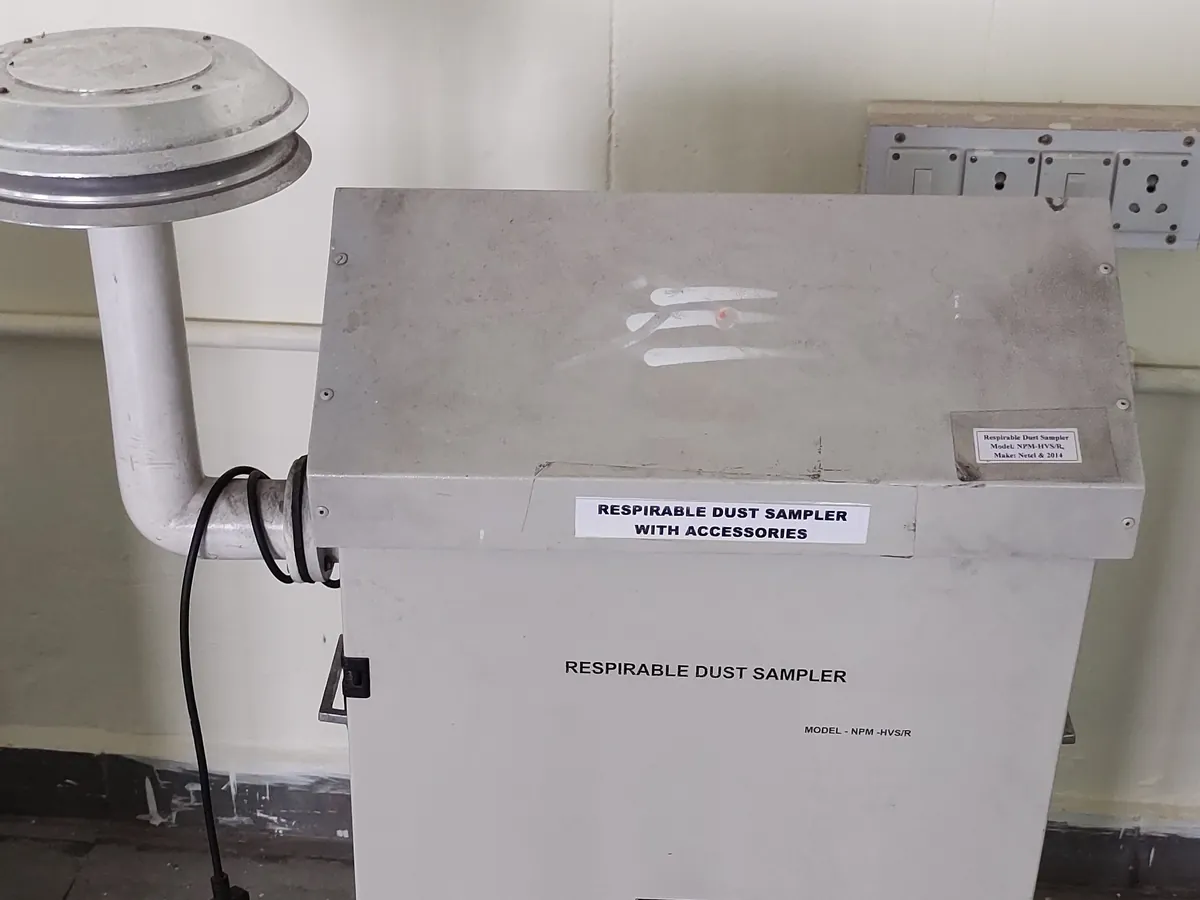
Particulate Matter (PM10 / PM2.5) Sampler
Draws a known volume of ambient air through a size-selective inlet and a filter so that the mass of PM10 or PM2.5 particles collected can be weighed and expressed as µg/m³.
- Environmental monitoring agencies and pollution control boards
- Environmental consultancies
- Mining, cement, power and steel
- Research institutions
- Construction and infrastructure projects
Test your PM sampler knowledge
Multiple-choice questions
Pick an answer to see whether you are right and why.
Q1. What does PM2.5 mean?
basicQ2. How is PM concentration calculated in a gravimetric sampler?
basicQ3. Why is an accurate flow rate essential for a PM sampler?
intermediateQ4. What is a typical design flow rate for a low-volume PM2.5 sampler?
basicQ5. Why are filters conditioned in a controlled-humidity room before each weighing?
intermediateQ6. A flow check shows the sampler indicating 16.67 L/min while the transfer standard reads 16.41 L/min. What is the percentage difference relative to the standard?
advanced
Viva questions
Think of your answer first, then open it to compare.
1. Explain how a PM10 inlet separates particles by size.
Air is accelerated through nozzles or a cyclone. Large particles have too much inertia to follow the air streamlines and hit an impaction plate or the cyclone wall, while smaller particles follow the air to the filter. The inlet is designed so 50% of 10 µm particles pass at the design flow.
2. What sources of error can affect a gravimetric PM result?
Flow errors and leaks, wrong run time, filter damage or fibre loss, handling contamination, static charge on PTFE filters, different conditioning at the two weighings, loss of semi-volatile material, and an unclean or ungreased impactor letting coarse particles through.
3. How do you calibrate the flow of a PM sampler?
Install a clean filter, connect a certified transfer standard to the inlet, run at design flow, and compare indicated flow with the standard while recording ambient temperature and pressure. Calculate the differences against the standard and design flow, adjust if needed, and repeat at several points for a full calibration.
Keep every PM sampler in control: usage logs, calibration and maintenance schedules, and automatic blocking of overdue instruments.