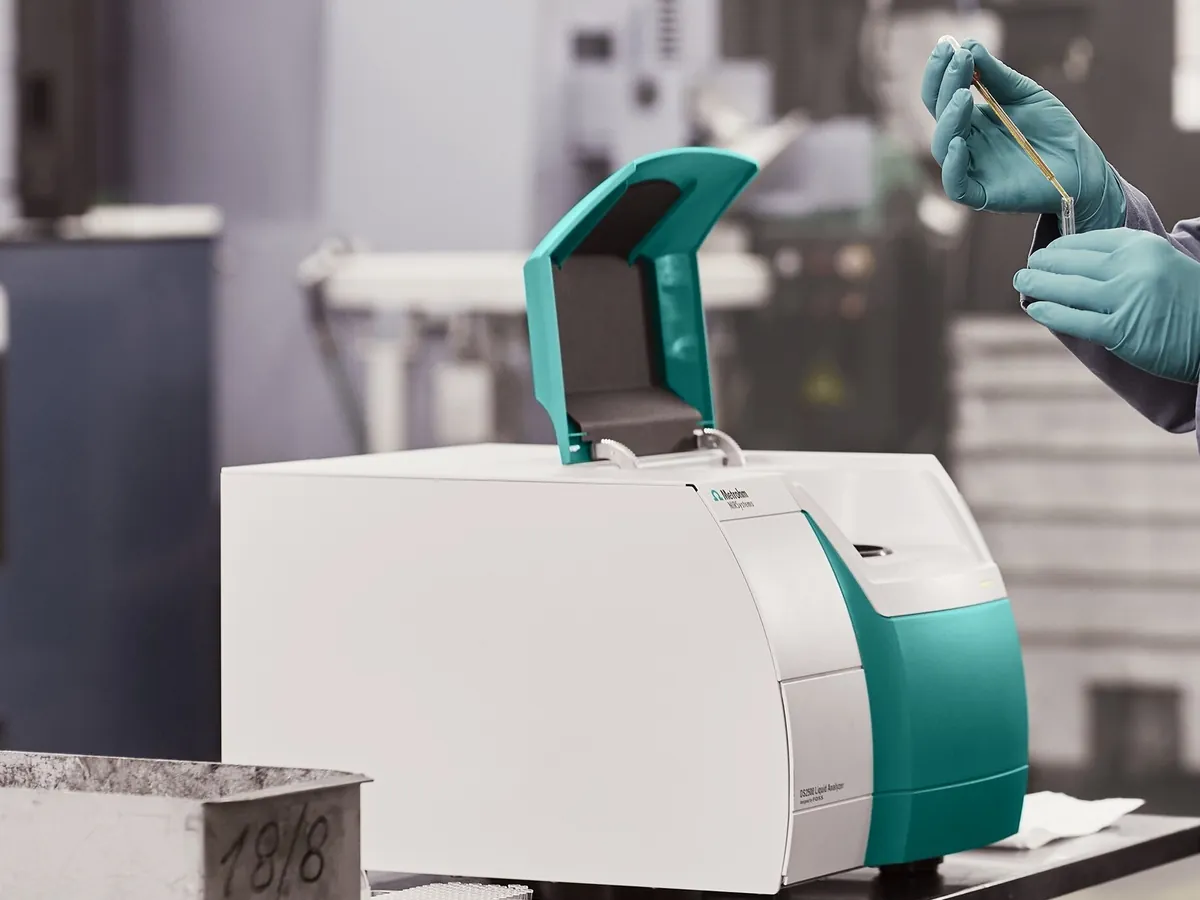
Near-infrared (NIR) spectrometer
Measures how a sample absorbs near-infrared light (about 780–2500 nm) through glass or plastic, in seconds and without sample preparation. Used with chemometric libraries for raw-material identity testing, blend monitoring and moisture.
- Pharmaceutical
- Agriculture & grain
- Food & beverage
- Petrochemical
- Polymers
- Animal feed
How NIR works
Molecules absorb near-infrared light at overtone and combination frequencies of their fundamental vibrations, mainly bonds containing hydrogen (C–H, O–H, N–H). Absorbance is recorded as log (1/R) in reflectance or log (1/T) in transmission. Because the bands overlap, the spectrum is pre-treated (e.g. derivative, standard normal variate) and compared with reference spectra using chemometric algorithms.
The path of a sample
- 01
Light source
A tungsten-halogen lamp gives broad, continuous near-infrared light.
- 02
Wavelength selection
An interferometer (FT-NIR), a grating, a diode array or an acousto-optic filter separates the wavelengths.
- 03
Sample interface
Light reaches the sample through a reflectance window, a fibre-optic probe, a vial holder or a transmission cell.
- 04
Detection
InGaAs or PbS detectors record the reflected or transmitted light at each wavelength.
- 05
Spectral pre-treatment
Software applies derivatives, SNV or smoothing to remove baseline shifts and scatter effects.
- 06
Chemometric evaluation
The pre-treated spectrum is compared with the library or fed into a model, which returns a pass/fail identity or a predicted value.
Main parts and what they do
Tungsten-halogen lamp
Broad-band near-infrared source; has a finite life and is checked by energy tests.
Wavelength selector
Michelson interferometer (FT-NIR), grating monochromator, diode array or AOTF that separates wavelengths.
Internal reference standards
Built-in wavelength (e.g. polystyrene or rare-earth) and reflectance (e.g. Spectralon) references used for automatic checks.
Sample interface
Integrating sphere or reflectance window for vials and powders, fibre-optic probe for bags and drums, transmission cell for liquids and tablets.
Detector
InGaAs (indium gallium arsenide) or PbS (lead sulfide) detector sensitive to near-infrared light.
Chemometric software
Acquires spectra, applies pre-treatments, runs library and model evaluations, and keeps a 21 CFR Part 11-compliant audit trail.
Terms every analyst should know
Overtones and combination bands
NIR absorptions are weak multiples (overtones) and sums (combinations) of mid-IR vibrations. That is why NIR light penetrates deep into samples and why no dilution is needed.
Diffuse reflectance
In powders, light is scattered many times before it returns. The result is reported as log (1/R), which behaves like absorbance.
Spectral pre-treatment
Derivatives remove baseline offsets; standard normal variate (SNV) and multiplicative scatter correction reduce particle-size effects.
Spectral library
A collection of spectra from several authentic, representative lots of each material. A test spectrum is identified by comparing it with every entry.
Identification algorithms
Correlation coefficient or hit quality index for simple identity; PCA-based distance, SIMCA or Mahalanobis distance for qualification and close look-alikes.
Quantitative models
Partial least squares (PLS) regression links spectra to reference values (e.g. Karl Fischer water) and predicts them for new samples.
Model lifecycle
Models are validated (specificity, robustness), monitored during routine use and updated when new sources of variation appear.
Keep every NIR in control: usage logs, calibration and maintenance schedules, and automatic blocking of overdue instruments.