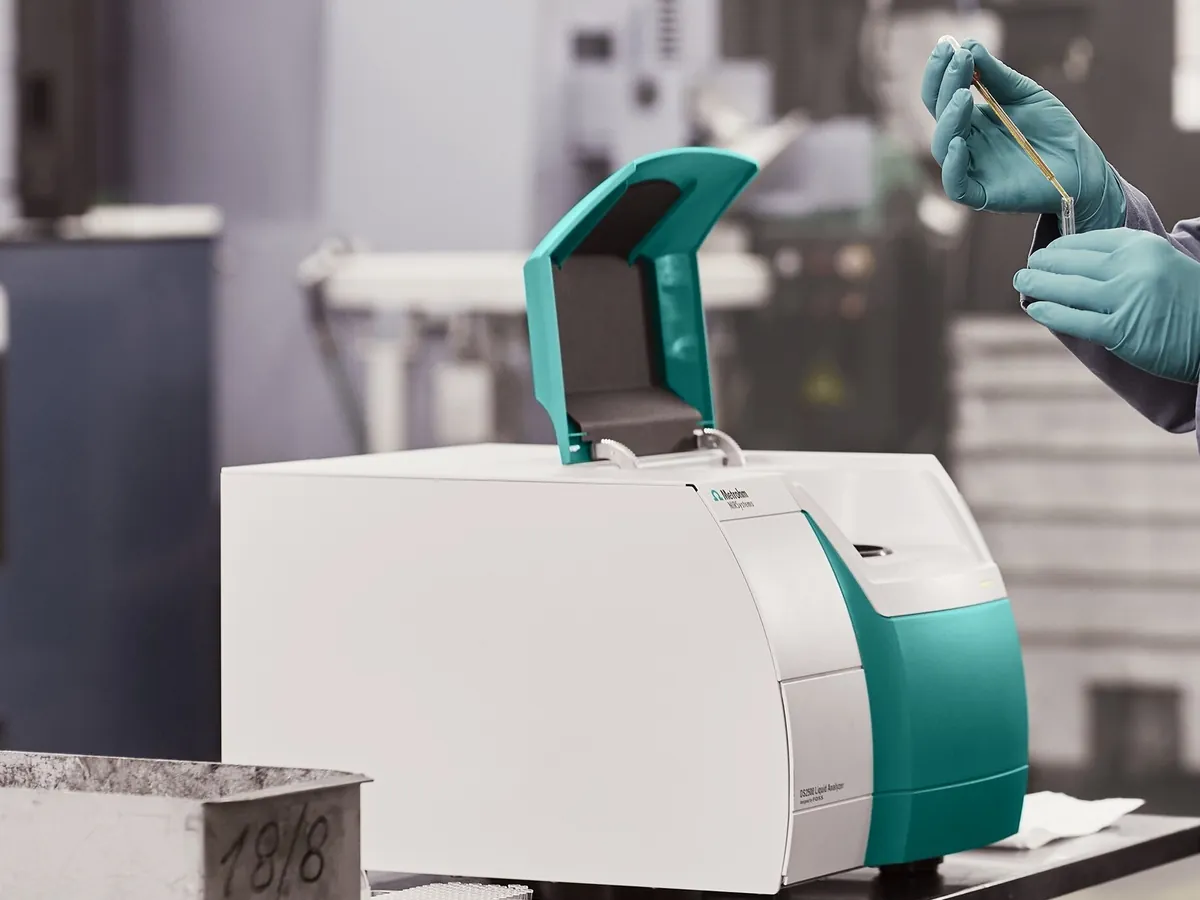
Near-infrared (NIR) spectrometer
Measures how a sample absorbs near-infrared light (about 780–2500 nm) through glass or plastic, in seconds and without sample preparation. Used with chemometric libraries for raw-material identity testing, blend monitoring and moisture.
- Pharmaceutical
- Agriculture & grain
- Food & beverage
- Petrochemical
- Polymers
- Animal feed
Test your NIR knowledge
Multiple-choice questions
Pick an answer to see whether you are right and why.
Q1. Near-infrared absorption bands arise mainly from:
basicQ2. Why is NIR popular for identity testing of raw materials at the warehouse?
basicQ3. Powders are usually measured on an NIR spectrometer in which mode?
intermediateQ4. What is the main purpose of standard normal variate (SNV) or derivative pre-treatment of NIR spectra?
intermediateQ5. Which material is commonly used to check the wavelength accuracy of an NIR spectrometer?
intermediateQ6. In a photometric linearity check, observed absorbance is plotted against certified absorbance of reflectance standards. Typical acceptance criteria are:
advancedQ7. An authentic lot from a new supplier fails NIR library identity. What is the correct approach?
advanced
Viva questions
Think of your answer first, then open it to compare.
1. What is a chemometric spectral library and how is it built for NIR identity testing?
It is a set of reference spectra from several authentic lots of each material, ideally covering different suppliers, lots, particle sizes and seasons. Each material's spectra form a class. A test spectrum is compared with every class by an algorithm such as correlation, PCA-based distance or SIMCA. The library is validated for specificity (it must reject look-alike materials) and robustness, then maintained under change control.
2. Can NIR be used to measure moisture in granules? What else is needed?
Yes. Water has strong NIR bands (around 1450 and 1940 nm). But NIR is a secondary method: a PLS model is built by measuring samples whose water content is known from Karl Fischer, then validated for accuracy, linearity and range. Predictions outside the model range or flagged as outliers are not reported.
3. Why can a validated NIR library not simply be copied to a new instrument?
Small differences in wavelength scale, photometric response and optics change spectra slightly. The library or model must be transferred: check both instruments' calibration, measure transfer samples on both, apply any standardisation and show that the library still identifies and rejects materials correctly on the new instrument.
Keep every NIR in control: usage logs, calibration and maintenance schedules, and automatic blocking of overdue instruments.