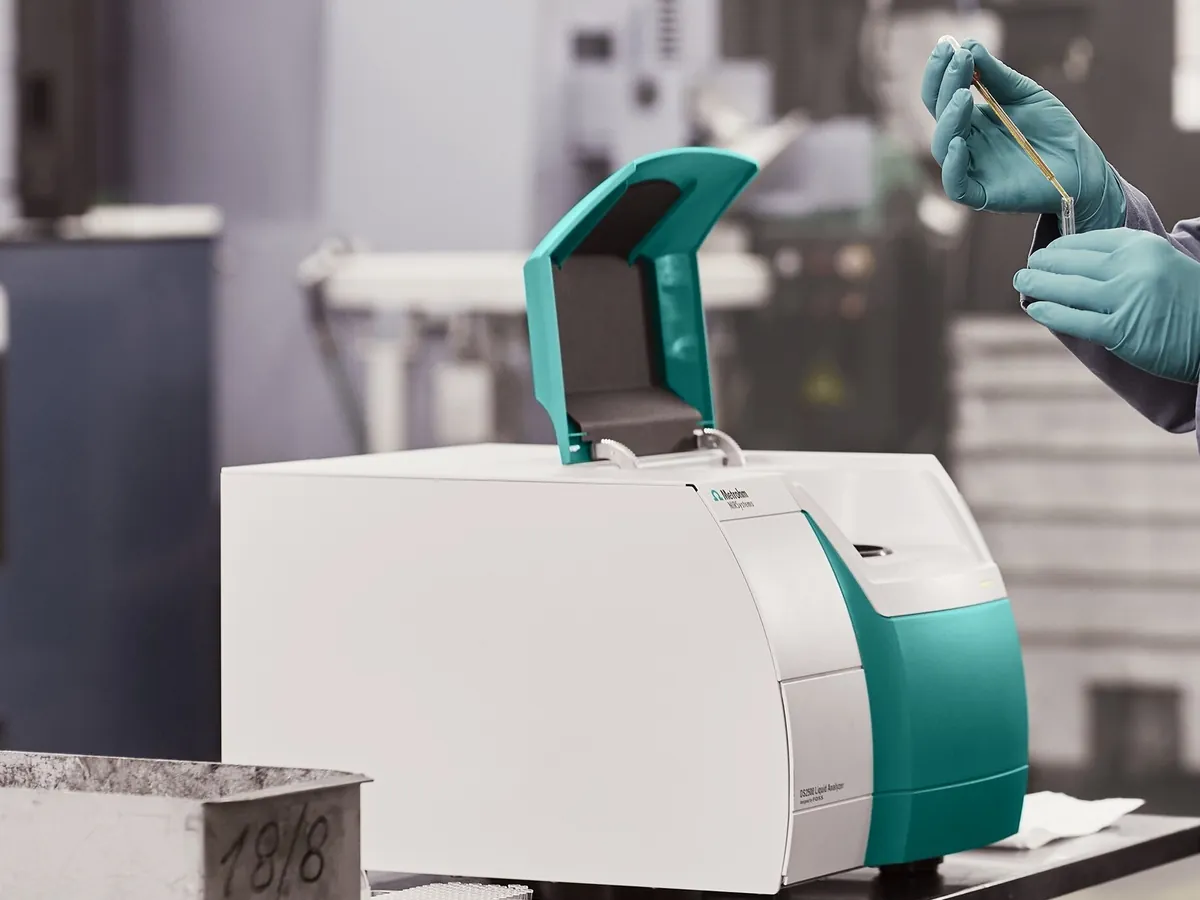
Near-infrared (NIR) spectrometer
Measures how a sample absorbs near-infrared light (about 780–2500 nm) through glass or plastic, in seconds and without sample preparation. Used with chemometric libraries for raw-material identity testing, blend monitoring and moisture.
- Pharmaceutical
- Agriculture & grain
- Food & beverage
- Petrochemical
- Polymers
- Animal feed
What is NIR?
A near-infrared spectrometer shines light of about 780–2500 nm (roughly 12,800–4000 cm⁻¹) onto a sample and records how much is absorbed at each wavelength. Solids and powders are usually measured by diffuse reflectance: light enters the powder, is scattered and partly absorbed, and the light that comes back out is collected. Liquids are measured by transmission or transflectance.
NIR bands are overtones and combinations of C–H, O–H and N–H vibrations. They are broad, weak and overlap heavily, so an NIR spectrum cannot be read by eye like a mid-IR spectrum. Instead the spectrum is compared with a library or a calibration model built with chemometrics (mathematical and statistical tools such as principal component analysis or partial least squares).
The big practical advantage is speed. Because NIR light passes through glass vials and polyethylene sampling bags, a warehouse analyst can confirm the identity of every container of a raw material in seconds, without opening the bag or sending samples to the lab. NIR is also used on-line in manufacturing to follow blend uniformity, granulation moisture and drying end-points as part of process analytical technology (PAT).
Used for
- Identity testing of incoming raw materials and excipients, often 100% container testing in the warehouse
- Qualification of raw materials (e.g. distinguishing grades of lactose, microcrystalline cellulose or magnesium stearate)
- Moisture content of granules, lyophilised cakes and APIs (with a model calibrated against Karl Fischer)
- Blend uniformity monitoring in blenders (PAT)
- Content uniformity and assay of intact tablets (with a validated quantitative model)
- Drying end-point and granulation monitoring
- Screening for counterfeit or substandard medicines
How it works
- 01
Light source
A tungsten-halogen lamp gives broad, continuous near-infrared light.
- 02
Wavelength selection
An interferometer (FT-NIR), a grating, a diode array or an acousto-optic filter separates the wavelengths.
- 03
Sample interface
Light reaches the sample through a reflectance window, a fibre-optic probe, a vial holder or a transmission cell.
- 04
Detection
InGaAs or PbS detectors record the reflected or transmitted light at each wavelength.
- 05
Spectral pre-treatment
Software applies derivatives, SNV or smoothing to remove baseline shifts and scatter effects.
- 06
Chemometric evaluation
The pre-treated spectrum is compared with the library or fed into a model, which returns a pass/fail identity or a predicted value.
Advantages
- Very fast: a measurement takes seconds
- Non-destructive and needs no sample preparation or reagents
- Measures through glass vials and many plastic bags, so containers need not be opened
- Portable and handheld instruments allow testing at the warehouse or on the shop floor
- Suits on-line and in-line process monitoring
- Several properties (identity, moisture, particle size effects) can come from one spectrum
Limitations
- Bands are broad and overlapping; results depend on a chemometric model, not direct reading of the spectrum
- Building and validating a library or quantitative model needs many representative samples, time and expertise
- Models must be maintained: new suppliers, grades or instrument changes can make them fail
- Sensitive to physical properties (particle size, packing, moisture), which can mask or mimic chemical differences
- Poor sensitivity for minor components (typically below about 0.1–1% w/w)
- Struggles to tell apart very similar molecules or salts without careful model work
2 calibration procedures
Keep every NIR in control: usage logs, calibration and maintenance schedules, and automatic blocking of overdue instruments.