Membrane filtration unit
A manifold with filter funnels connected to a vacuum source (or a peristaltic pump for closed canisters) that passes liquid samples through a 0.45 µm membrane so that microorganisms are retained and can be grown and counted.
- Pharmaceutical
- Biotech
- Water testing
- Food & beverage
- Medical devices
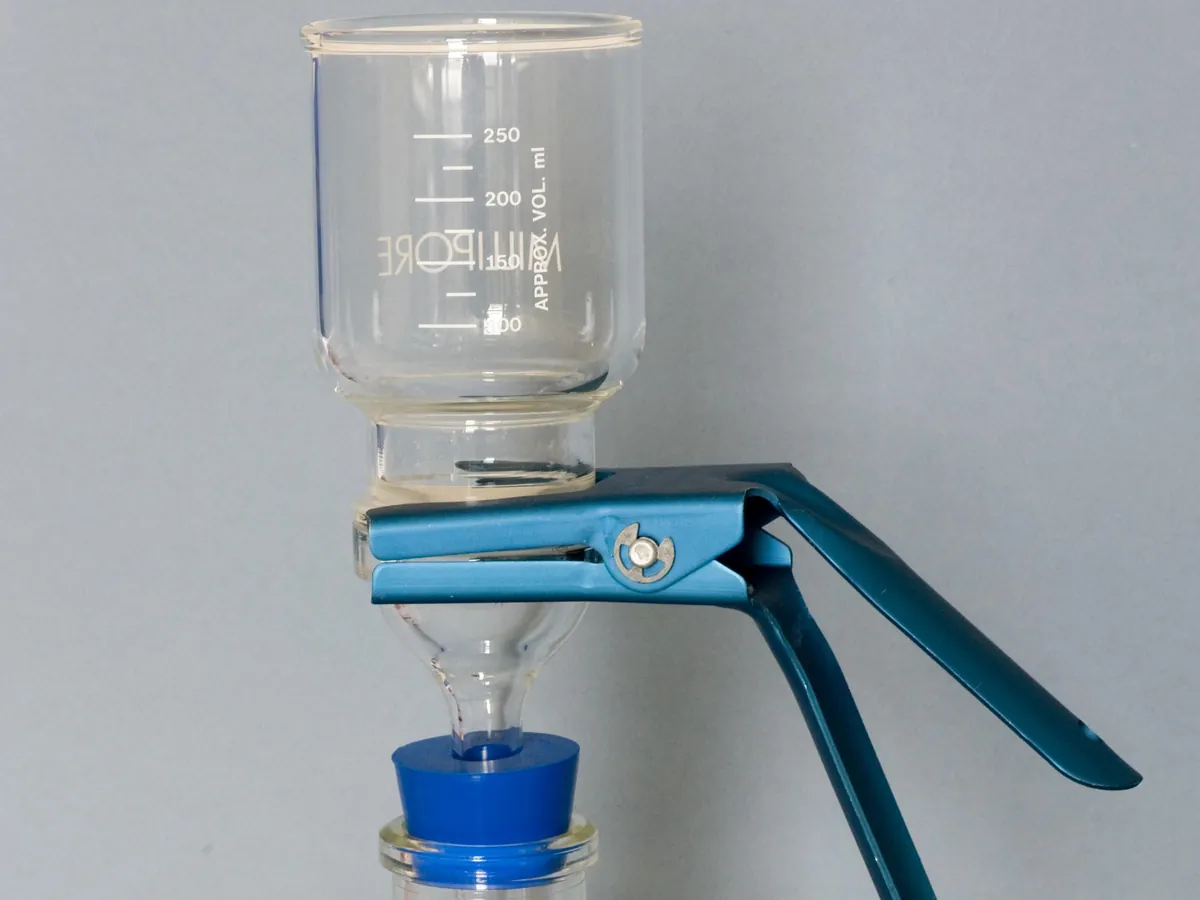
What is Filtration unit?
Membrane filtration concentrates microorganisms from large volumes of liquid onto a small filter. A sample is poured into a funnel above a sterile 0.45 µm membrane; vacuum draws the liquid through and the organisms stay on the surface. The membrane is then placed on agar to count colonies, or rinsed and incubated in broth for a sterility test.
It is the method of choice for water testing (where counts are low and large volumes are needed), for products with antimicrobial activity (because rinsing the membrane removes the inhibiting substance) and for sterility testing of filterable products. Open manifolds with stainless-steel or disposable funnels are used for water and microbial limits; closed canister systems driven by a peristaltic pump are used for sterility testing in isolators or Grade A.
The unit itself is simple but needs aseptic handling. Funnels must be sterile, the vacuum must not damage the membrane, and negative controls show that the system adds no contamination.
Used for
- Microbial count of purified water and WFI
- Sterility testing of filterable products by membrane filtration
- Microbial enumeration of products with antimicrobial activity
- Testing of rinse fluids from devices and container closures
- Bioburden testing before sterilising filtration
How it works
- 01
Assemble
Fit a sterile funnel and 0.45 µm membrane onto the manifold in the LAF or isolator.
- 02
Wet
Pre-wet the membrane with sterile diluent if the method requires.
- 03
Filter
Pour or pump the sample through the membrane under controlled vacuum.
- 04
Rinse
Rinse with sterile rinse fluid to remove product residues.
- 05
Transfer
Place the membrane on agar, or add medium to the closed canister.
- 06
Incubate
Incubate as per the method and count or examine for growth.
Advantages
- Tests large volumes, giving low limits of detection
- Rinsing removes antimicrobial substances from the membrane
- Simple and inexpensive (open manifolds)
- Closed systems lower the risk of false positives in sterility tests
Limitations
- Samples with particles or high viscosity can block the membrane
- Some products bind to the membrane or need a special type
- Excessive vacuum can damage organisms or the membrane
- Many aseptic manipulations with open funnels
Methods that use Filtration unit
Keep every Filtration unit in control: usage logs, calibration and maintenance schedules, and automatic blocking of overdue instruments.