Membrane filtration unit
A manifold with filter funnels connected to a vacuum source (or a peristaltic pump for closed canisters) that passes liquid samples through a 0.45 µm membrane so that microorganisms are retained and can be grown and counted.
- Pharmaceutical
- Biotech
- Water testing
- Food & beverage
- Medical devices
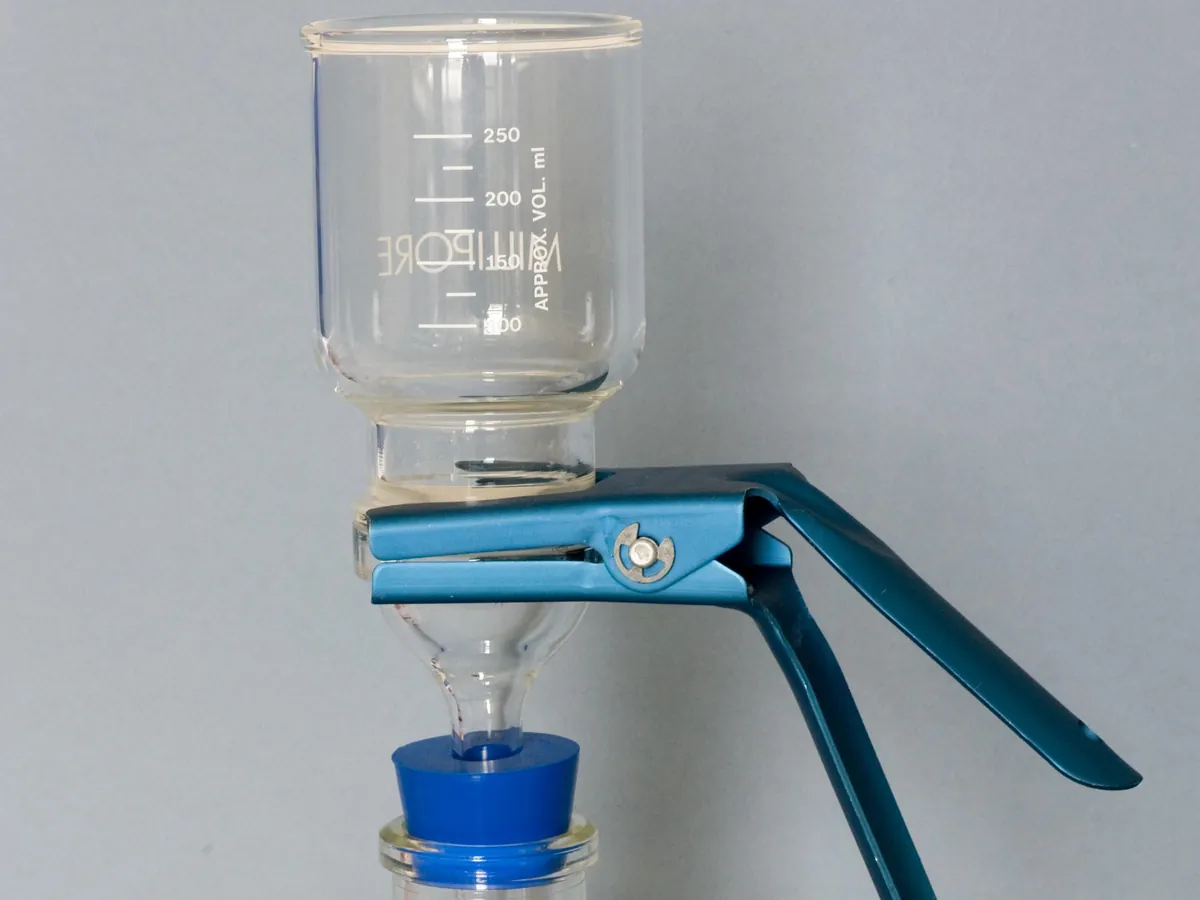
How Filtration unit works
A membrane with a nominal pore size of 0.45 µm retains bacteria, yeasts and moulds while liquid passes through under vacuum or pump pressure. The membrane is rinsed with a sterile fluid to wash away antimicrobial substances, then transferred to agar (counting) or covered with broth (sterility). Each colony that grows on the membrane is one cfu from the filtered volume.
The path of a sample
- 01
Assemble
Fit a sterile funnel and 0.45 µm membrane onto the manifold in the LAF or isolator.
- 02
Wet
Pre-wet the membrane with sterile diluent if the method requires.
- 03
Filter
Pour or pump the sample through the membrane under controlled vacuum.
- 04
Rinse
Rinse with sterile rinse fluid to remove product residues.
- 05
Transfer
Place the membrane on agar, or add medium to the closed canister.
- 06
Incubate
Incubate as per the method and count or examine for growth.
Main parts and what they do
Manifold (3- or 6-place)
Stainless-steel base with valves for each filter position.
Funnels and filter supports
Hold the sample over the membrane; autoclavable steel or sterile single-use.
Membranes
Sterile 47 mm, 0.45 µm filters, often gridded to help counting.
Vacuum pump and trap
Draws liquid through; the trap and in-line filter protect the pump from liquid and aerosols.
Peristaltic pump and closed canisters (sterility)
Pump the product through closed filter canisters; the head speed is adjustable.
Sterile forceps
Transfer membranes without touching the filtration surface.
Terms every analyst should know
Pore size
0.45 µm membranes are standard for microbial recovery; 0.2–0.22 µm membranes are sterilising-grade and used for filtration of solutions, not usually for counting.
Membrane material
Mixed cellulose esters are common for counts; low-binding materials may be needed for some products. The material must be validated with the product.
Rinsing
Rinse fluids such as peptone water wash preservatives and antibiotics off the membrane. The number and volume of rinses are fixed during method suitability.
Closed systems
Canisters with built-in membranes, filled through tubing by a peristaltic pump, reduce exposure to the environment in sterility testing.
Keep every Filtration unit in control: usage logs, calibration and maintenance schedules, and automatic blocking of overdue instruments.