Membrane filtration unit
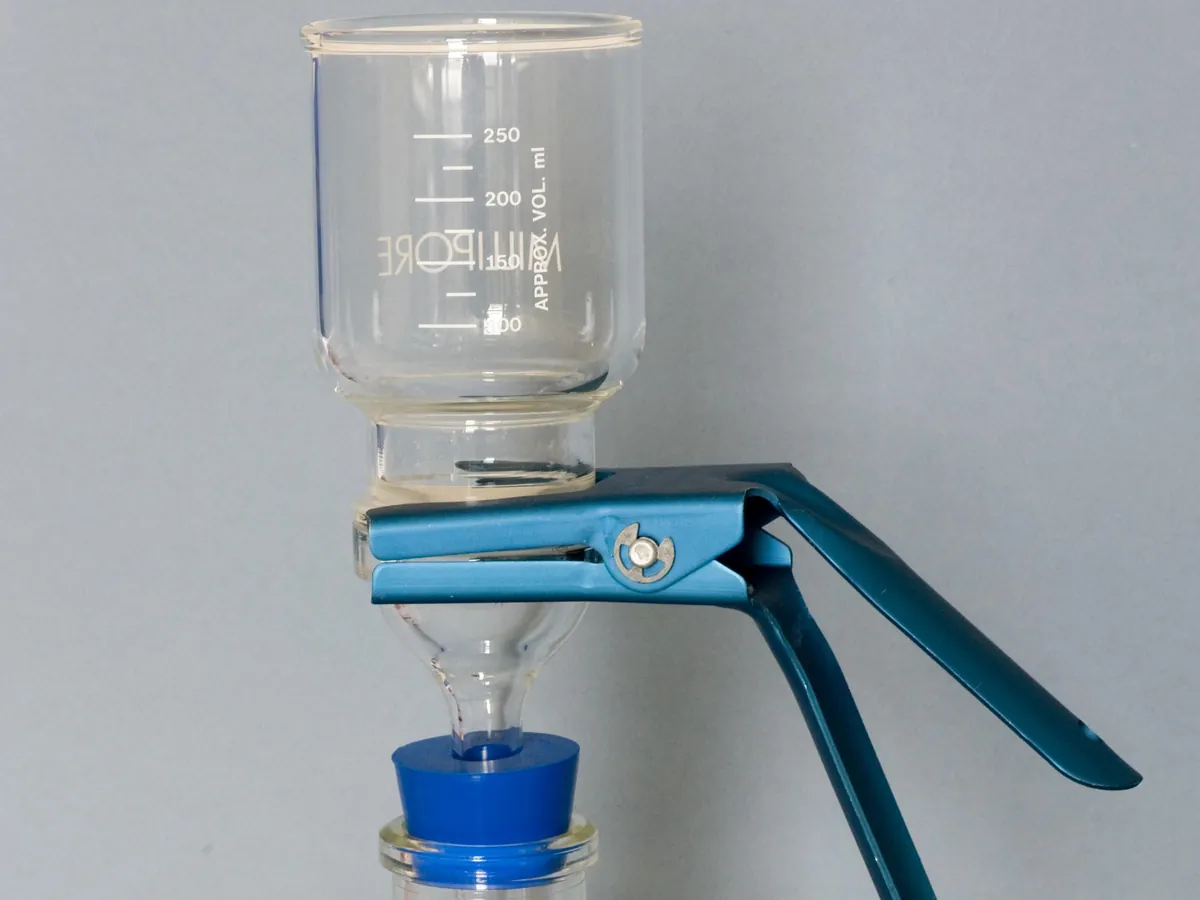
A manifold with filter funnels connected to a vacuum source (or a peristaltic pump for closed canisters) that passes liquid samples through a 0.45 µm membrane so that microorganisms are retained and can be grown and counted.
- Pharmaceutical
- Biotech
- Water testing
- Food & beverage
- Medical devices
Test your Filtration unit knowledge
Multiple-choice questions
Pick an answer to see whether you are right and why.
Q1. What nominal pore size membrane is usually used to recover microorganisms for counting?
basicQ2. Why is membrane filtration preferred for water samples?
basicQ3. Why is the membrane rinsed after filtering a product with preservatives?
intermediateQ4. Which part protects the vacuum pump from liquid and aerosols?
intermediateQ5. Why are closed canister systems used for sterility testing?
intermediateQ6. 200 mL of WFI is filtered and 3 colonies grow. What is the count per 100 mL?
basic
Viva questions
Think of your answer first, then open it to compare.
1. Describe how you place the membrane on the agar after filtration.
Remove the funnel, lift the membrane by its edge with sterile forceps, and roll it onto the agar from one side so that no air bubbles are trapped underneath. Bubbles stop nutrients reaching organisms and can hide colonies.
2. Growth is seen on the negative control membrane. What do you do?
The test is invalid. Check sterilisation records for funnels and rinse fluid, the environmental monitoring data and the analyst's technique; identify the organism, correct the cause and repeat the test with a fresh negative control.
3. Compare membrane filtration and direct inoculation in the sterility test.
Membrane filtration is preferred when the product can be filtered: the whole sample is tested and antimicrobial residues are rinsed away. Direct inoculation places the product straight into the media and is used for products that cannot be filtered (e.g. some suspensions, devices); the product must not exceed about 10% of the medium volume and must not inhibit growth.
Keep every Filtration unit in control: usage logs, calibration and maintenance schedules, and automatic blocking of overdue instruments.