Melting Point Apparatus
Heats a sample packed in a thin glass capillary at a slow, controlled rate and records the temperatures at which it starts and finishes melting. Used for identity and purity checks of APIs and excipients.
- Pharmaceutical
- Fine chemicals
- Agrochemicals
- Dyes and pigments
- Academic labs
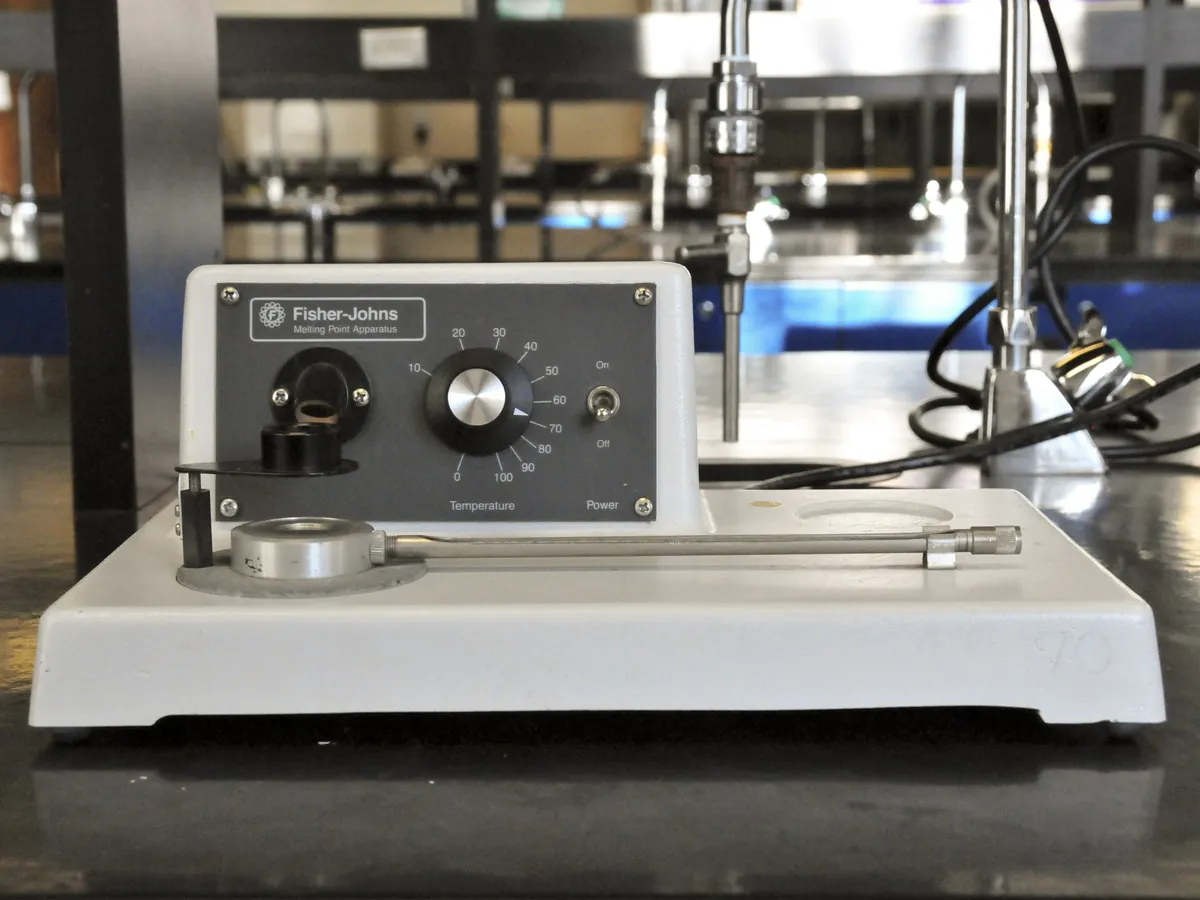
How Melting point apparatus works
A crystalline solid changes to liquid at a characteristic temperature. When the sample in a capillary is heated slowly, the block temperature at the first sign of liquid and at complete melting are recorded. Because heat must flow from the block into the sample, the reading depends on the heating rate, so the rate and the capillary are fixed by the pharmacopoeia and the instrument is calibrated with melting point reference standards.
The path of a sample
- 01
Prepare sample
Dry and finely powder the sample, then pack it to a fixed height in a capillary.
- 02
Pre-heat
Heat the block rapidly to a few degrees below the expected melting point.
- 03
Insert capillary
Place the capillary in the block once the start temperature is stable.
- 04
Slow ramp
Heat at a slow, constant rate, commonly about 1 °C/min.
- 05
Observe
Record the temperature of collapse or first liquid and of the clear point.
- 06
Report
Report the melting range and compare it with the specification.
Main parts and what they do
Heating block
Metal block (often aluminium or copper) with holes for capillaries and an electric heater; it gives a uniform temperature around the sample.
Temperature sensor
Platinum resistance thermometer (Pt100) set close to the capillaries; it measures the block temperature that is reported.
Controller
Sets the start temperature, the ramp rate and the stop temperature.
Viewing system
Magnifying lens with back lighting, or a camera with video recording on automatic models.
Optical detector (automatic models)
Measures the light transmitted through the capillary; the change as the solid turns clear marks the melting points.
Capillary tubes
Thin-walled glass tubes, closed at one end, of the internal diameter specified in the pharmacopoeia (about 1 mm).
Cooling fan
Cools the block quickly between runs.
Terms every analyst should know
Melting range
The interval from the start of melting to the clear point. A narrow range suggests a pure substance.
Melting point depression
Impurities lower the melting point and broaden the range. This is why melting range is used as a purity indicator.
Heating rate effect
Faster heating makes the block run ahead of the sample, so the reading comes out too high. The rate must match the method.
Mixed melting point
Mixing the sample with the reference standard: no depression suggests the same substance; a lower, wider range suggests a different one.
Melting with decomposition
Some substances darken or bubble while melting. The pharmacopoeia then defines how the point is read, and the heating rate is critical.
Keep every Melting point apparatus in control: usage logs, calibration and maintenance schedules, and automatic blocking of overdue instruments.