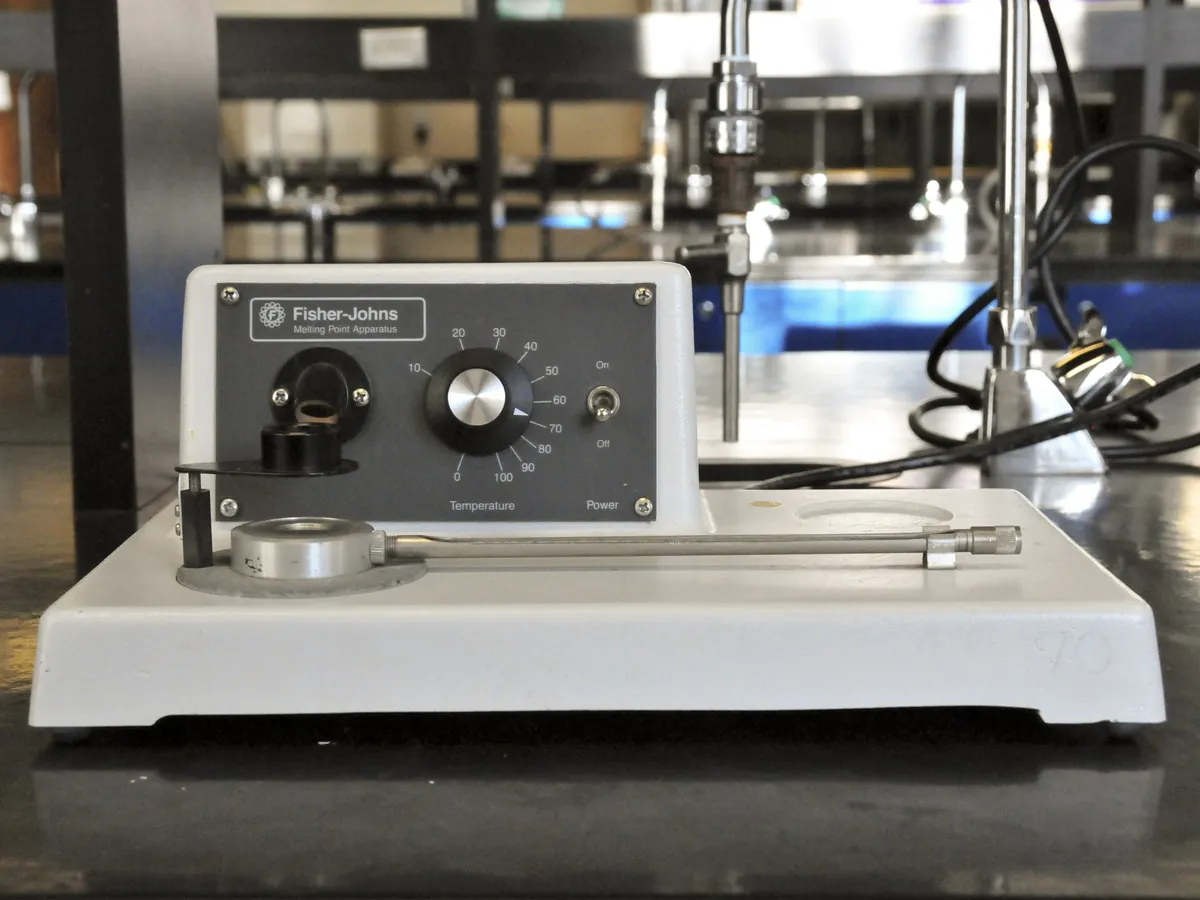
Melting Point Apparatus
Heats a sample packed in a thin glass capillary at a slow, controlled rate and records the temperatures at which it starts and finishes melting. Used for identity and purity checks of APIs and excipients.
- Pharmaceutical
- Fine chemicals
- Agrochemicals
- Dyes and pigments
- Academic labs
Test your Melting point apparatus knowledge
Multiple-choice questions
Pick an answer to see whether you are right and why.
Q1. What is the typical heating rate near the expected melting point in the capillary method?
basicQ2. What effect do impurities usually have on the melting range of a crystalline substance?
basicQ3. An analyst heats at 5 °C/min instead of 1 °C/min. What is the most likely result?
intermediateQ4. How high should the packed sample column in the capillary typically be?
basicQ5. What is used to calibrate a melting point apparatus?
intermediateQ6. A 1 : 1 mixture of the sample and the reference standard melts lower and over a wider range than either alone. What does this suggest?
advanced
Viva questions
Think of your answer first, then open it to compare.
1. What do the start and end of the melting range mean?
The start is the temperature at which the column collapses against the capillary wall or liquid first appears. The end, or clear point, is when the sample becomes completely liquid. Together they form the melting range.
2. Why must the sample be dried and finely powdered before the test?
Moisture or solvent lowers and broadens the melting range. A fine powder packs tightly and conducts heat evenly, so melting is sharp and reproducible.
3. How would you handle a substance that melts with decomposition?
Follow the monograph: it usually fixes the start temperature, the heating rate and how the point is read, because the result depends strongly on these. Record observations such as darkening or gas evolution, and consider DSC/TGA for more information.
Keep every Melting point apparatus in control: usage logs, calibration and maintenance schedules, and automatic blocking of overdue instruments.