Gel Permeation / Size-Exclusion Chromatography (GPC / SEC)
Separates molecules by their size in solution rather than by chemistry, so large molecules elute first. Used for polymer molecular-weight distribution and for protein aggregates in biologics.
- Pharmaceutical
- Biopharmaceutical
- Polymers & plastics
- Food (polysaccharides)
- Cosmetics
- Chemicals
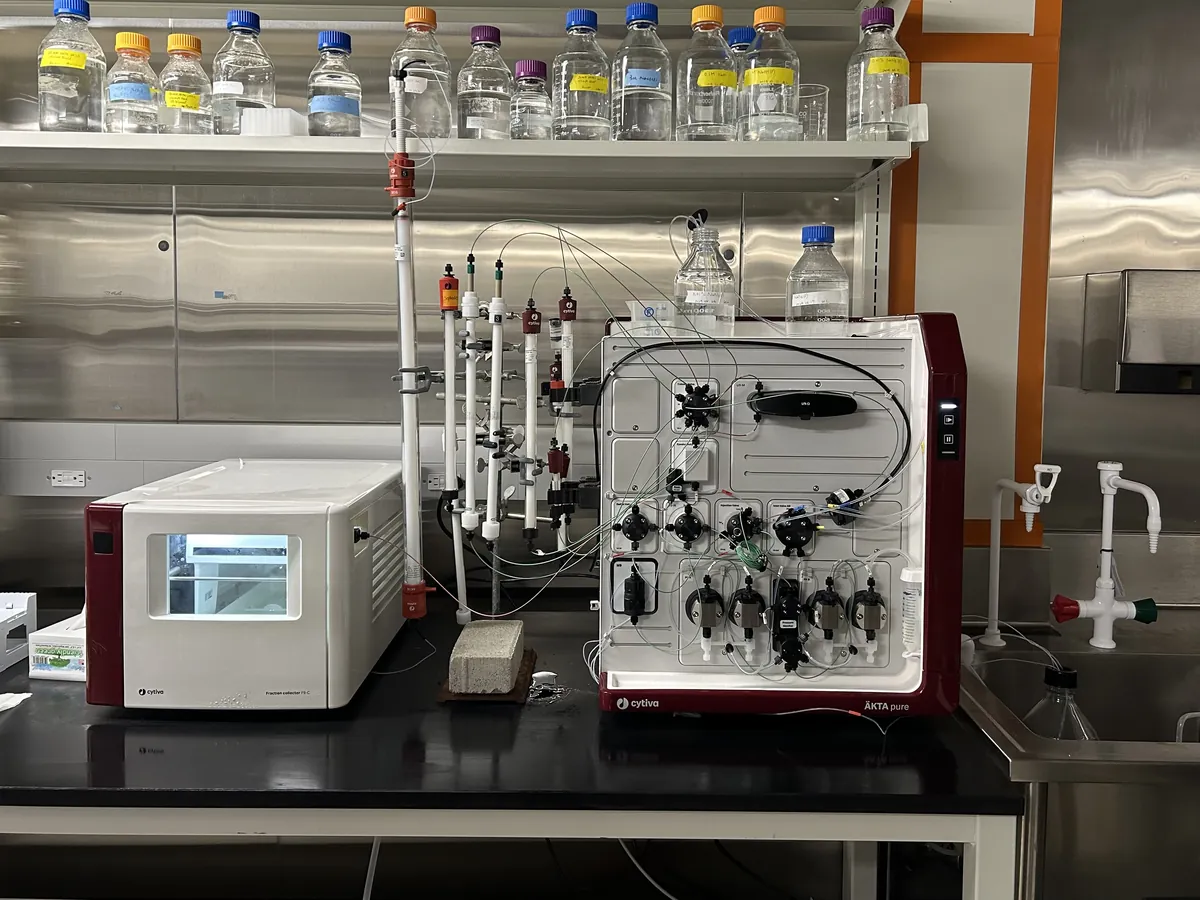
How GPC / SEC works
Separation is by hydrodynamic volume (size in solution). Molecules too large to enter any pores elute at the exclusion limit; molecules small enough to enter all pores elute at the total permeation volume; molecules in between are partly retained according to size. A calibration curve of log molecular weight against elution volume, made with narrow standards, converts retention into molecular weight.
The path of a sample
- 01
Mobile phase
An isocratic solvent (e.g. THF for GPC) or aqueous buffer with salt (e.g. phosphate + NaCl for SEC) that dissolves the sample and suppresses interactions.
- 02
Pump
Delivers a very steady, pulse-free flow, because elution volume is the measured quantity.
- 03
Injection
The sample, dissolved in mobile phase, is injected at a modest concentration to avoid viscosity effects.
- 04
Column set
One or more columns with suitable pore sizes separate molecules by size; larger molecules leave first.
- 05
Detector(s)
Refractive index (RI) for polymers, UV at 280 or 214 nm for proteins, and optionally light scattering or viscometry.
- 06
Software
Uses the calibration curve to calculate Mn, Mw, dispersity or % monomer and aggregates.
Main parts and what they do
Solvent reservoir and degasser
Holds and degasses the isocratic mobile phase; THF often needs stabiliser and protection from peroxides.
Isocratic pump
Supplies an exact, pulse-free flow; flow precision directly affects molecular-weight results.
Autosampler
Injects the sample, often at larger volumes (20–100 µL) than in reversed-phase HPLC.
SEC / GPC columns
Porous polymer (e.g. styrene–divinylbenzene) or diol-bonded silica packings with defined pore sizes, often in series.
Column oven
Keeps viscosity and elution volumes stable; some polymers need elevated temperature to dissolve.
Refractive index detector
Universal detector that responds to almost any polymer; very sensitive to temperature and flow changes.
UV, light-scattering or viscometer detectors (optional)
UV for proteins; multi-angle light scattering (MALS) and viscometry for absolute molar mass and structure.
GPC / SEC software
Builds the calibration curve and calculates molecular-weight averages, distributions and % aggregate.
Terms every analyst should know
Hydrodynamic volume
The effective size of a molecule in solution, which depends on molecular weight, shape and solvent.
Exclusion limit
The size above which molecules cannot enter the pores and all elute together at the interstitial (void) volume.
Total permeation volume
The elution volume of very small molecules that enter all pores. All size-based separation happens between the void and this volume.
Mn, Mw and dispersity
Number-average and weight-average molecular weight. Dispersity (Mw ÷ Mn, also called polydispersity index) describes how broad the distribution is; 1.0 means all chains are the same size.
Conventional vs absolute calibration
Conventional calibration uses standards (polystyrene, PEG/PEO, pullulan, proteins) and is relative; a light-scattering detector gives absolute molar mass.
Secondary interactions
Adsorption or ionic effects that delay elution and break the size-only assumption; controlled with salt, pH or solvent choice.
Keep every GPC / SEC in control: usage logs, calibration and maintenance schedules, and automatic blocking of overdue instruments.