Gel Permeation / Size-Exclusion Chromatography (GPC / SEC)
Separates molecules by their size in solution rather than by chemistry, so large molecules elute first. Used for polymer molecular-weight distribution and for protein aggregates in biologics.
- Pharmaceutical
- Biopharmaceutical
- Polymers & plastics
- Food (polysaccharides)
- Cosmetics
- Chemicals
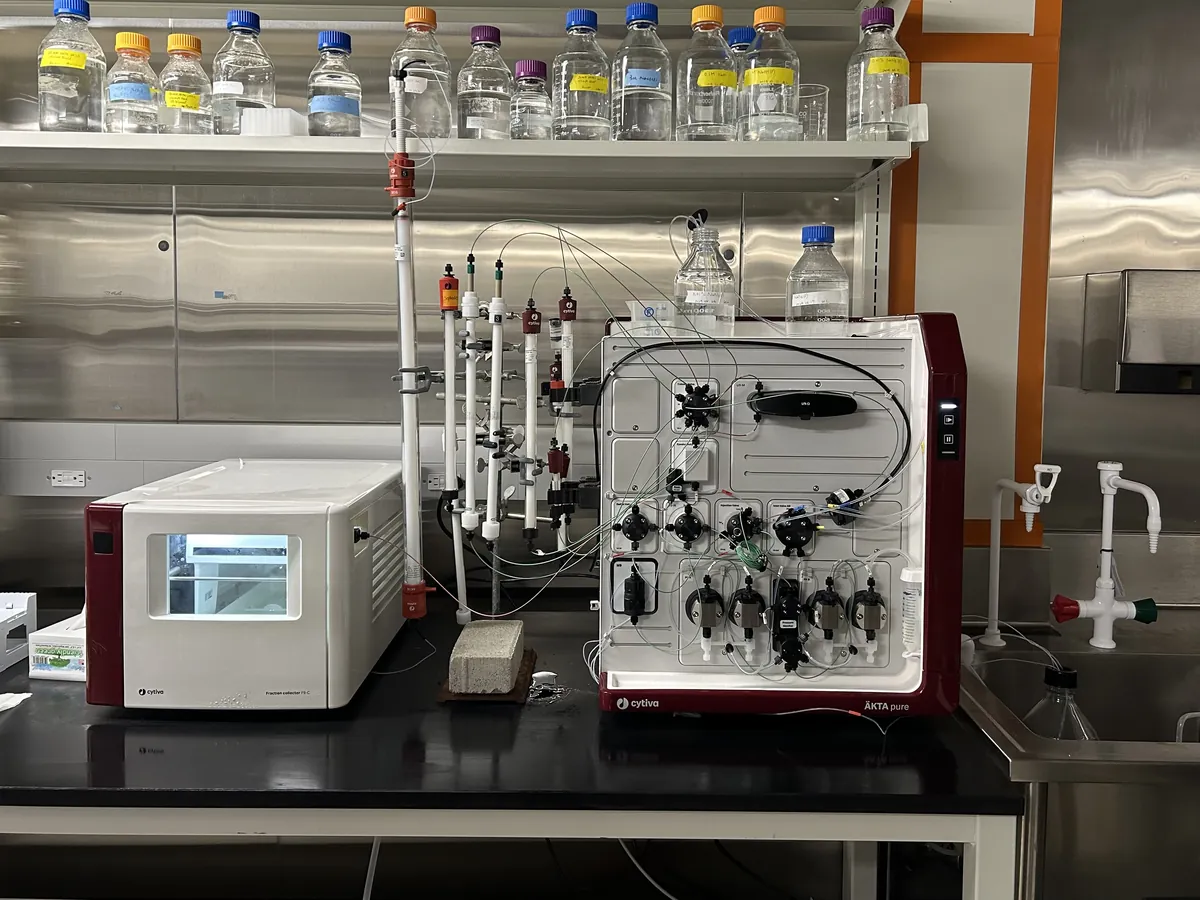
What is GPC / SEC?
In size-exclusion chromatography the column is packed with porous particles whose pores are of a controlled size. Small molecules can enter the pores and take a long path through the column. Large molecules cannot enter, or enter only some pores, so they pass through faster. The result is that molecules come out in order of decreasing size.
The same technique has two common names. GPC (gel permeation chromatography) usually means polymers dissolved in organic solvents such as tetrahydrofuran (THF). SEC or gel filtration usually means water-soluble molecules, such as proteins, in aqueous buffers. The column chemistry is chosen so that analytes do not stick to the packing; ideally, separation is by size alone.
In pharma, GPC is used to measure the molecular-weight distribution of polymeric excipients (such as PEG, povidone, HPMC and biodegradable polyesters like PLGA) and of heparins. SEC-HPLC is a routine release and stability test for biologics, where it measures the monomer and the high-molecular-weight aggregates that can affect safety.
Used for
- Molecular-weight averages (Mn, Mw) and dispersity of polymers and excipients
- Molecular-mass distribution of low-molecular-weight heparins
- Aggregate and fragment content of monoclonal antibodies and other proteins
- Stability monitoring of biologics (growth of dimers and aggregates)
- Polymer degradation in controlled-release formulations
- Desalting and buffer exchange in sample preparation
How it works
- 01
Mobile phase
An isocratic solvent (e.g. THF for GPC) or aqueous buffer with salt (e.g. phosphate + NaCl for SEC) that dissolves the sample and suppresses interactions.
- 02
Pump
Delivers a very steady, pulse-free flow, because elution volume is the measured quantity.
- 03
Injection
The sample, dissolved in mobile phase, is injected at a modest concentration to avoid viscosity effects.
- 04
Column set
One or more columns with suitable pore sizes separate molecules by size; larger molecules leave first.
- 05
Detector(s)
Refractive index (RI) for polymers, UV at 280 or 214 nm for proteins, and optionally light scattering or viscometry.
- 06
Software
Uses the calibration curve to calculate Mn, Mw, dispersity or % monomer and aggregates.
Advantages
- Gives the whole molecular-weight distribution, not just one number
- Gentle, non-denaturing conditions for proteins in aqueous buffers
- Simple isocratic method; elution order is predictable
- Can be combined with light scattering for absolute molar mass
Limitations
- Low peak capacity: only a limited number of peaks can be resolved
- Conventional calibration gives molecular weight relative to the standards used, not absolute values
- Unwanted adsorption or ionic interactions with the packing distort results
- Columns are fragile and need slow pressure and solvent changes
- Runs are slow and require stable flow; small flow errors cause large molecular-weight errors
Keep every GPC / SEC in control: usage logs, calibration and maintenance schedules, and automatic blocking of overdue instruments.