Tablet Friability Tester (Friabilator)
Tumbles a sample of uncoated tablets in a rotating drum to see how much weight they lose by chipping and abrasion. Shows whether tablets can survive coating, packing and transport.
- Pharmaceutical
- Nutraceuticals
- Veterinary medicines
- Food tablets
What is Friability tester?
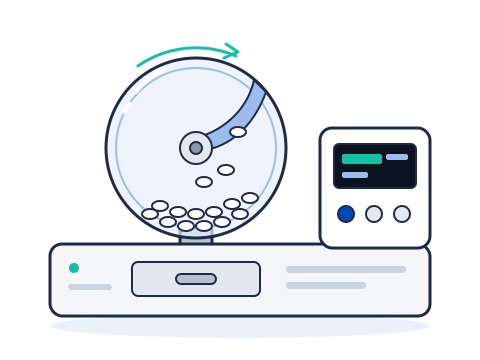
The friability tester rotates a transparent drum with a curved internal projection. At each turn the tablets are lifted and dropped, so they rub and fall against each other and the drum wall.
The tablets are weighed before and after a fixed number of revolutions (commonly 100 revolutions at 25 rpm, i.e. 4 minutes). The weight loss, expressed as a percentage, is the friability.
Friability is a routine in-process and release test for uncoated tablets. A common compendial limit is a maximum mean weight loss of not more than 1.0%, with no cracked, cleaved or broken tablets.
Used for
- In-process control during compression
- Release testing of uncoated tablets where specified
- Checking tablet cores before film coating
- Formulation and scale-up studies
How it works
- 01
Sample
Take the specified number of whole tablets (for small tablets, enough to weigh about 6.5 g; for larger tablets, commonly 10).
- 02
Dedust and weigh
Remove loose dust and weigh the tablets accurately (W1).
- 03
Tumble
Place the tablets in the drum and rotate 100 times at 25 ± 1 rpm.
- 04
Dedust and reweigh
Remove the tablets, dedust them and weigh again (W2).
- 05
Calculate
Friability % = (W1 − W2) ÷ W1 × 100; check for broken tablets.
Advantages
- Simple, quick and inexpensive
- Directly relevant to handling and coating losses
- Standardised drum and procedure in the pharmacopoeias
Limitations
- Not designed for coated tablets or very soft chewable tablets
- Sensitive to dedusting and weighing technique
- Large or unusually shaped tablets may need a tilted drum or modified procedure
1 calibration procedure
Methods that use Friability tester
Keep every Friability tester in control: usage logs, calibration and maintenance schedules, and automatic blocking of overdue instruments.