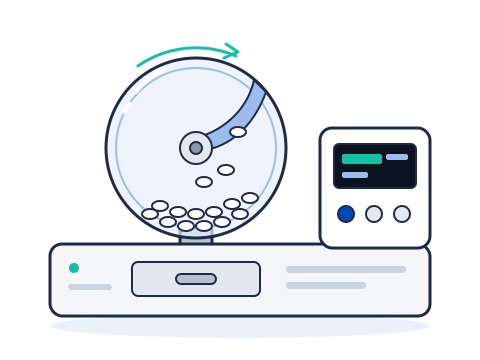
Tablet Friability Tester (Friabilator)
Tumbles a sample of uncoated tablets in a rotating drum to see how much weight they lose by chipping and abrasion. Shows whether tablets can survive coating, packing and transport.
- Pharmaceutical
- Nutraceuticals
- Veterinary medicines
- Food tablets
Test your Friability tester knowledge
Multiple-choice questions
Pick an answer to see whether you are right and why.
Q1. The friability drum normally rotates at:
basicQ2. How many revolutions are used in a standard friability test?
basicQ3. Tablets weigh 6.612 g before and 6.587 g after tumbling. What is the friability?
intermediateQ4. A common compendial limit for friability of uncoated tablets is:
intermediateQ5. For tablets weighing 650 mg or less, how large is the friability sample?
intermediateQ6. After the test, the tablets weigh slightly more than before. The most likely reason is:
advanced
Viva questions
Think of your answer first, then open it to compare.
1. Why is friability tested?
To show the tablets can withstand coating, packing, transport and handling without chipping or breaking, which would affect appearance, dose and patient acceptance.
2. How do you calibrate a friability tester?
Set 100 revolutions, time the run with a calibrated stopwatch and count the revolutions. Speed = revolutions ÷ minutes, which should be 25 ± 1 rpm, and the count must match the set value. Drum dimensions are also checked against the chapter.
3. Why is friability not usually done on coated tablets?
The coating protects the core and is designed to resist abrasion, so the test is aimed at uncoated tablets and tablet cores before coating, where it predicts losses during the coating process.
Keep every Friability tester in control: usage logs, calibration and maintenance schedules, and automatic blocking of overdue instruments.