Crude fibre analyser
Boils a defatted sample first in dilute acid and then in dilute alkali, filters it in fritted crucibles, and weighs the dried and ashed residue. The organic residue is reported as crude fibre.
- Animal feed
- Food & beverage
- Agriculture
- Spices
- Academic research
What is Fibre analyser?
Crude fibre is the part of a plant food that survives boiling in dilute sulphuric acid and then dilute sodium hydroxide. It is mostly cellulose with some lignin. The method was developed in the nineteenth century (the Weende scheme) and is still used for feed, cereals, spices and some food specifications.
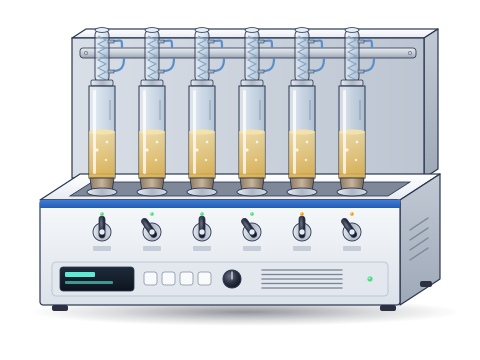
A fibre analyser automates the tedious parts. Samples sit in glass crucibles with a fritted base. The unit heats reagents, boils the crucibles for exact times, filters under vacuum and rinses with hot water, all on one manifold. A separate cold extraction unit is often used to defat samples with acetone or petroleum ether first.
Crude fibre is not the same as dietary fibre. It underestimates dietary fibre because hemicellulose and some lignin dissolve in the acid and alkali. Nutrition labels usually need dietary fibre by an enzymatic-gravimetric method, while crude fibre is used where a standard or specification asks for it.
Used for
- Crude fibre in animal feed and feed ingredients
- Crude fibre in cereals, flour, bran and pulses
- Fibre in spices and condiments where the specification requires it
- Quality control of oilseed meals and fodder
- Neutral and acid detergent fibre with suitable reagents (feed analysis)
How it works
- 01
Defat
Extract fat with acetone or petroleum ether if the sample has more than a few per cent fat.
- 02
Acid boil
Boil for 30 min in dilute sulphuric acid (about 1.25%, 0.13 M).
- 03
Filter & wash
Filter under vacuum and wash with hot water until neutral.
- 04
Alkali boil
Boil for 30 min in dilute sodium hydroxide (about 1.25%, 0.31 M).
- 05
Dry & weigh
Wash, rinse with acetone, dry (typically at 130 °C) and weigh the crucible.
- 06
Ash & weigh
Ash at about 500–550 °C and reweigh; the loss is crude fibre.
Advantages
- Simple gravimetric method with no calibration curve
- Several samples processed in parallel with exact timing
- Filtration under vacuum is faster and more repeatable than manual cloth filtration
- Same crucibles go from extraction to drying and ashing, reducing transfer losses
Limitations
- Crude fibre is an empirical value that depends strictly on the procedure
- Underestimates dietary fibre
- Fine or high-protein samples can clog the crucible frit
- Hot acid and alkali handling is hazardous
1 calibration procedure
Methods that use Fibre analyser
Keep every Fibre analyser in control: usage logs, calibration and maintenance schedules, and automatic blocking of overdue instruments.