Food & proximate analysis
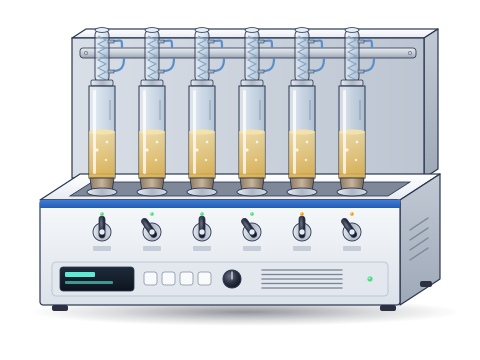
Crude fibre analyser
Boils a defatted sample first in dilute acid and then in dilute alkali, filters it in fritted crucibles, and weighs the dried and ashed residue. The organic residue is reported as crude fibre.
- Animal feed
- Food & beverage
- Agriculture
- Spices
- Academic research
Follow your site SOP
This is a typical operating sequence for learning. Your instrument model and approved SOP take precedence.
STAGE 1
Before you start
- 1Clean crucibles, ignite them at the ashing temperature, cool in a desiccator and weigh if required by your method.
- 2Prepare acid and alkali at the exact strengths in the method and check them by titration.
- 3Grind the sample to pass the sieve size in the method (often 1 mm).
- 4Check vacuum, cooling water and heater function.
- Reagent strength and boiling time define the result. Small changes give different crude fibre values.
STAGE 2
Defatting and acid digestion
- 1Weigh about 1–2 g of sample into each crucible (or use a defatted sample of known original mass).
- 2Defat in the cold extraction unit if the fat content is above a few per cent.
- 3Fit crucibles to the hot extraction unit, add hot acid and an antifoam if needed.
- 4Bring to the boil quickly and boil for exactly 30 min.
- 5Filter under vacuum and wash three times with hot water.
- Hot dilute acid still causes burns. Keep the shield closed during boiling.
STAGE 3
Alkali digestion, drying and ashing
- 1Add hot sodium hydroxide, boil for exactly 30 min and filter.
- 2Wash with hot water until neutral, then rinse with acetone.
- 3Dry the crucibles (typically 130 °C for about 2 h, or as the method states), cool in a desiccator and weigh.
- 4Ash in a muffle furnace at about 500–550 °C, cool in a desiccator and weigh again.
- 5Run a reagent blank crucible and a reference material in each batch.
- Let crucibles cool in stages before putting them into or taking them out of the furnace, to avoid cracking.
STAGE 4
Shutdown
- 1Flush the reagent lines with water.
- 2Clean the crucibles (alkaline cleaning or ignition as the supplier advises).
- 3Switch off heaters and vacuum; complete the log.
In LimsPulse · Calibration Management
Keep every Fibre analyser in control: usage logs, calibration and maintenance schedules, and automatic blocking of overdue instruments.