Crude fibre analyser
Boils a defatted sample first in dilute acid and then in dilute alkali, filters it in fritted crucibles, and weighs the dried and ashed residue. The organic residue is reported as crude fibre.
- Animal feed
- Food & beverage
- Agriculture
- Spices
- Academic research
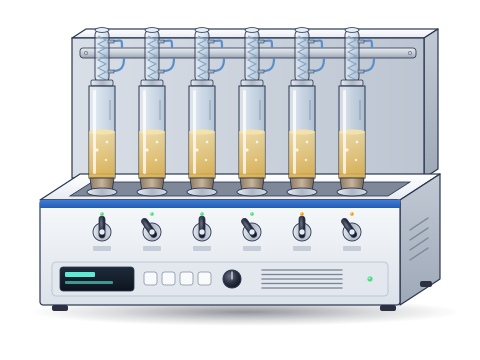
How Fibre analyser works
A defatted sample is boiled for a fixed time in dilute sulphuric acid, then in dilute sodium hydroxide. Sugars, starch, protein and some hemicellulose dissolve. The insoluble residue is dried and weighed, then ashed. The loss in mass on ashing is the organic residue, reported as crude fibre.
The path of a sample
- 01
Defat
Extract fat with acetone or petroleum ether if the sample has more than a few per cent fat.
- 02
Acid boil
Boil for 30 min in dilute sulphuric acid (about 1.25%, 0.13 M).
- 03
Filter & wash
Filter under vacuum and wash with hot water until neutral.
- 04
Alkali boil
Boil for 30 min in dilute sodium hydroxide (about 1.25%, 0.31 M).
- 05
Dry & weigh
Wash, rinse with acetone, dry (typically at 130 °C) and weigh the crucible.
- 06
Ash & weigh
Ash at about 500–550 °C and reweigh; the loss is crude fibre.
Main parts and what they do
Hot extraction unit
Heats and boils reagents in columns above each crucible, with reflux condensers to keep volume constant.
Fritted glass crucibles
Hold the sample, act as filters and go into the oven and furnace.
Reagent preheaters and dispensers
Heat acid, alkali and rinse water so boiling starts quickly.
Vacuum and pressure system
Filters and drains liquid; a gentle back-pressure keeps the sample suspended during boiling.
Cold extraction unit
Defats samples with solvent at room temperature before the acid boil.
Drying oven and muffle furnace (external)
Dry the residue (about 130 °C) and ash it (about 500–550 °C).
Terms every analyst should know
Crude fibre
The organic residue left after sequential acid and alkali digestion. Mainly cellulose and part of the lignin.
Empirical method
The result is defined by the method itself. Reagent strength, boiling time and particle size must follow the standard exactly.
Ash correction
Weighing before and after ashing removes the mineral part of the residue, so only organic matter is counted.
Fritted crucible
Glass crucible with a porous sintered base (often porosity P2) that acts as the filter and survives ashing.
Dietary fibre
All non-digestible carbohydrate plus lignin, measured by enzymatic-gravimetric methods. Always higher than crude fibre for the same food.
Keep every Fibre analyser in control: usage logs, calibration and maintenance schedules, and automatic blocking of overdue instruments.