Copper Strip Corrosion Bath
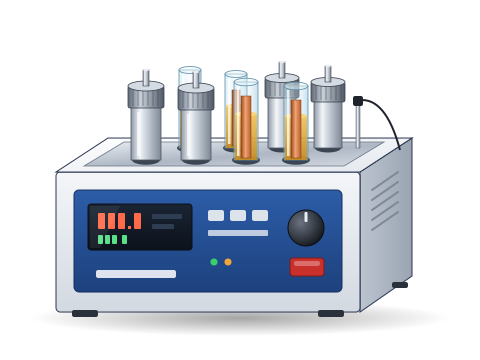
A thermostatic bath that holds a polished copper strip immersed in a fuel or oil at a set temperature (for example 50 °C or 100 °C) for a set time. The tarnished strip is then compared with the ASTM colour standards to grade corrosiveness.
- Petroleum refining
- Fuel terminals
- Lubricant blending
- Aviation fuel quality
- Independent testing laboratories
What is Copper corrosion bath?
Some sulphur compounds, especially elemental sulphur, hydrogen sulphide and mercaptans, attack copper and its alloys used in fuel pumps, bearings and fittings. The copper strip test (ASTM D130, ISO 2160, IS 1448 Part 15) shows whether a product is likely to corrode copper. A freshly polished copper strip is soaked in the sample at a set temperature and time, washed, and its colour compared with the ASTM Copper Strip Corrosion Standards.
The bath is a stirred liquid (water or oil) or solid-block heater held to within about ±1 °C. Volatile products such as petrol, LPG-related products and light naphthas are tested inside a sealed stainless-steel pressure vessel (often called a 'bomb') so that no vapour escapes. Less volatile products such as diesel and lubricating oils are usually tested in a test tube, sometimes with a loose vented cover.
Typical conditions are 3 h at 50 °C for petrol and diesel, and 3 h at 100 °C (or longer, or higher temperature) for lubricating oils, but the product specification states which to use. Results are reported as a class (1 to 4) with a letter (a, b, c…), such as '1a' or '2c', together with the time and temperature.
Used for
- Corrosiveness of petrol, diesel, kerosene and jet fuel to copper (specifications typically require class 1)
- Lubricating oils, gear oils and hydraulic fluids at 100 °C or above
- LPG and natural gas liquids (related method ASTM D1838)
- Detecting active sulphur after refinery treating or additive changes
- Biodiesel and blends
How it works
- 01
Prepare strip
A copper strip (about 12.5 mm × 75 mm) is surface-prepared with silicon carbide paper and final-polished with silicon carbide grains on cotton, without touching it by hand.
- 02
Immerse
The strip is placed in about 30 mL of sample in a test tube, which goes into the pressure vessel for volatile products.
- 03
Heat
The tube or vessel is held in the bath at the set temperature (for example 50 ± 1 °C) for the set time (for example 3 h ± 5 min).
- 04
Wash
The strip is removed, washed with a wash solvent (for example isooctane) and dried by blotting with filter paper.
- 05
Compare
The strip is compared with the ASTM Copper Strip Corrosion Standards, held to reflect light at about 45°, and assigned a class.
Advantages
- Simple and inexpensive
- Directly relevant to performance in copper-containing fuel and lubrication systems
- Many samples can run at the same time
- Widely specified in fuel and lubricant standards
Limitations
- Visual, semi-quantitative result based on colour comparison
- Strip preparation (polishing) strongly affects the result
- Does not identify which sulphur compound is responsible
- Results depend strictly on time and temperature; different conditions are not comparable
- Colour standards fade with light exposure and must be kept in their case
1 calibration procedure
Methods that use Copper corrosion bath
Keep every Copper corrosion bath in control: usage logs, calibration and maintenance schedules, and automatic blocking of overdue instruments.