Copper Strip Corrosion Bath
A thermostatic bath that holds a polished copper strip immersed in a fuel or oil at a set temperature (for example 50 °C or 100 °C) for a set time. The tarnished strip is then compared with the ASTM colour standards to grade corrosiveness.
- Petroleum refining
- Fuel terminals
- Lubricant blending
- Aviation fuel quality
- Independent testing laboratories
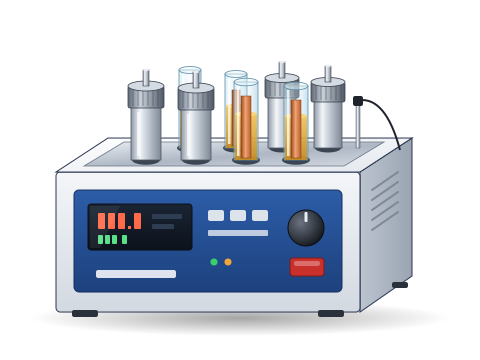
How Copper corrosion bath works
Reactive sulphur compounds form copper sulphides and other films on clean copper. The thickness and type of film change the strip's colour from light orange tarnish through reds, lavender and peacock colours to black corrosion. Comparing the strip with standard colour plates gives a corrosion class.
The path of a sample
- 01
Prepare strip
A copper strip (about 12.5 mm × 75 mm) is surface-prepared with silicon carbide paper and final-polished with silicon carbide grains on cotton, without touching it by hand.
- 02
Immerse
The strip is placed in about 30 mL of sample in a test tube, which goes into the pressure vessel for volatile products.
- 03
Heat
The tube or vessel is held in the bath at the set temperature (for example 50 ± 1 °C) for the set time (for example 3 h ± 5 min).
- 04
Wash
The strip is removed, washed with a wash solvent (for example isooctane) and dried by blotting with filter paper.
- 05
Compare
The strip is compared with the ASTM Copper Strip Corrosion Standards, held to reflect light at about 45°, and assigned a class.
Main parts and what they do
Bath
Liquid or solid-block bath that holds test tubes or pressure vessels at the set temperature within about ±1 °C.
Pressure vessels (bombs)
Stainless-steel vessels with a screw cap and seal, used for volatile samples.
Test tubes
Glass tubes of about 25 mm × 150 mm holding the sample and strip.
Copper strips
High-purity copper strips of specified dimensions.
Polishing materials
Silicon carbide paper and grains, a vice or polishing holder, and absorbent cotton.
Wash solvent
Sulphur-free hydrocarbon solvent such as isooctane for washing strips.
Temperature sensor
Calibrated thermometer or probe to check bath temperature.
ASTM Copper Strip Corrosion Standards
Colour reproductions of typical strips for each class, sealed in a plastic case.
Terms every analyst should know
Corrosion classes
1 = slight tarnish (1a light orange, 1b dark orange); 2 = moderate tarnish (2a claret red to 2e brassy or gold); 3 = dark tarnish (3a magenta overcast, 3b multicoloured); 4 = corrosion (4a transparent black to 4c glossy black).
Active sulphur
Sulphur in a form that reacts with copper, such as elemental sulphur, H₂S and some mercaptans. Total sulphur alone does not predict copper corrosion.
Pressure vessel
A sealed stainless-steel vessel that keeps volatile samples from boiling or evaporating during the test. It must be pressure-tested.
Borderline strips
When a strip falls between two standards, it is given the more tarnished classification.
Keep every Copper corrosion bath in control: usage logs, calibration and maintenance schedules, and automatic blocking of overdue instruments.