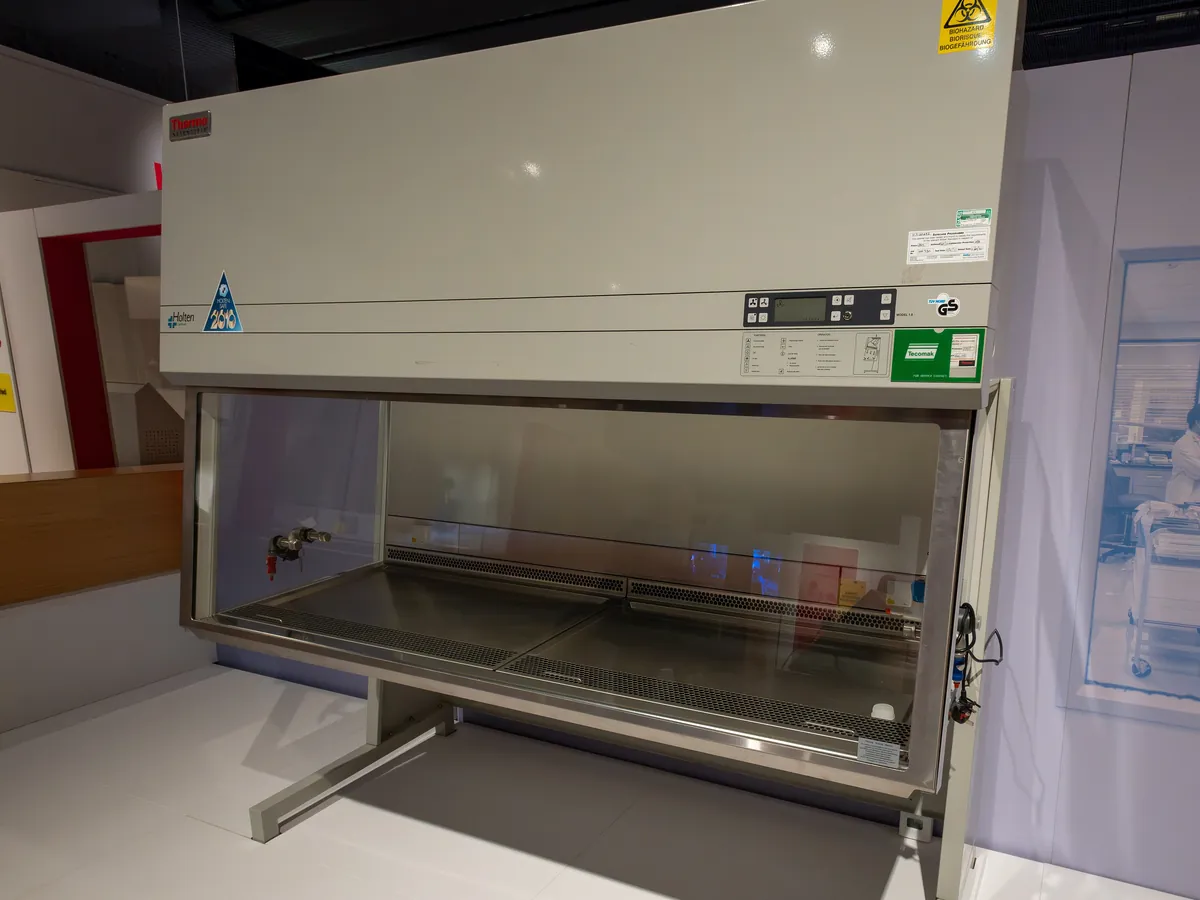
Biosafety cabinet (microbiological safety cabinet)
A ventilated enclosure that protects the operator, the product and the room when handling microorganisms. HEPA-filtered downflow keeps the work clean, an inflow of room air at the front stops aerosols escaping, and the exhaust is HEPA-filtered before it leaves the cabinet.
- Pharmaceutical
- Biotech
- Hospitals and clinical labs
- Vaccine manufacture
- Food & beverage
- Research laboratories
How BSC works
A fan draws room air through the front grille (inflow), which forms an air curtain that keeps aerosols inside the cabinet. Air above the work surface is HEPA-filtered and flows down evenly (downflow) to protect the work. The air is split at the work surface: in a Class II A2 cabinet about 70% is recirculated through the supply HEPA filter and about 30% is exhausted through the exhaust HEPA filter, balancing the air drawn in at the front.
The path of a sample
- 01
Inflow
Room air enters through the front opening and grille at a set speed, protecting the operator.
- 02
Downflow
HEPA-filtered air moves down over the work surface, protecting the product.
- 03
Split at the work surface
Downflow divides near the front and rear grilles; contaminated air is drawn away from the work.
- 04
Plenum and fan
Air is drawn into a plenum behind the work zone and pressurised by the fan.
- 05
Recirculation
Part of the air passes back through the supply HEPA filter (Class II A2).
- 06
Exhaust
The rest leaves through the exhaust HEPA filter, into the room or a duct.
Main parts and what they do
Front opening and sash
Glass window raised to a fixed working height (often about 20 cm). The sash height alarm warns if it is set wrongly.
Front and rear grilles
Openings in the work surface where inflow and part of the downflow are drawn away. Must not be blocked.
Supply (downflow) HEPA filter
Filters air before it flows down over the work surface.
Exhaust HEPA filter
Filters air leaving the cabinet so microorganisms do not escape.
Fan / motor blower
Moves air through both filters; often an EC motor that compensates for filter loading.
Airflow monitor and alarm
Shows inflow or downflow status and sounds an alarm if airflow falls outside limits.
Stainless-steel work tray
Removable, easy-to-disinfect surface; a spill sump may lie underneath.
UV lamp (optional)
Supplementary surface disinfection when the cabinet is not in use; not a replacement for chemical disinfection.
Exhaust connection (thimble or hard duct)
Carries exhaust air out of the building on ducted cabinets (A2 with canopy, B1, B2).
Terms every analyst should know
Cabinet classes
Class I protects operator and room; Class II protects operator, product and room; Class III is a sealed glove box. Most QC microbiology labs use Class II type A2.
Inflow velocity
Speed of room air entering the front opening. NSF/ANSI 49 typically expects at least 0.51 m/s (100 ft/min) for Class II A2; EN 12469 typically expects at least 0.40 m/s for Class II.
Downflow velocity
Speed of filtered air moving down over the work surface, typically 0.25–0.50 m/s, set by the manufacturer for each model.
Operator protection factor
How well the cabinet keeps aerosols in, measured with a potassium iodide (KI-discus) or microbiological challenge. EN 12469 expects a high factor (typically at least 1 × 10^5 for Class II).
Air balance
Inflow, downflow and exhaust must stay in balance. A loading filter or blocked grille changes all three, which is why alarms monitor the airflow.
BSC vs LAF
A laminar air flow unit blows filtered air towards the operator and protects only the product. A BSC draws air in at the front and filters the exhaust, so it also protects the operator.
Keep every BSC in control: usage logs, calibration and maintenance schedules, and automatic blocking of overdue instruments.