Automated cell counter
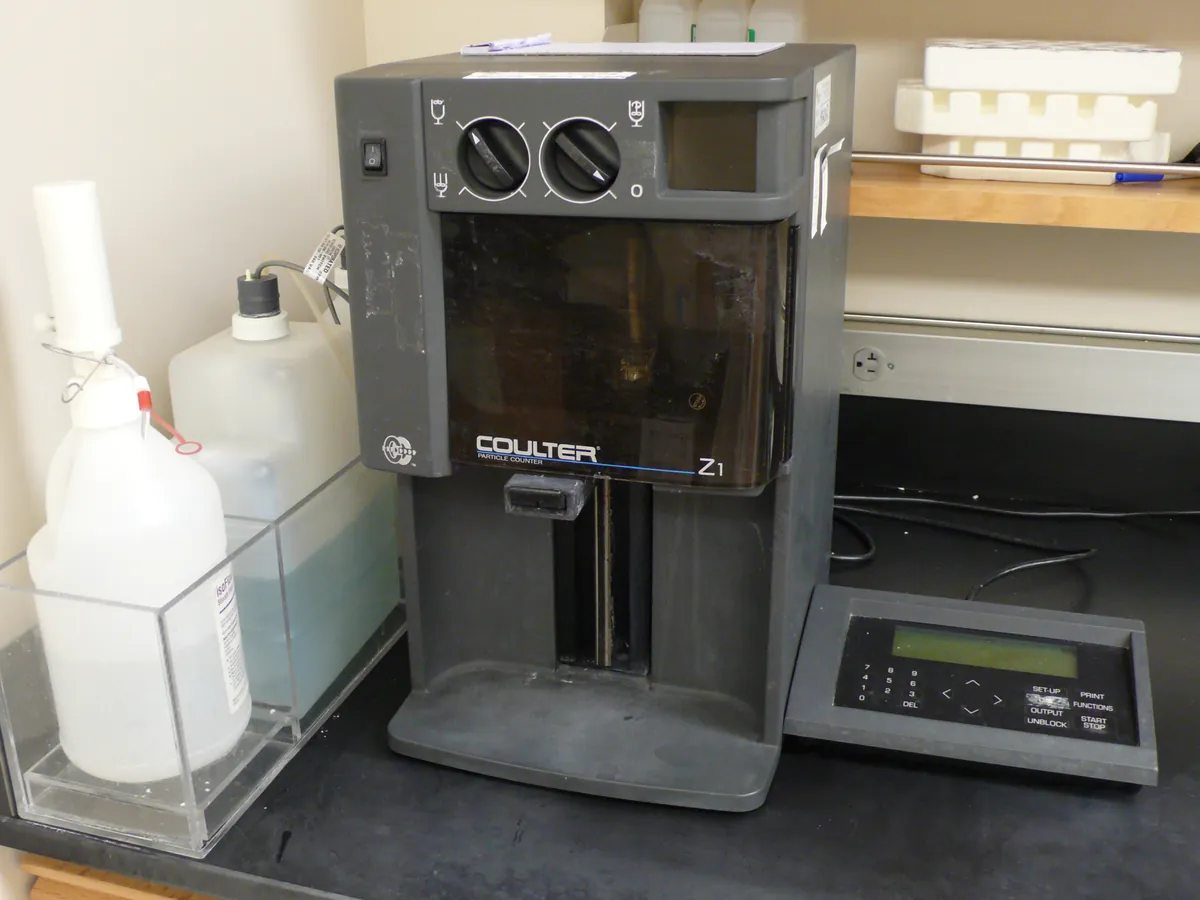
Counts cells and measures their viability automatically, usually by imaging a stained sample in a disposable or reusable counting chamber. It replaces manual haemocytometer counting for routine cell culture and bioprocess work.
- Biotechnology
- Biopharmaceutical
- Cell and gene therapy
- Academic research
- Vaccine manufacture
- Regenerative medicine
Test your Cell counter knowledge
Multiple-choice questions
Pick an answer to see whether you are right and why.
Q1. In trypan blue exclusion, which cells appear blue?
basicQ2. Cells are mixed 1:1 with trypan blue. What dilution factor must be applied?
basicQ3. What is used to check the counting accuracy of an automated counter?
intermediateQ4. Five bead counts average 1.010 × 10⁶/mL against a certified 1.00 × 10⁶/mL. What is the recovery?
intermediateQ5. Why are AO/PI fluorescent stains often preferred over trypan blue for samples with debris?
intermediateQ6. Why should cells be counted soon after mixing with trypan blue?
basicQ7. About how many cells must be counted to keep the counting (Poisson) error near 5%?
advanced
Viva questions
Think of your answer first, then open it to compare.
1. Automated counts are 20% higher than manual haemocytometer counts. How do you investigate?
Check the dilution factor in the protocol, size gates (debris counted as cells), clump handling, mixing before sampling and slide loading. Count reference beads to check the instrument, then compare both methods on the same samples over the range and align settings with the validated definition of a cell.
2. What do reference beads not test in a cell counter?
Beads do not test live/dead classification, stain uptake, clumping or cell-specific size gates. Those need comparison with manual counts or control cells of known viability.
3. What does ISO 20391-2 add to the evaluation of a cell counting method?
It describes a dilution-series design and statistics to assess proportionality (whether counts scale with dilution) and precision, so counting methods can be evaluated even without a cell reference material.
Keep every Cell counter in control: usage logs, calibration and maintenance schedules, and automatic blocking of overdue instruments.