Autoclave (steam steriliser)
Kills microorganisms, including bacterial spores, with saturated steam under pressure. Used in the QC microbiology lab to sterilise culture media, glassware and equipment, and to decontaminate used media before disposal.
- Pharmaceutical
- Biotech
- Hospitals
- Food & beverage
- Research laboratories
- Medical devices
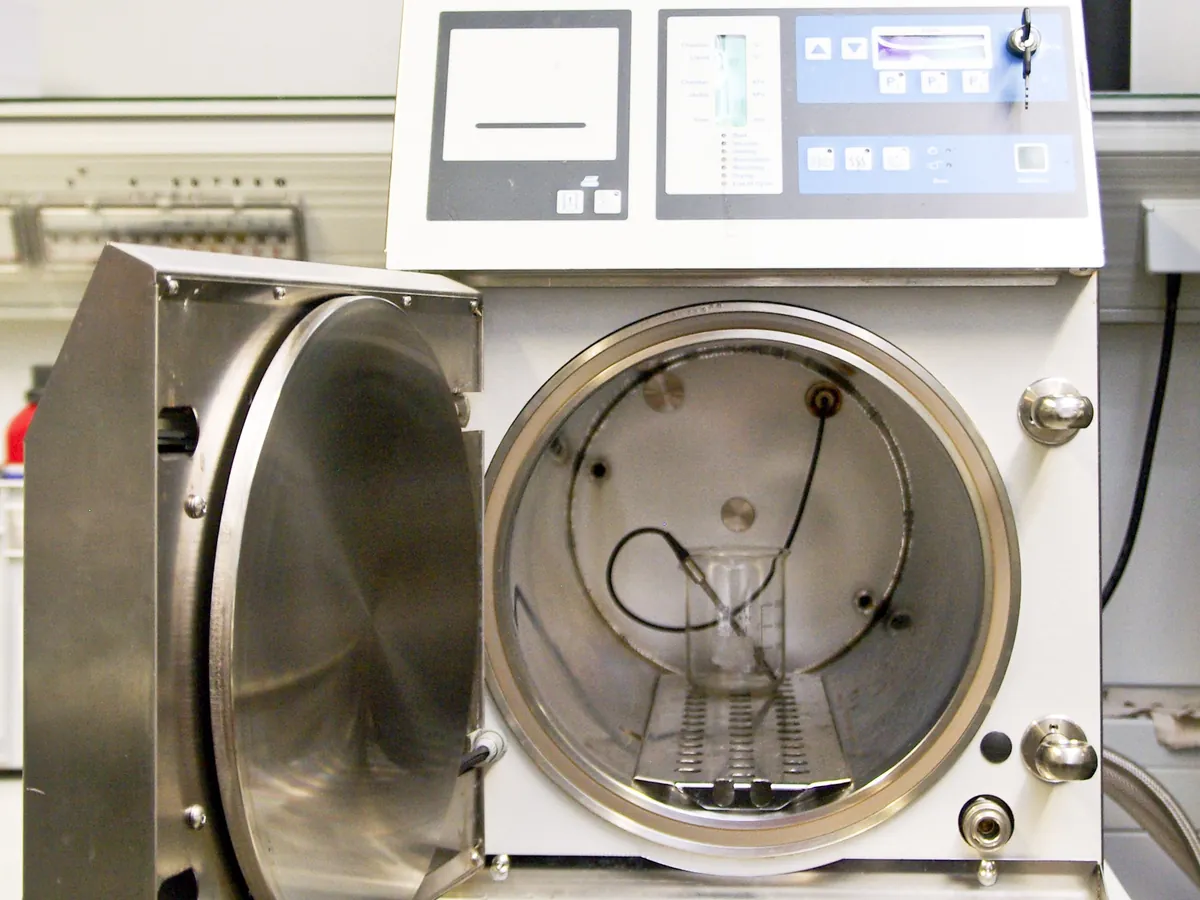
How Autoclave works
Saturated steam under pressure condenses on the cooler load and transfers latent heat, which denatures and coagulates microbial proteins. Lethality depends on temperature and time: at 121 °C a few minutes is enough to kill large numbers of resistant spores, and each 10 °C rise in temperature increases the killing rate about tenfold for typical spores (z = 10 °C).
The path of a sample
- 01
Load
Items are loaded in a validated pattern with space for steam to circulate; liquid containers are loosely closed.
- 02
Air removal
Air is removed by gravity displacement or by several vacuum and steam pulses (pre-vacuum).
- 03
Heat-up
Steam fills the chamber and the load heats until the drain or load probe reaches the set temperature.
- 04
Exposure (hold)
The set temperature is held for the validated time, e.g. 121 °C for 15 minutes.
- 05
Exhaust & cooling
Steam is vented; liquid loads cool slowly so they do not boil over, while porous loads are dried under vacuum.
- 06
Record & release
The printout or electronic record is reviewed against the cycle parameters before the load is released.
Main parts and what they do
Pressure chamber and jacket
Stainless-steel vessel that holds the load; the surrounding jacket is kept hot to reduce condensation on the chamber walls.
Door with safety interlock
Seals the chamber with a gasket; the interlock prevents opening while the chamber is pressurised or hot.
Steam generator or plant steam supply
Provides clean saturated steam; an integral electric generator is common in lab autoclaves.
Vacuum pump
Removes air before sterilisation and dries porous loads afterwards (pre-vacuum autoclaves).
Drain and steam trap
Removes condensate and air from the bottom of the chamber; the drain temperature probe usually controls the cycle.
Temperature sensors
Chamber drain probe for control and recording, plus an optional flexible load probe placed in a reference container.
Pressure gauge and transducer
Show and record chamber and jacket pressure; used to confirm that steam is saturated at the measured temperature.
Safety valve
Opens automatically to release pressure if it exceeds the design limit.
Controller and printer / data recorder
Runs the selected cycle, raises alarms and records time, temperature and pressure for every load.
Air filter (vacuum break)
Bacteria-retentive filter through which air re-enters the chamber at the end of the cycle.
Terms every analyst should know
Saturated steam
Steam in equilibrium with water at a given pressure. It has a fixed temperature for each pressure, so pressure and temperature should agree. Superheated or wet steam sterilises less reliably.
F0 value
The equivalent sterilising time, in minutes at 121.1 °C, delivered by a cycle, calculated with z = 10 °C. It lets cycles at different temperatures be compared.
D-value
Time at a stated temperature needed to kill 90% (one log) of a microbial population. Geobacillus stearothermophilus spores have a D121 of about 1.5–2 minutes.
Gravity displacement vs pre-vacuum
Gravity cycles rely on steam being lighter than air and suit liquids and simple solid items. Pre-vacuum cycles pull air out mechanically and are needed for porous and wrapped loads such as garments and filters.
Cold spot
The slowest-heating location in the chamber or load, often near the drain or in the centre of the largest liquid volume. Cycles are validated so the cold spot reaches the required lethality.
Load configuration
The arrangement, size and number of items. Each validated load pattern has its own heating profile; untested patterns should not be used for routine sterilisation.
Keep every Autoclave in control: usage logs, calibration and maintenance schedules, and automatic blocking of overdue instruments.