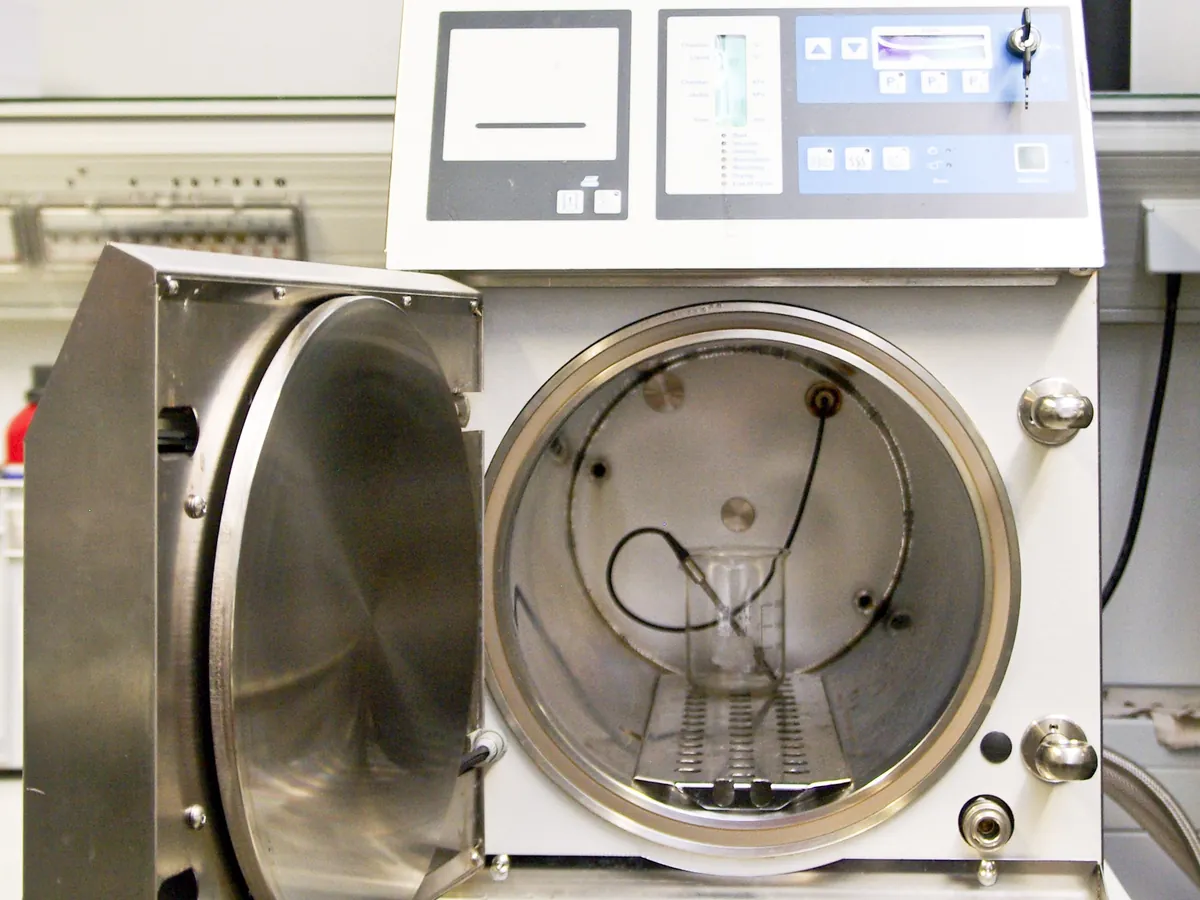
Autoclave (steam steriliser)
Kills microorganisms, including bacterial spores, with saturated steam under pressure. Used in the QC microbiology lab to sterilise culture media, glassware and equipment, and to decontaminate used media before disposal.
- Pharmaceutical
- Biotech
- Hospitals
- Food & beverage
- Research laboratories
- Medical devices
Test your Autoclave knowledge
Multiple-choice questions
Pick an answer to see whether you are right and why.
Q1. What is a typical autoclave cycle for sterilising culture media?
basicQ2. Why does saturated steam sterilise more effectively than dry air at the same temperature?
basicQ3. Which organism is used in biological indicators for steam sterilisation?
basicQ4. What does the Bowie-Dick test check?
intermediateQ5. The F0 value of a cycle is expressed as:
intermediateQ6. During heat penetration studies, where is the cold spot usually found in a liquid load?
intermediateQ7. A cold spot holds 122.1 °C for 1 minute. Approximately how much F0 does that minute add?
advancedQ8. Why are liquid loads run on a cycle with slow exhaust?
advanced
Viva questions
Think of your answer first, then open it to compare.
1. Why should clean media and used cultures not be autoclaved in the same load?
Sterilisation and decontamination have different purposes and validated cycles. Mixing them risks cross-contamination of clean media if the cycle fails, and blurs traceability. Many labs use separate autoclaves or at least separate, labelled cycles.
2. Explain the difference between gravity displacement and pre-vacuum autoclaves.
In gravity displacement, steam entering the chamber pushes the heavier air out through the bottom drain; it suits liquids and simple solid items. In pre-vacuum, a pump removes air in several pulses before steam is admitted, which is needed for porous and wrapped loads where air would otherwise be trapped. Pre-vacuum autoclaves need a daily Bowie-Dick test.
3. A biological indicator shows growth after a validated cycle. What do you do?
Treat the load as not sterile and quarantine it. Check the positive and negative controls and the BI handling to rule out a test error, and identify the organism. Review the cycle record, air removal, load pattern and the temperature data at that position. Raise a deviation, correct the cause and repeat the challenge before using the cycle again.
4. What is the relationship between pressure and temperature in an autoclave, and why is it checked?
For saturated steam, each pressure corresponds to one temperature (about 1.05 bar gauge at 121 °C). If the measured temperature is lower than expected for the pressure, air is probably present in the chamber, or one of the instruments is faulty.
Keep every Autoclave in control: usage logs, calibration and maintenance schedules, and automatic blocking of overdue instruments.