Laboratory Water Purification System
Produces purified and ultrapure water for the laboratory by combining pretreatment, reverse osmosis, ion exchange, UV and final filtration. Supplies water for HPLC mobile phases, standards, reagents and microbiology.
- Pharmaceutical
- Biotech
- Clinical labs
- Universities
- Environmental
- Food & beverage
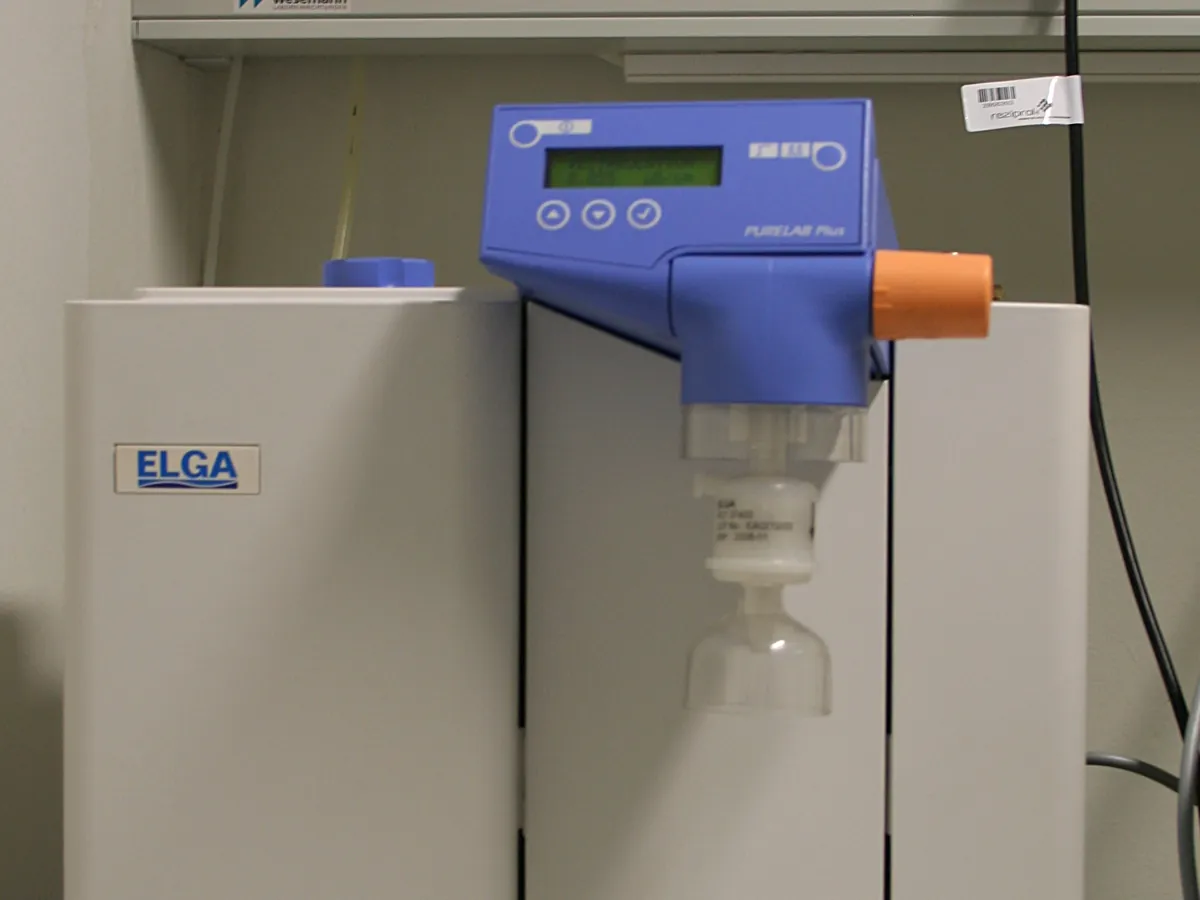
What is Lab water system?
Almost every QC test uses water: to make mobile phases, buffers, standards and media, and to rinse glassware. Tap water contains salts, organics, particles, bacteria and dissolved gases, so it must be purified. A laboratory water purification system does this at the point of use.
Most systems work in two stages. A first stage, often reverse osmosis (RO) with electrodeionisation or ion exchange, produces 'pure' water (often called Type 2 or Type 3) that is stored in a reservoir. A second 'polishing' stage takes this water through ion-exchange cartridges, UV oxidation and a final filter to give ultrapure (Type 1) water on demand.
The system monitors its own water quality, usually resistivity (MΩ·cm at 25 °C) and often TOC. Lab water used for QC tests is different from the plant's pharmaceutical purified water system, which is a validated GMP utility covered by USP <1231> and the water monographs. Lab grade water is usually specified against ISO 3696 or ASTM D1193.
Used for
- HPLC and LC-MS mobile phases and diluents
- Preparation of standards, reagents and volumetric solutions
- Reagent water for TOC and conductivity standards
- Culture media and microbiology reagents (with suitable filtration)
- Final rinsing of laboratory glassware
- Feed water for autoclaves, stability chambers and humidifiers
How it works
- 01
Pretreatment
Particle filter and activated carbon remove sediment, chlorine and some organics.
- 02
Reverse osmosis
A semi-permeable membrane under pressure rejects most dissolved salts, organics and microbes.
- 03
Storage
RO or Type 2 water is held in a protected reservoir with a vent filter.
- 04
Polishing
Ion-exchange resins and UV oxidation (often at 185/254 nm) remove trace ions and organics.
- 05
Final filtration
A point-of-use filter (for example 0.22 µm) removes particles and bacteria at dispensing.
- 06
Monitoring
Resistivity and TOC are measured and displayed continuously.
Advantages
- Water of consistent quality on demand
- Built-in monitoring of resistivity and TOC
- Removes ions, organics, particles and bacteria in one unit
- Lower cost and less handling than buying bottled water
Limitations
- Water quality falls quickly once dispensed; ultrapure water picks up CO₂ and contaminants from air and containers
- Consumables (cartridges, filters, UV lamps) must be changed on time
- Stored water in the reservoir can support bacterial growth if not sanitised
- Resistivity does not detect non-ionic contaminants; TOC and microbial checks are also needed
Methods that use Lab water system
Keep every Lab water system in control: usage logs, calibration and maintenance schedules, and automatic blocking of overdue instruments.