Laboratory Water Purification System
Produces purified and ultrapure water for the laboratory by combining pretreatment, reverse osmosis, ion exchange, UV and final filtration. Supplies water for HPLC mobile phases, standards, reagents and microbiology.
- Pharmaceutical
- Biotech
- Clinical labs
- Universities
- Environmental
- Food & beverage
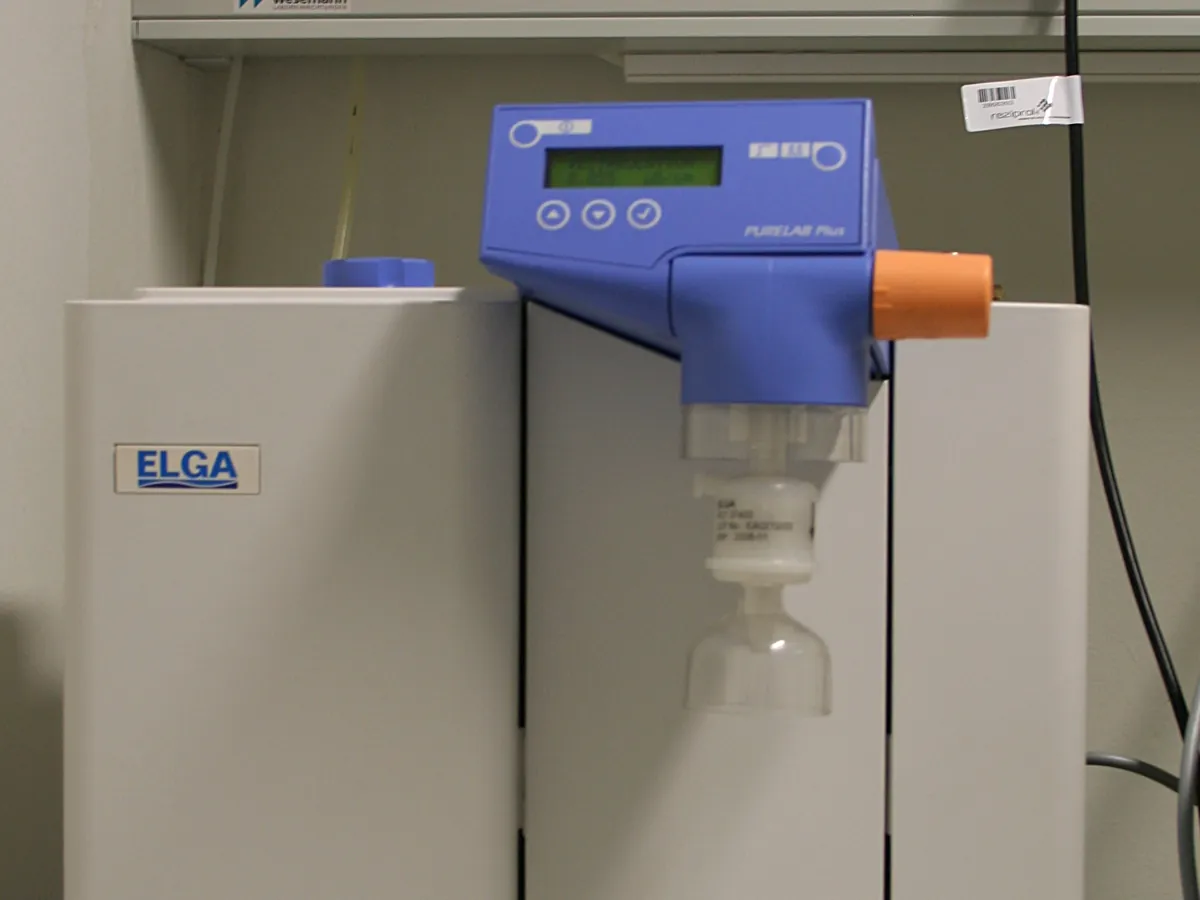
How Lab water system works
Water passes through a series of purification steps, each removing different contaminants. Pretreatment removes particles and chlorine, reverse osmosis removes most ions and organics, ion exchange or electrodeionisation removes remaining ions, UV light breaks down organics and kills bacteria, and a final membrane filter removes particles and bacteria. Resistivity and TOC sensors monitor the product water.
The path of a sample
- 01
Pretreatment
Particle filter and activated carbon remove sediment, chlorine and some organics.
- 02
Reverse osmosis
A semi-permeable membrane under pressure rejects most dissolved salts, organics and microbes.
- 03
Storage
RO or Type 2 water is held in a protected reservoir with a vent filter.
- 04
Polishing
Ion-exchange resins and UV oxidation (often at 185/254 nm) remove trace ions and organics.
- 05
Final filtration
A point-of-use filter (for example 0.22 µm) removes particles and bacteria at dispensing.
- 06
Monitoring
Resistivity and TOC are measured and displayed continuously.
Main parts and what they do
Pretreatment cartridge
Removes particles, chlorine and some organics to protect the RO membrane.
Reverse osmosis module
Main purification step for the feed water.
Reservoir with vent filter
Stores pure water; the vent filter stops airborne contamination.
Ion-exchange / polishing cartridges
Remove trace ions to reach high resistivity.
UV lamp
Oxidises organics and reduces bacteria.
Resistivity and TOC monitors
Measure product water quality continuously.
Point-of-use filter
Final 0.22 µm or ultrafilter that removes particles, bacteria and, for ultrafilters, endotoxins.
Terms every analyst should know
Resistivity
The reciprocal of conductivity. Theoretical pure water at 25 °C is about 18.2 MΩ·cm; any dissolved ions lower it.
Water grades
ISO 3696 defines grades 1, 2 and 3; ASTM D1193 defines Types I–IV. Type 1 / grade 1 water is used for the most sensitive work such as HPLC and trace analysis.
Reverse osmosis
Pressure forces water through a membrane that holds back most ions and larger molecules. Typical rejection of dissolved ions is above 95%.
Electrodeionisation (EDI)
Ion-exchange resins regenerated continuously by an electric field, so no chemical regeneration is needed.
Lab water versus GMP water
Purified water and water for injections are made by validated plant systems and tested against pharmacopoeial monographs. Lab water systems supply reagent-grade water for analysis.
Keep every Lab water system in control: usage logs, calibration and maintenance schedules, and automatic blocking of overdue instruments.