In vitro SPF analyser (UV transmittance analyser)
Measures how much ultraviolet light passes through a thin film of sunscreen spread on a roughened PMMA plate, then calculates in vitro SPF, UVA protection factor and critical wavelength from the transmittance spectrum.
- Cosmetics & personal care
- Sunscreen manufacturers
- UV filter suppliers
- Contract testing labs
- Textiles (UV protection)
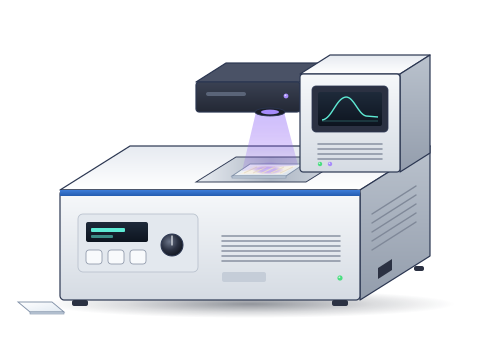
How SPF analyser works
A thin product film on a roughened PMMA plate is illuminated with UV light from 290 to 400 nm. The transmitted light, including scattered light collected by an integrating sphere, is compared with light through a blank plate to give transmittance T(λ). SPF is the ratio of the erythemally weighted UV dose without the film to that with the film; UVA-PF uses a UVA-specific action spectrum. The critical wavelength is where 90% of the area under the absorbance curve (290–400 nm) has been reached.
The path of a sample
- 01
Reference blank
A PMMA plate coated with a thin layer of glycerine or a similar non-absorbing liquid is measured to set 100% transmittance.
- 02
Apply product
The product is weighed onto the plate at the specified dose and spread evenly with a fingertip (gloved, pre-saturated) or robot.
- 03
Dry
The film is left to settle, typically about 15–30 minutes in the dark at room temperature.
- 04
Scan
Transmittance is measured from 290 to 400 nm in 1 nm steps at several spots on each plate.
- 05
Irradiate (optional)
For UVA-PF the plate is exposed to a defined dose from a solar simulator and scanned again.
- 06
Calculate
Software weights transmittance with action spectra and the reference sun spectrum to give SPF, UVA-PF and critical wavelength.
Main parts and what they do
UV light source
Pulsed xenon or deuterium/xenon lamp giving continuous output from 290 to 400 nm.
Monochromator / spectrometer
Separates wavelengths (typically 1 nm resolution) and measures intensity at each.
Integrating sphere or diffuser
Collects transmitted and scattered light so that scattering films are measured correctly.
Sample stage
Holds the PMMA plate; often motorised to scan several positions per plate.
PMMA plates
Moulded or sandblasted plates of defined roughness that carry the product film.
Solar simulator (separate or built-in)
Delivers a controlled UV dose for photostability pre-irradiation in UVA-PF testing.
Software
Stores spectra, applies action spectra and sun spectra, calculates SPF, UVA-PF, ratios and critical wavelength, and keeps an audit trail.
Terms every analyst should know
Transmittance and absorbance
T(λ) is the fraction of light that passes through the film. Absorbance A(λ) = −log₁₀ T(λ). A film with T = 0.05 (5%) has A = 1.30.
Erythemal action spectrum
A standard curve (CIE) that weights each UV wavelength by how strongly it causes sunburn. UVB around 300 nm is weighted far more than UVA.
Reference sun spectrum
A standard spectral irradiance of midday sunlight used so that results from different labs and lamps are comparable.
SPF calculation
SPF = Σ E(λ)·S(λ) ÷ Σ E(λ)·S(λ)·T(λ). If the weighted dose reaching the skin is cut to 1/20, SPF = 20.
UVA-PF
Calculated like SPF but with the persistent pigment darkening (PPD) action spectrum and a UVA source spectrum, 320–400 nm. ISO 24443 scales the curve to the in vivo SPF first.
Critical wavelength
The wavelength below which 90% of the integrated absorbance from 290 nm lies. A higher value means more even protection across UVB and UVA.
PMMA plates
Polymethyl methacrylate plates with a controlled surface roughness that mimics skin texture. Roughness strongly affects how the film spreads.
Keep every SPF analyser in control: usage logs, calibration and maintenance schedules, and automatic blocking of overdue instruments.