Soxhlet / fat extraction system
Extracts fat from a dried, ground food sample with a repeatedly recycled organic solvent. The solvent is then evaporated and the fat left behind is weighed.
- Food & beverage
- Animal feed
- Oilseeds and edible oils
- Agriculture
- Academic research
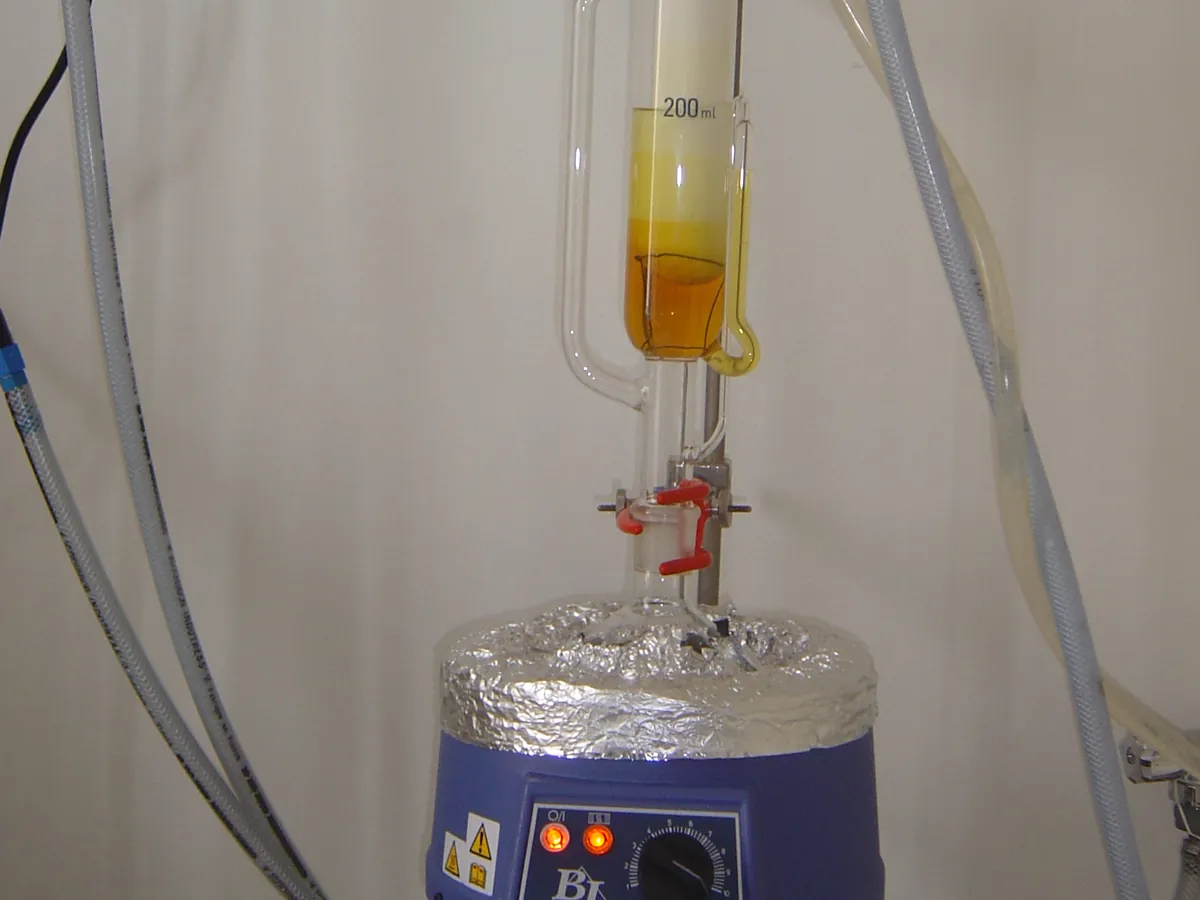
How Soxhlet works
Fat dissolves in non-polar solvents. A dried, ground sample is extracted repeatedly with fresh condensed solvent. The fat collects in the pre-weighed flask, the solvent is evaporated, and the increase in flask mass is the fat in the sample.
The path of a sample
- 01
Prepare sample
Dry and grind the food; hydrolyse with hydrochloric acid first if total fat is needed.
- 02
Load thimble
Weigh the sample into a cellulose thimble and plug it with fat-free cotton.
- 03
Extract
Boiling solvent condenses onto the thimble, dissolves fat and siphons back to the flask, cycle after cycle.
- 04
Recover solvent
Most solvent is distilled off and collected for reuse or disposal.
- 05
Dry flask
Remove the last traces of solvent in an oven, cool in a desiccator.
- 06
Weigh
The mass gained by the flask is the extracted fat.
Main parts and what they do
Boiling flask or extraction cup
Holds the solvent and collects the extracted fat. It is pre-dried and weighed.
Extraction chamber with siphon
Holds the thimble; when it fills to the siphon height, solvent and fat drain back to the flask.
Cellulose thimble
Porous holder for the sample that lets solvent through but keeps solids in.
Condenser
Water-cooled condenser that turns solvent vapour back to liquid above the thimble.
Heating mantle or hot plate
Boils the solvent at a controlled rate, without open flames.
Solvent recovery system (automated units)
Collects distilled solvent at the end of extraction so it can be reused.
Chiller or cooling water supply
Keeps the condenser cold so solvent is not lost.
Terms every analyst should know
Crude fat / ether extract
Everything the solvent extracts: triglycerides plus small amounts of free fatty acids, sterols, pigments and waxes.
Siphon cycle
One fill-and-empty of the extraction chamber. Classic methods specify a rate, for example several cycles per hour, for a set number of hours.
Bound vs free fat
Free fat is extracted directly. Bound fat in protein or starch matrices is released only after acid hydrolysis.
Solvent choice
Petroleum ether (boiling range about 40–60 °C) extracts fewer non-fat substances; diethyl ether extracts more but forms peroxides and absorbs water.
Constant mass
The fat flask is dried and weighed until two weighings agree within the limit in the method.
Keep every Soxhlet in control: usage logs, calibration and maintenance schedules, and automatic blocking of overdue instruments.