Refrigerator / deep freezer
Pharmaceutical-grade cold storage for reference standards, reagents, culture media, samples and temperature-sensitive products, typically at 2–8 °C (refrigerator), −20 °C (freezer) or −80 °C (ultra-low).
- Pharmaceutical
- Biotech
- Hospitals & blood banks
- Clinical research
- Food testing
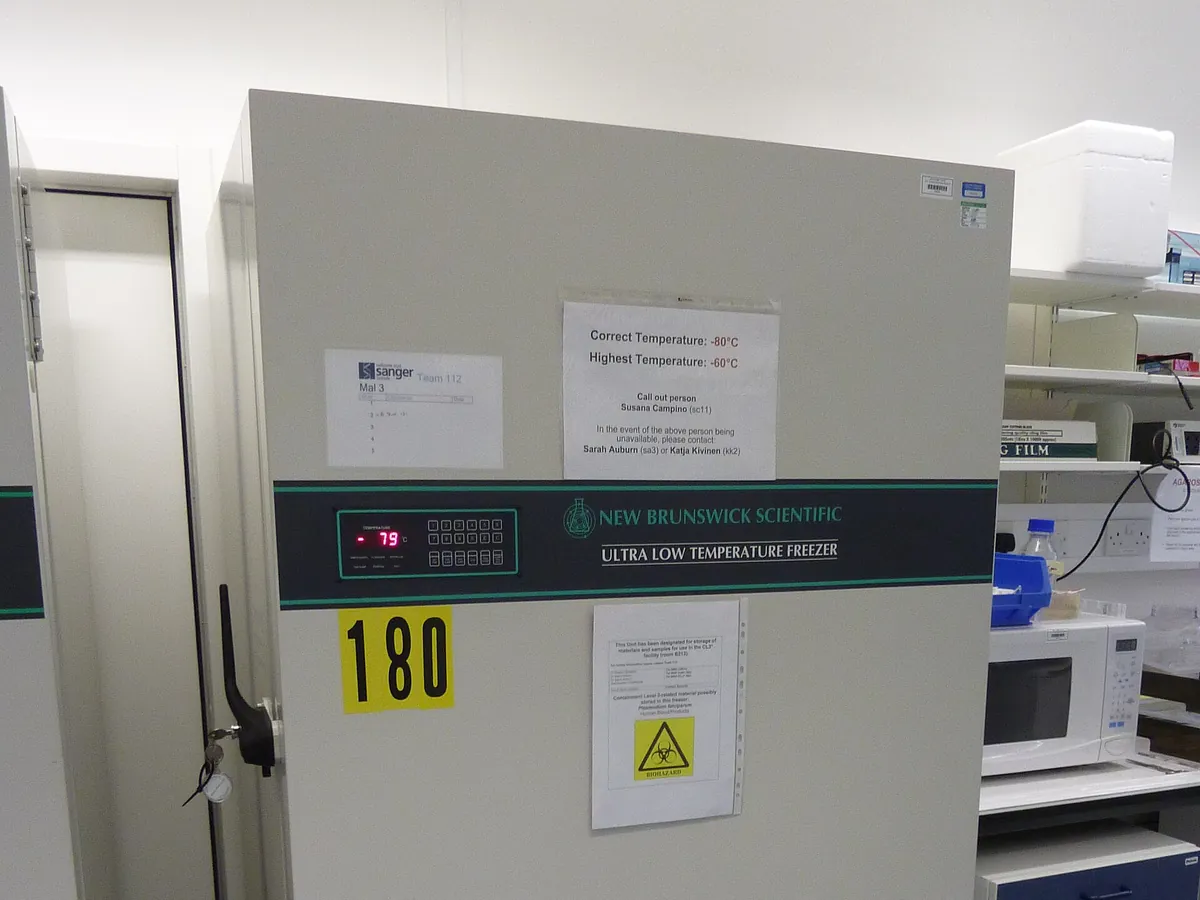
How Fridge / freezer works
A vapour-compression refrigeration cycle pumps heat out of the insulated cabinet. A refrigerant evaporates in the evaporator coil inside the cabinet, absorbing heat, and condenses in the condenser outside, releasing it to the room. A thermostat or controller switches the compressor to hold the set point.
The path of a sample
- 01
Compression
The compressor raises the pressure and temperature of the refrigerant vapour.
- 02
Condensation
The hot vapour gives up heat to the room in the condenser and becomes liquid.
- 03
Expansion
The liquid passes through an expansion valve or capillary, and its pressure and temperature drop.
- 04
Evaporation
Inside the cabinet the cold refrigerant evaporates and absorbs heat from the air.
- 05
Circulation and control
A fan spreads the cold air evenly; the controller cycles the compressor to keep the set temperature.
Main parts and what they do
Insulated cabinet and door
Keeps heat out; solid or glass door with a magnetic gasket and often a lock.
Compressor and condenser
Pump heat out of the cabinet and release it to the room.
Evaporator and fan
Absorb heat inside the cabinet and circulate cold air evenly.
Controller and display
Hold the set point and display the temperature; often with min/max memory.
Alarm system
Audible and remote alarms for high or low temperature, door open and power failure.
Data logger port / probe
Lets an independent calibrated logger record temperature continuously, often in a glycol bottle to buffer short air spikes.
Shelves and drawers
Hold material with space for air to circulate.
Terms every analyst should know
Storage ranges
Refrigerator 2–8 °C; freezer typically −25 °C to −10 °C; ultra-low around −80 °C. Use the range stated on the product label.
Temperature mapping
Logging temperature at many positions to find warm and cold spots and define where material may be stored.
Excursion
A period outside the allowed range. Its size and duration are compared with stability data to decide whether material is still usable.
Recovery time
How long the unit takes to return within range after a door opening; measured during qualification.
Mean kinetic temperature
A single calculated temperature that expresses the overall thermal effect of fluctuating storage temperatures. Used when assessing excursions.
Keep every Fridge / freezer in control: usage logs, calibration and maintenance schedules, and automatic blocking of overdue instruments.