Osmometer
Measures the osmolality of a solution, the total concentration of dissolved particles, usually by how much the solution's freezing point is lowered. Used for injections, eye drops and infusion fluids.
- Pharmaceutical
- Biotech
- Clinical laboratories
- Food & beverage
- Academic research
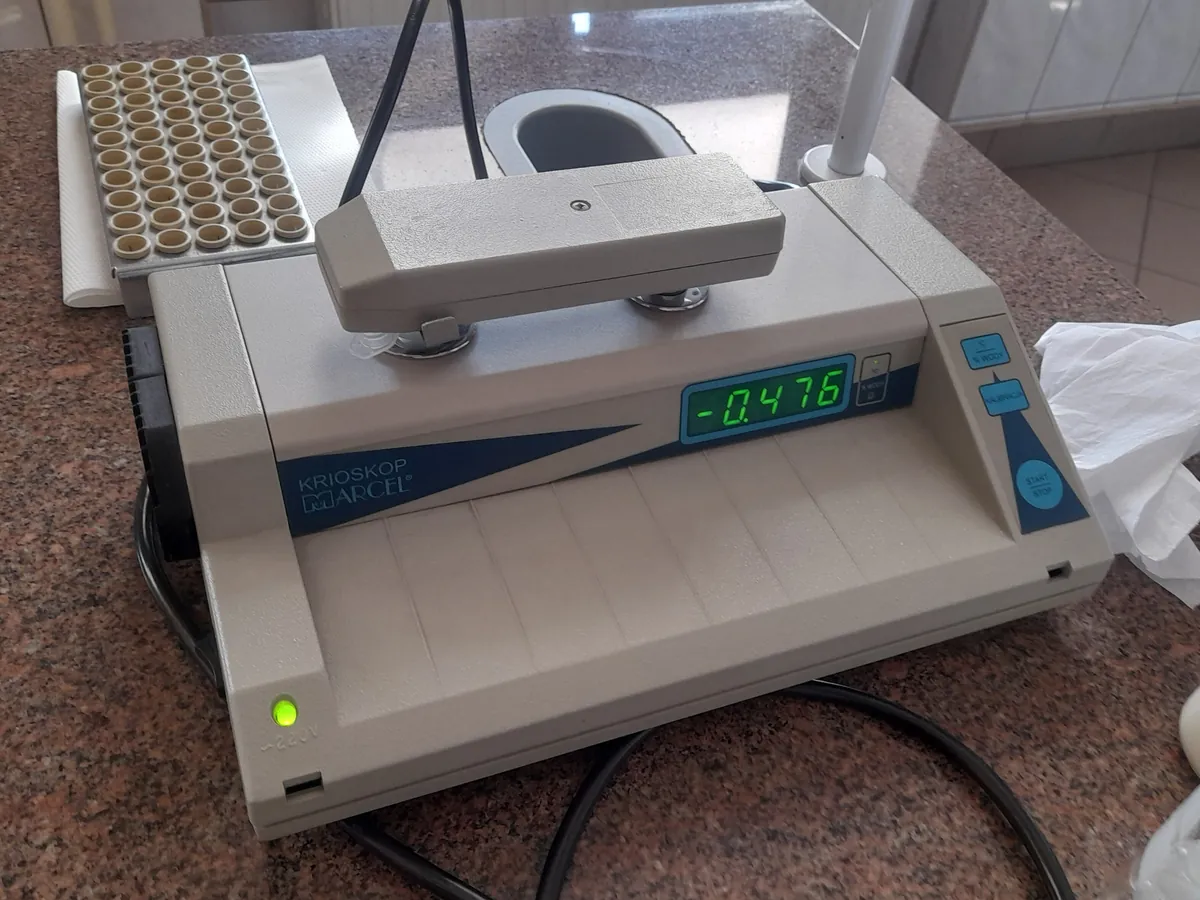
What is Osmometer?
Osmolality is the number of osmotically active particles (molecules and ions) per kilogram of water, reported in mOsm/kg. Body fluids such as blood plasma typically have an osmolality of around 280–300 mOsm/kg. Injections, infusions and eye drops are often made close to this value (isotonic) so they do not damage cells or cause pain.
Dissolved particles lower the freezing point of water. Each osmole of particles per kilogram of water lowers it by about 1.86 °C. A freezing-point osmometer supercools a small sample, starts freezing, and measures the temperature at which ice and liquid are in balance. The instrument converts this freezing point into osmolality.
Other designs exist: vapour pressure osmometers measure the dew point above the sample, and membrane osmometers measure the colloid osmotic pressure of proteins. Pharmacopoeial tests for parenterals and ophthalmics usually use the freezing-point method.
Used for
- Osmolality of injections and infusion fluids
- Tonicity of eye drops and nasal solutions
- In-process checks during compounding of parenteral solutions
- Development of isotonic formulations
- Cell culture media and biological buffers
- Clinical testing of serum and urine
How it works
- 01
Pipette
A small, fixed volume of sample is pipetted into a clean sample tube.
- 02
Supercool
The sample is cooled below its freezing point in a cooling block without freezing.
- 03
Induce freezing
Vibration, a seeding wire or a cold probe starts ice formation.
- 04
Plateau
Heat of fusion warms the sample to a stable plateau, the freezing point.
- 05
Measure
A thermistor measures the plateau temperature very precisely.
- 06
Convert
The instrument converts the freezing point depression into mOsm/kg using its calibration line.
Advantages
- Small sample volume, often 20–250 µL
- Fast: one result in a few minutes
- Measures all dissolved particles together, regardless of what they are
- Simple operation with automated freezing and calculation
- Directly linked to physiological tonicity
Limitations
- Does not identify which substances are present
- Volatile solutes (such as ethanol) affect freezing point but not tonicity in the body in the same way
- Very viscous samples or samples with particles may not freeze reproducibly
- Needs careful pipetting and clean sample tubes; small errors matter
- Accuracy is best within the range covered by the calibration standards
1 calibration procedure
Methods that use Osmometer
Keep every Osmometer in control: usage logs, calibration and maintenance schedules, and automatic blocking of overdue instruments.