Osmometer
Measures the osmolality of a solution, the total concentration of dissolved particles, usually by how much the solution's freezing point is lowered. Used for injections, eye drops and infusion fluids.
- Pharmaceutical
- Biotech
- Clinical laboratories
- Food & beverage
- Academic research
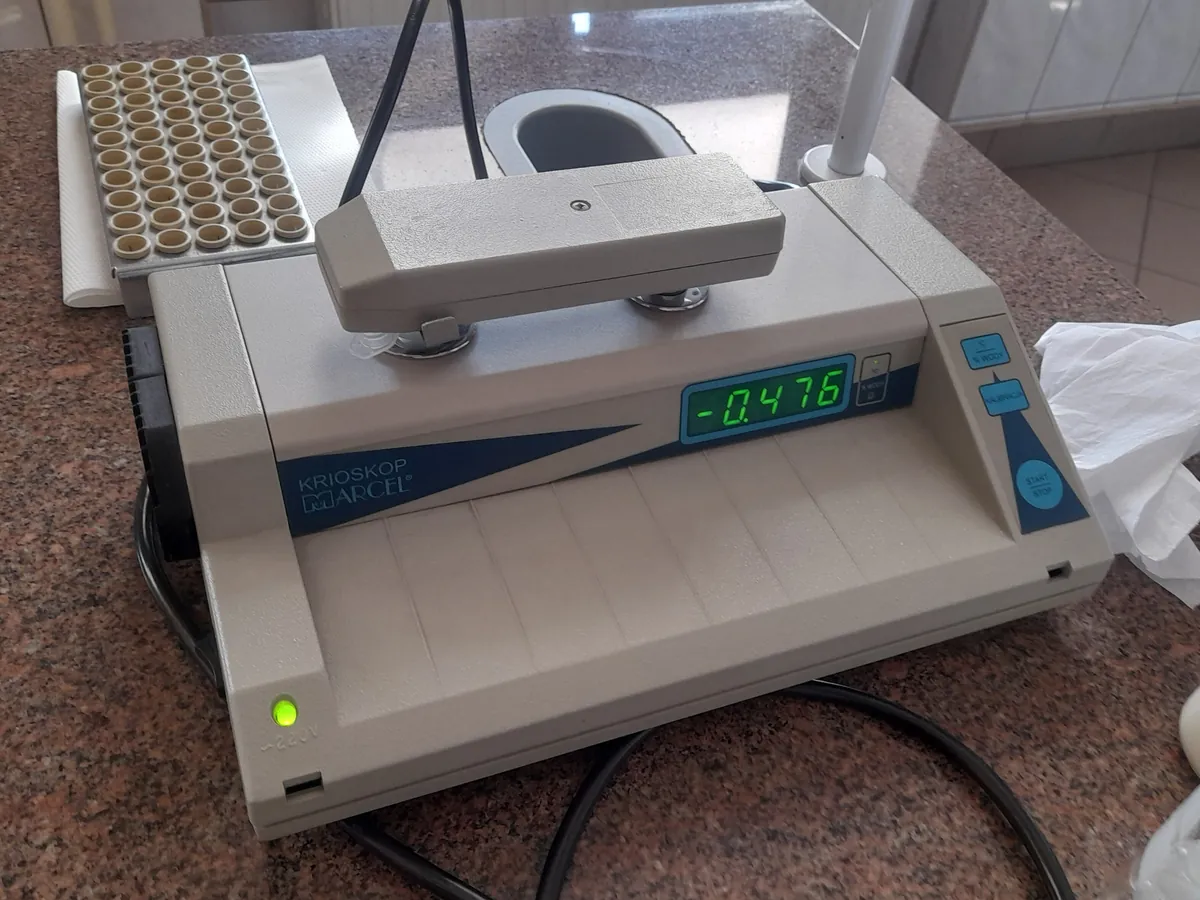
How Osmometer works
A freezing-point osmometer cools the sample below its freezing point (supercooling) and then starts crystallisation, often by a mechanical vibration or seeding probe. The heat released by freezing warms the sample to a plateau, the true freezing point, where ice and liquid coexist. A thermistor measures this temperature. Osmolality is proportional to the freezing point depression: ΔTf = 1.86 × osmolality (in osmol/kg).
The path of a sample
- 01
Pipette
A small, fixed volume of sample is pipetted into a clean sample tube.
- 02
Supercool
The sample is cooled below its freezing point in a cooling block without freezing.
- 03
Induce freezing
Vibration, a seeding wire or a cold probe starts ice formation.
- 04
Plateau
Heat of fusion warms the sample to a stable plateau, the freezing point.
- 05
Measure
A thermistor measures the plateau temperature very precisely.
- 06
Convert
The instrument converts the freezing point depression into mOsm/kg using its calibration line.
Main parts and what they do
Cooling block
Thermoelectric (Peltier) block that cools the sample to below its freezing point.
Thermistor probe
Very sensitive temperature sensor dipped into the sample to measure the freezing plateau.
Freeze-induction device
Vibrating wire, stirring wire or seeding probe that starts crystallisation at the right moment.
Sample tubes
Small disposable tubes for a fixed volume of sample.
Precision pipette
Delivers the exact sample volume the instrument needs; volume affects the cooling curve.
Electronics and software
Control the cooling cycle, store the calibration and calculate osmolality.
Printer / data interface
Records results with date, time and sample ID.
Terms every analyst should know
Osmolality
Osmoles of solute particles per kilogram of water (mOsm/kg). This is what an osmometer measures.
Osmolarity
Osmoles per litre of solution (mOsm/L). It is often calculated from the formula and is close to, but not the same as, osmolality.
Freezing point depression
Dissolved particles lower the freezing point of water by about 1.86 °C per osmol/kg (the cryoscopic constant of water).
Isotonic
Having about the same osmolality as body fluids, typically around 280–300 mOsm/kg. Hypotonic is lower, hypertonic is higher.
Osmotic coefficient
A correction because ions do not behave completely independently. For 0.9% sodium chloride, the measured osmolality (about 286 mOsm/kg) is lower than the value of about 308 calculated from the formula assuming full dissociation.
Keep every Osmometer in control: usage logs, calibration and maintenance schedules, and automatic blocking of overdue instruments.