Osmometer · Calibration procedure
Calibration with osmolality standards
Calibrates the osmometer with certified sodium chloride osmolality standards that bracket the working range, then checks it with a reference solution.
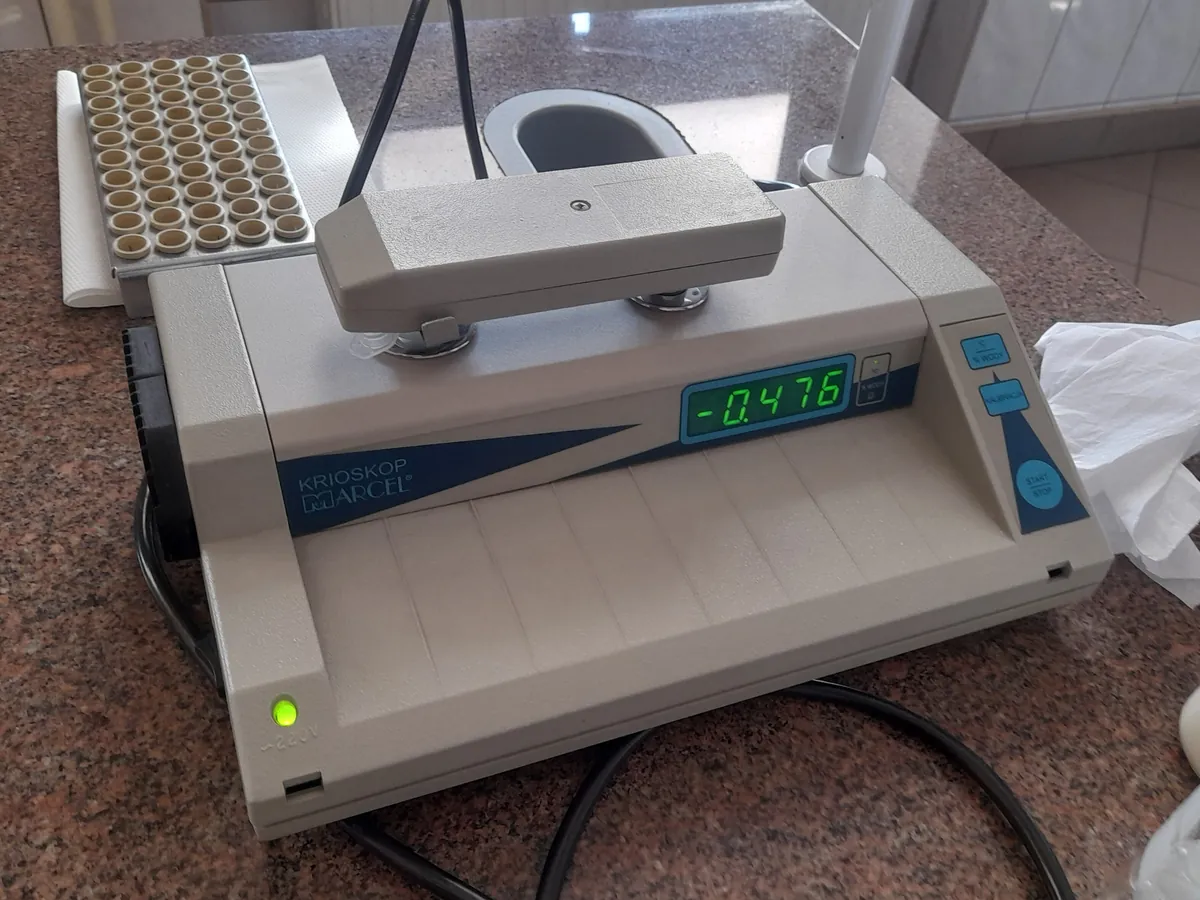
PURPOSE
Why this is checked
The osmometer turns a freezing point into mOsm/kg using its calibration line. Calibrating with certified standards makes sure the conversion is correct over the range used for products.
Frequency
Typically every 6 or 12 months, after repair or probe replacement, or when the reference check fails. A reference check is usually run daily. As defined in your SOP.
Learn how the Osmometer worksYOU WILL NEED
Standards & tools
- Certified osmolality standards (usually sodium chloride in water), e.g. 100 mOsm/kg and 500 mOsm/kg (or as the manufacturer specifies), plus a 290 mOsm/kg reference solution
- Calibrated precision pipette
BEFORE YOU START
Prerequisites
- Instrument at operating temperature
- Probe clean and dry
- Fresh ampoules of standards within expiry; opened ampoules used straight away
PROCEDURE
Step by step
- 1Enter the calibration mode.
- 2Measure the low standard (e.g. 100 mOsm/kg) as the instrument directs; repeat if the software requires.
- 3Measure the high standard (e.g. 500 mOsm/kg).
- 4Accept the calibration when the software confirms it.
- 5Measure the 290 mOsm/kg reference solution in triplicate as a check.
- 6Measure each standard again as a sample to confirm accuracy, if your SOP requires.
RECORD
Example observation table
| Standard (mOsm/kg) | Reading 1 | Reading 2 | Reading 3 | Mean | Difference | Result |
|---|---|---|---|---|---|---|
| 100 | 101 | 100 | 101 | 100.7 | +0.7 | Pass |
| 290 (reference) | 289 | 290 | 289 | 289.3 | −0.7 | Pass |
| 500 | 498 | 499 | 500 | 499.0 | −1.0 | Pass |
CALCULATION
How to calculate the result
Difference = Mean reading − Certified value; expected freezing point depression ΔTf = 1.86 × osmolality (osmol/kg)
- 290 mOsm/kg reference: mean = (289 + 290 + 289) ÷ 3 = 289.3 mOsm/kg; difference = −0.7
- Expected ΔTf for 290 mOsm/kg = 1.86 × 0.290 = 0.539 °C
- 500 mOsm/kg standard: mean = 499.0; difference = −1.0
ACCEPTANCE CRITERIA
Pass if
- Each standard and the reference solution within the limit in your SOP, often based on the manufacturer's specification (for example within about ±2 mOsm/kg near 290 mOsm/kg, or ±0.5% to 1% at higher values).
- Repeatability within the manufacturer's specification.
IF IT FAILS
What to do
- Clean the probe, use fresh ampoules of standards and repeat the calibration.
- Check the pipette and the sample volume.
- If it still fails, call service and assess results since the last passing check.
In LimsPulse · Calibration Management
LimsPulse schedules this calibration, records the result against limits, and blocks the instrument everywhere if it fails or goes overdue.