Jar Test Apparatus
A bank of four to six paddle stirrers that mix identical water samples in beakers with different doses of coagulant, so the analyst can find the dose that gives the best floc formation and settling.
- Drinking water utilities
- Municipal and industrial wastewater treatment
- Chemical suppliers (coagulant trials)
- Paper, textile and mining industries
- Universities and training
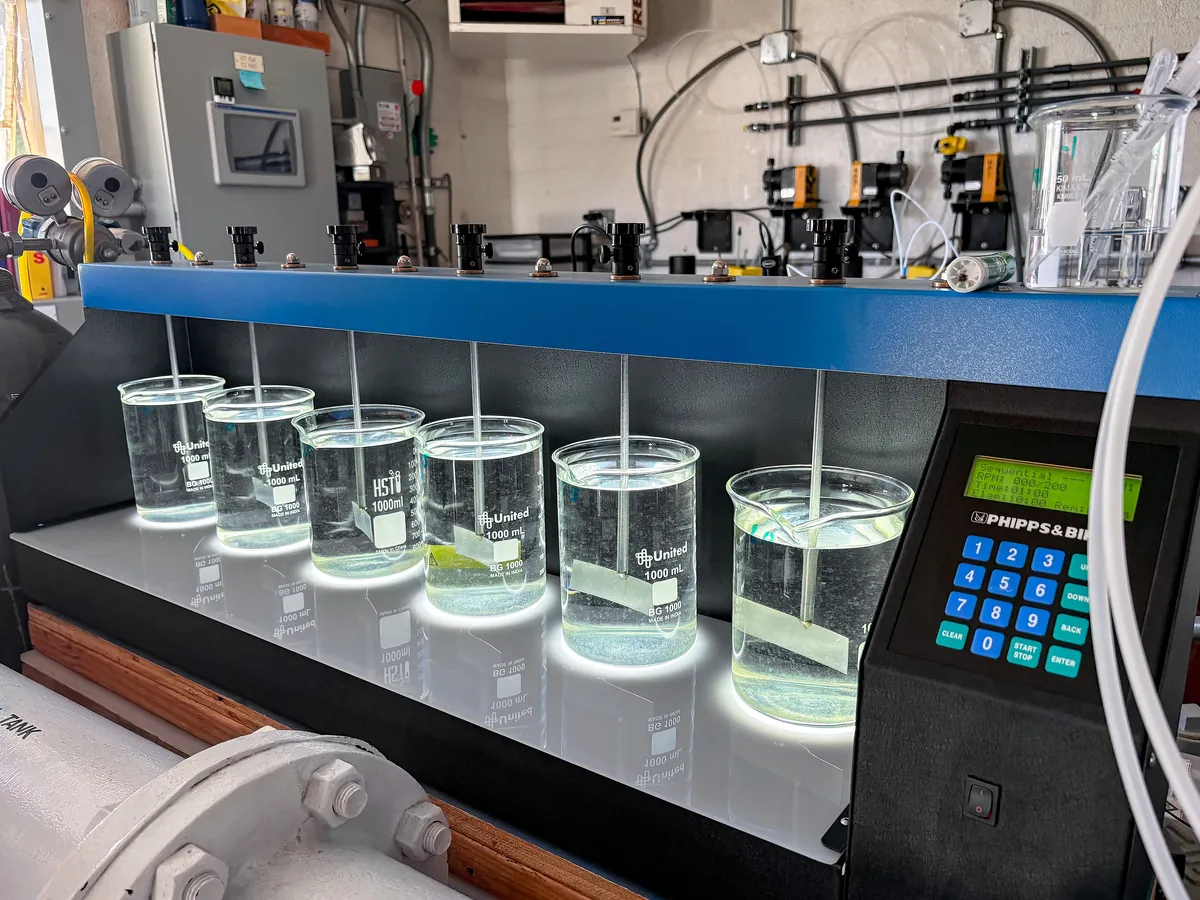
How Jar tester works
Coagulants neutralise the negative surface charge on colloidal particles. Rapid mixing spreads the coagulant quickly, slow mixing lets small particles collide and grow into flocs, and quiet settling lets the flocs fall out. The best dose gives the lowest settled turbidity with acceptable pH and residual coagulant.
The path of a sample
- 01
Fill jars
Equal volumes of raw water (commonly 1 L) go into each beaker.
- 02
Dose
Each jar receives a different coagulant dose, added at the same time.
- 03
Rapid mix
Paddles run fast (often 100–300 rpm) for about 1 minute to disperse the coagulant.
- 04
Slow mix (flocculation)
Speed is reduced (often 20–40 rpm) for 15–30 minutes to grow flocs.
- 05
Settle and measure
Paddles stop; after settling (often 15–30 minutes), the clear water is sampled for turbidity, pH and other tests.
Main parts and what they do
Multi-position stirrer frame
Holds four to six paddles at the same height and spacing.
Paddles and shafts
Flat stainless steel or coated paddles that mix each jar identically.
Motor and speed controller
Drives all paddles at a set speed, often with a digital display and programmable steps.
Beakers or square jars
Hold the water samples; square jars reduce swirling and give more uniform mixing.
Illuminated base
Lights the jars from below so floc formation is easy to observe.
Dosing rack (optional)
Holds syringes or tubes so all doses are added at the same moment.
Timer
Controls the rapid mix, slow mix and settling stages.
Terms every analyst should know
Coagulation
Destabilising colloids by neutralising their surface charge, usually with a metal salt that forms positively charged hydrolysis products.
Flocculation
Gentle mixing that brings destabilised particles together into larger, settleable flocs. Polymers can act as flocculant aids.
Velocity gradient (G)
A measure of mixing intensity in s⁻¹. Jar test speeds are often chosen to match the G value of the plant's mixers, using the paddle and jar geometry.
Alkalinity and pH
Alum and ferric salts consume alkalinity and lower pH. Each coagulant works best in a certain pH range, so pH is checked in each jar.
Optimum dose
The lowest dose that gives the target settled turbidity. Overdosing can re-stabilise particles and increase residual metal.
Keep every Jar tester in control: usage logs, calibration and maintenance schedules, and automatic blocking of overdue instruments.