High-Performance Thin-Layer Chromatography (HPTLC)
An instrumental, standardised form of TLC that uses fine-particle plates, automated band application, controlled development and densitometric scanning. Widely used for herbal identification fingerprints and semi-quantitative or quantitative assays.
- Pharmaceutical
- Herbal and nutraceutical
- Food & cosmetics
- Forensic
- Academic research
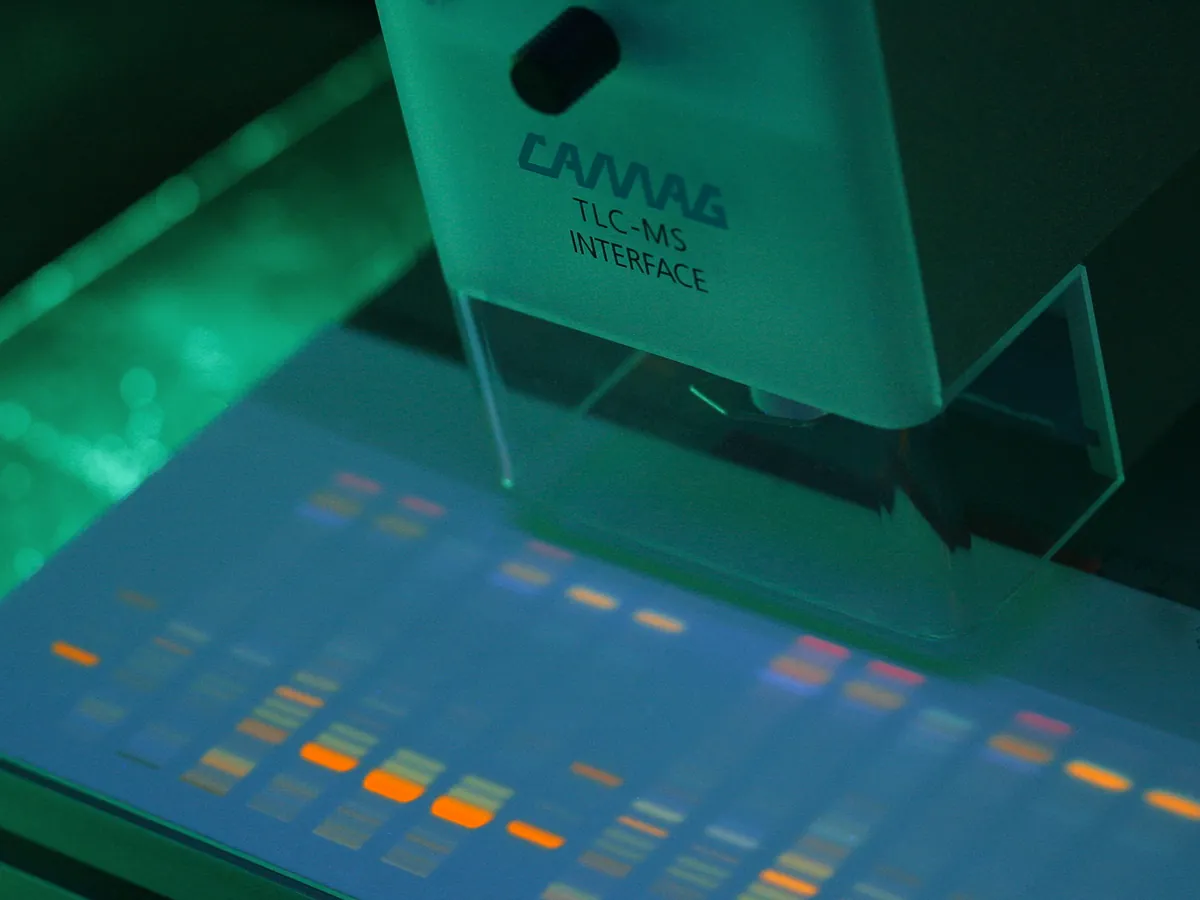
How HPTLC works
Separation is by adsorption (on silica gel) or partition (on modified layers) as the mobile phase moves up the plate by capillary action. Each compound has a characteristic retardation factor (Rf). After development, zones are made visible under UV light or with a derivatisation reagent and measured by a densitometer, which scans each track and records absorbance or fluorescence against position.
The path of a sample
- 01
Plate preparation
HPTLC silica gel 60 F254 plates are pre-washed and activated if the method requires.
- 02
Band application
An automatic applicator sprays defined volumes as narrow bands (e.g. 8 mm long) at fixed positions.
- 03
Development
The plate is developed in a twin-trough or automatic chamber with controlled saturation and humidity, to a fixed distance (e.g. 70 mm).
- 04
Drying and derivatisation
The plate is dried, then a reagent may be applied by dipping or spraying and the plate heated.
- 05
Documentation
Images are taken under UV 254 nm, UV 366 nm and white light.
- 06
Densitometry
A scanner measures each track; peak areas are used for comparison or quantitation against standards.
Main parts and what they do
HPTLC plates
Glass or aluminium plates with a thin, uniform layer of fine-particle silica gel (often with fluorescent indicator F254).
Automatic sample applicator
Applies precise volumes as narrow bands by spray-on technique under nitrogen.
Developing chamber (twin-trough or automatic)
Develops the plate with controlled saturation, humidity and migration distance.
Derivatisation device
Applies visualisation reagent evenly by dipping or spraying.
Plate heater
Heats the plate evenly after derivatisation to develop colours.
Visualiser / documentation system
Captures plate images under UV 254 nm, UV 366 nm and white light.
Scanning densitometer
Scans each track with deuterium, tungsten or mercury lamp to measure absorbance or fluorescence.
Software
Controls instruments, records parameters, evaluates Rf and peak areas, and keeps an audit trail.
Terms every analyst should know
Rf value
Distance moved by the zone divided by distance moved by the solvent front, measured from the application position.
Band application
Spraying samples as narrow bands rather than spots gives sharper zones and better resolution and quantitation.
Chamber saturation and humidity
Vapour saturation and the plate's water content strongly affect Rf; HPTLC controls both for reproducibility.
Fingerprint
The characteristic pattern of zones from a herbal sample, compared with a reference standard or reference extract.
Densitometry
Scanning the plate with a light beam to measure absorbance or fluorescence of each zone, turning the plate into a set of chromatograms.
System suitability on the plate
A reference mixture applied on each plate must give the specified zones and separation for the plate to be valid.
Keep every HPTLC in control: usage logs, calibration and maintenance schedules, and automatic blocking of overdue instruments.