High-Performance Thin-Layer Chromatography (HPTLC)
An instrumental, standardised form of TLC that uses fine-particle plates, automated band application, controlled development and densitometric scanning. Widely used for herbal identification fingerprints and semi-quantitative or quantitative assays.
- Pharmaceutical
- Herbal and nutraceutical
- Food & cosmetics
- Forensic
- Academic research
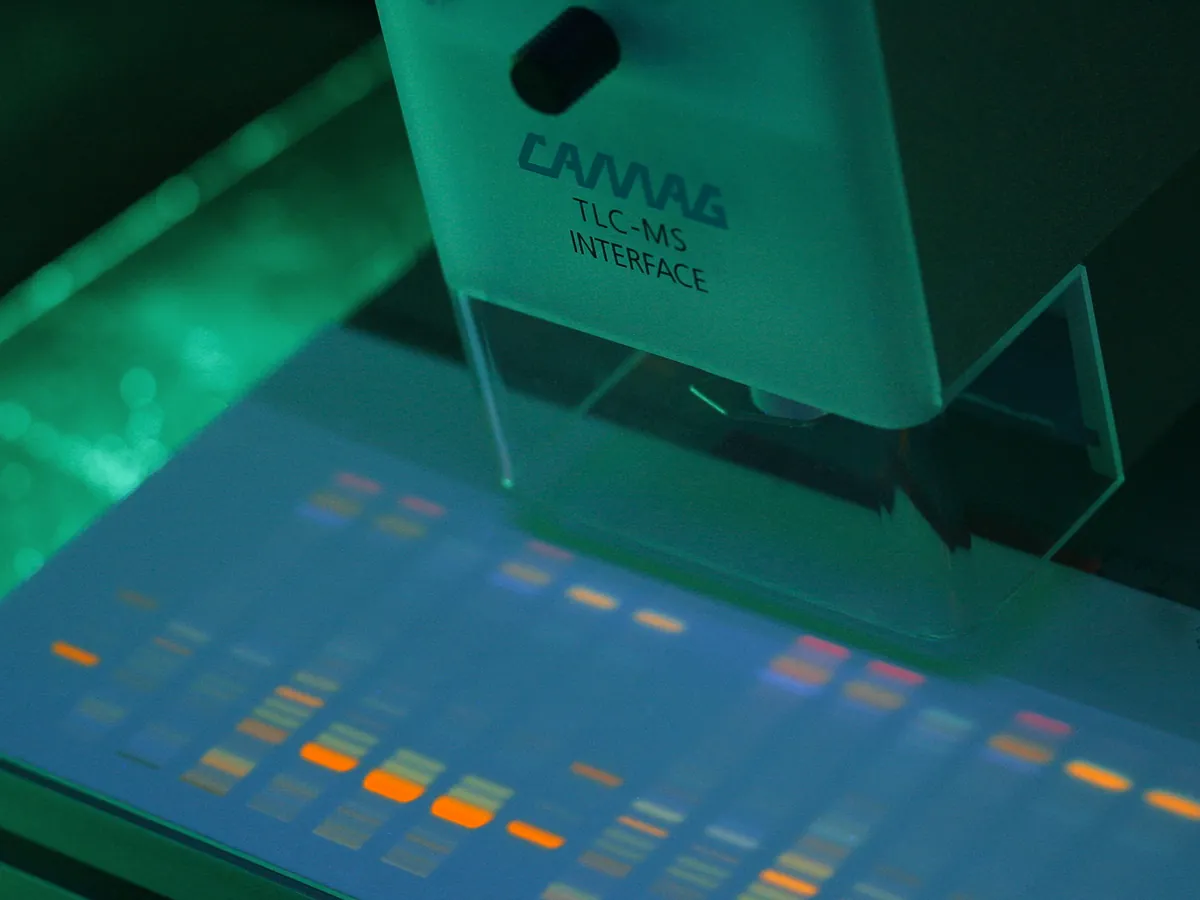
What is HPTLC?
HPTLC follows the same idea as ordinary TLC: samples are applied to a thin layer of adsorbent (usually silica gel) on a plate, the plate is developed in a solvent, and each component moves a characteristic distance. What makes it 'high performance' is the plate and the instruments. HPTLC plates use smaller, more uniform particles (about 5–6 µm compared with about 10–12 µm for TLC), which give sharper zones and better separation over a shorter distance.
Every step that is done by hand in classical TLC is controlled in HPTLC. Samples are sprayed on as narrow bands by an automatic applicator; the plate is developed in a twin-trough or automatic chamber with controlled saturation and humidity; reagents are applied by dipping or spraying devices; and the result is recorded with a calibrated imaging system and measured with a scanning densitometer.
Because many samples and standards run side by side on the same plate, under identical conditions, HPTLC is efficient for comparing samples. Pharmacopoeias use it as the identification method for many herbal drugs, where the pattern of bands (the fingerprint) is compared with that of a reference. It is also used for stability screening, cleaning verification and assays where a simple, low-cost method is enough.
Used for
- Identification of herbal drugs and extracts by fingerprint comparison
- Detection of adulteration and substitution in botanicals
- Assay of active ingredients by densitometric scanning
- Limit tests for related substances where the monograph uses TLC
- Screening of many samples in parallel (e.g. stability or cleaning samples)
- Effect-directed analysis with bioassays on the plate
How it works
- 01
Plate preparation
HPTLC silica gel 60 F254 plates are pre-washed and activated if the method requires.
- 02
Band application
An automatic applicator sprays defined volumes as narrow bands (e.g. 8 mm long) at fixed positions.
- 03
Development
The plate is developed in a twin-trough or automatic chamber with controlled saturation and humidity, to a fixed distance (e.g. 70 mm).
- 04
Drying and derivatisation
The plate is dried, then a reagent may be applied by dipping or spraying and the plate heated.
- 05
Documentation
Images are taken under UV 254 nm, UV 366 nm and white light.
- 06
Densitometry
A scanner measures each track; peak areas are used for comparison or quantitation against standards.
Advantages
- Many samples and standards run in parallel on one plate
- Low solvent use per sample and low running cost
- Plates are used once, so there is no carry-over between runs
- Whole result is visible as an image; plates can be re-examined with other reagents or light
- Simple sample preparation; crude extracts can be applied
Limitations
- Lower separation power than HPLC
- Sensitive to humidity, temperature and chamber saturation
- Quantitative precision is usually poorer than HPLC
- Needs standardised procedures to give reproducible results between labs
Keep every HPTLC in control: usage logs, calibration and maintenance schedules, and automatic blocking of overdue instruments.