High-Performance Thin-Layer Chromatography (HPTLC)
An instrumental, standardised form of TLC that uses fine-particle plates, automated band application, controlled development and densitometric scanning. Widely used for herbal identification fingerprints and semi-quantitative or quantitative assays.
- Pharmaceutical
- Herbal and nutraceutical
- Food & cosmetics
- Forensic
- Academic research
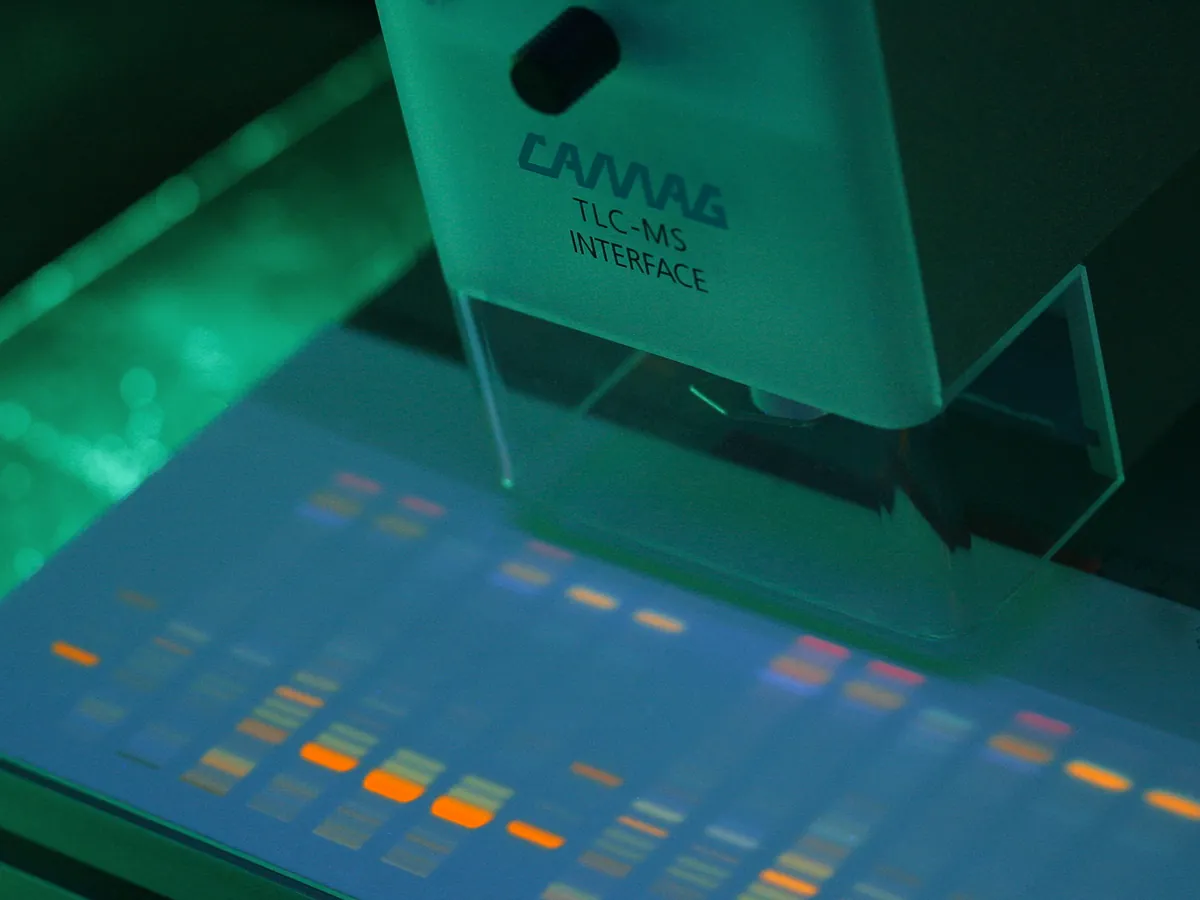
HPTLC calibration procedures
HPTLC has no instrument calibration of its own in most labs. Its performance is controlled through qualification (below) and the system suitability or acceptance checks of each test that uses it.
Instrument qualification (DQ · IQ · OQ · PQ)
- 01
DQ — Design qualification
Defines the modules needed (applicator, chamber, derivatiser, visualiser, scanner), wavelength range and software compliance.
- 02
IQ — Installation qualification
Confirms each module, serial numbers, gas supply, software version and connections are installed correctly.
- 03
OQ — Operational qualification
Checks applicator volume precision and positioning, scanner wavelength accuracy and repeatability, camera calibration and heater temperature.
- 04
PQ — Performance qualification
Runs a system suitability test plate (e.g. a defined reference mixture) to show reproducible Rf values and separation.
Keep every HPTLC in control: usage logs, calibration and maintenance schedules, and automatic blocking of overdue instruments.