GC Headspace Sampler
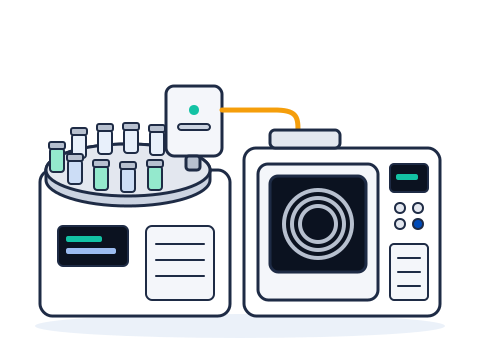
Heats a sealed vial containing the sample so volatile compounds move into the gas above it, then injects a portion of that gas into the GC. The standard way to test residual solvents without putting the sample matrix into the GC.
- Pharmaceutical
- Packaging
- Food & beverage
- Environmental
- Forensic
How Headspace works
At equilibrium in a sealed vial, a volatile analyte distributes between the sample phase and the gas phase according to its partition coefficient K. The concentration in the gas is CG = C0 / (K + β), where C0 is the original concentration in the sample and β is the phase ratio (gas volume ÷ liquid volume). Peak area is proportional to CG, so for the same K and β it is proportional to C0, which is why standards and samples must be prepared in the same way.
The path of a sample
- 01
Prepare vial
Weigh the sample into a headspace vial, add diluent, and crimp the septum cap immediately.
- 02
Equilibrate
The vial is heated (e.g. 80 °C for 30–60 min), often with shaking, until solvents reach equilibrium with the headspace.
- 03
Pressurise
Carrier gas pressurises the vial to above the loop or column head pressure.
- 04
Fill loop
The vial vents through a sample loop (e.g. 1 mL), trapping a fixed volume of headspace gas.
- 05
Inject
A valve switches the loop into the carrier stream, which sweeps the gas through a heated transfer line into the GC.
- 06
Separate & detect
The GC separates the solvents and the FID measures each one.
Main parts and what they do
Vial tray / carousel
Holds sealed headspace vials (commonly 10 or 20 mL) for the sequence.
Oven (thermostat)
Heats vials to the equilibration temperature, often with shaking to speed up equilibrium.
Sampling needle and valves
Pierce the septum, pressurise the vial and vent headspace gas into the loop.
Sample loop
Fixed-volume loop (e.g. 1 mL) that defines how much gas is injected; kept heated to prevent condensation.
Heated transfer line
Carries the gas from the sampler to the GC inlet, kept hotter than the loop to prevent condensation.
Crimp caps and septa
PTFE/silicone septa with aluminium crimp caps that keep the vial gas-tight under heat and pressure.
Crimper / decapper
Hand or electronic tool used to seal and open vials consistently.
Terms every analyst should know
Partition coefficient (K)
Ratio of analyte concentration in the sample phase to that in the gas phase at equilibrium. Low K means the analyte goes readily into the headspace and gives a large peak.
Phase ratio (β)
Gas volume ÷ liquid volume in the vial. For analytes with low K, reducing β (more liquid) increases sensitivity.
Equilibration temperature
Higher temperature lowers K for most solvents and increases response, but must stay well below the diluent's boiling point and must not degrade the sample.
Equilibration time
Long enough for the response to stop increasing; established during method development by plotting area against time.
Salting out
Adding salt to aqueous samples lowers the solubility of polar solvents and pushes them into the headspace.
Matrix effect
The sample matrix can change K. Standard addition or matrix-matched standards correct for it.
Keep every Headspace in control: usage logs, calibration and maintenance schedules, and automatic blocking of overdue instruments.