Dissolved Oxygen Meter
Measures the amount of oxygen dissolved in a liquid using an electrochemical or optical (luminescence) sensor. Used for water systems, fermentation, nitrogen-purged formulations and environmental testing.
- Pharmaceutical
- Biotech
- Environmental
- Food & beverage
- Aquaculture
- Power generation
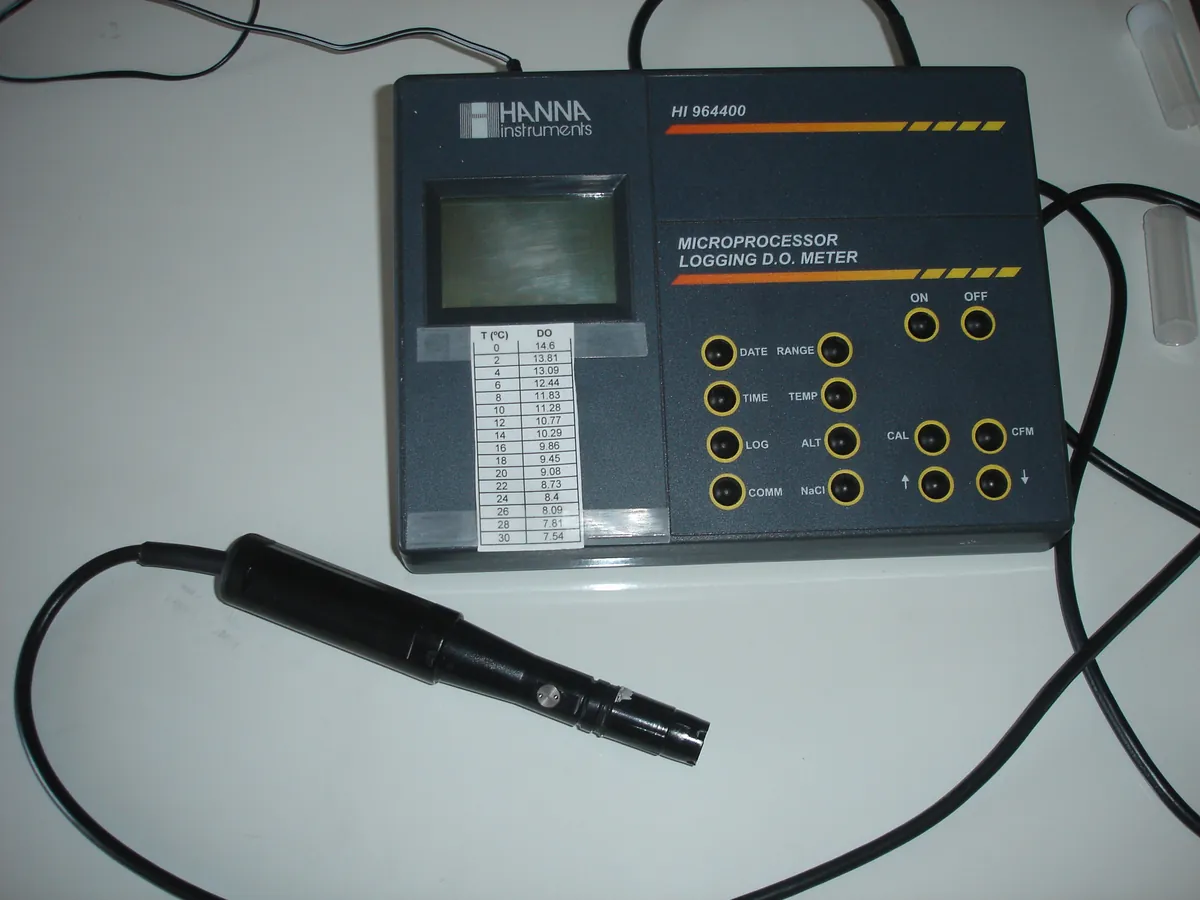
How DO meter works
Oxygen from the sample reaches the sensing element. In a Clark-type sensor it diffuses through a gas-permeable membrane and is reduced at a polarised cathode, giving a current proportional to the oxygen partial pressure. In an optical sensor oxygen quenches the luminescence of a dye, shortening its lifetime. The meter converts the signal to % saturation and, using temperature, pressure and salinity, to mg/L.
The path of a sample
- 01
Diffusion
Oxygen moves from the sample to the sensor element through a membrane or sensing layer.
- 02
Signal
A reduction current (electrochemical) or a change in luminescence lifetime (optical) is produced.
- 03
Temperature
A built-in sensor measures sample temperature.
- 04
Compensation
The meter corrects for temperature, barometric pressure and salinity.
- 05
Result
DO is displayed in mg/L and % saturation.
Main parts and what they do
DO sensor (probe)
Electrochemical or optical element that responds to oxygen.
Membrane cap / sensor cap
Gas-permeable membrane (electrochemical) or luminescent dye layer (optical).
Temperature sensor
Built into the probe for temperature compensation.
Meter / transmitter
Converts the signal, applies compensation and stores calibration data.
Barometer
Built into many meters to correct the saturation value for air pressure.
Calibration sleeve or bottle
Holds the probe in water-saturated air for the 100% calibration.
Terms every analyst should know
Oxygen solubility
Water holds less oxygen when it is warmer. At sea-level pressure, air-saturated fresh water contains roughly 9.1 mg/L at 20 °C and about 8.3 mg/L at 25 °C (see published solubility tables).
Partial pressure
The sensor responds to oxygen partial pressure, not concentration. That is why barometric pressure and salinity must be known to convert to mg/L.
Clark (polarographic / galvanic) sensor
A cathode and anode in electrolyte behind a membrane. Oxygen reduced at the cathode produces a current. These sensors consume oxygen, so the sample must flow or be stirred.
Optical (luminescent) sensor
A dye layer glows when excited by blue light. Oxygen shortens the glow. These sensors do not consume oxygen and need less maintenance.
Two-point calibration
A 100% point in water-saturated air (or air-saturated water) and a 0% point in oxygen-free solution set the sensor's slope and zero.
Keep every DO meter in control: usage logs, calibration and maintenance schedules, and automatic blocking of overdue instruments.