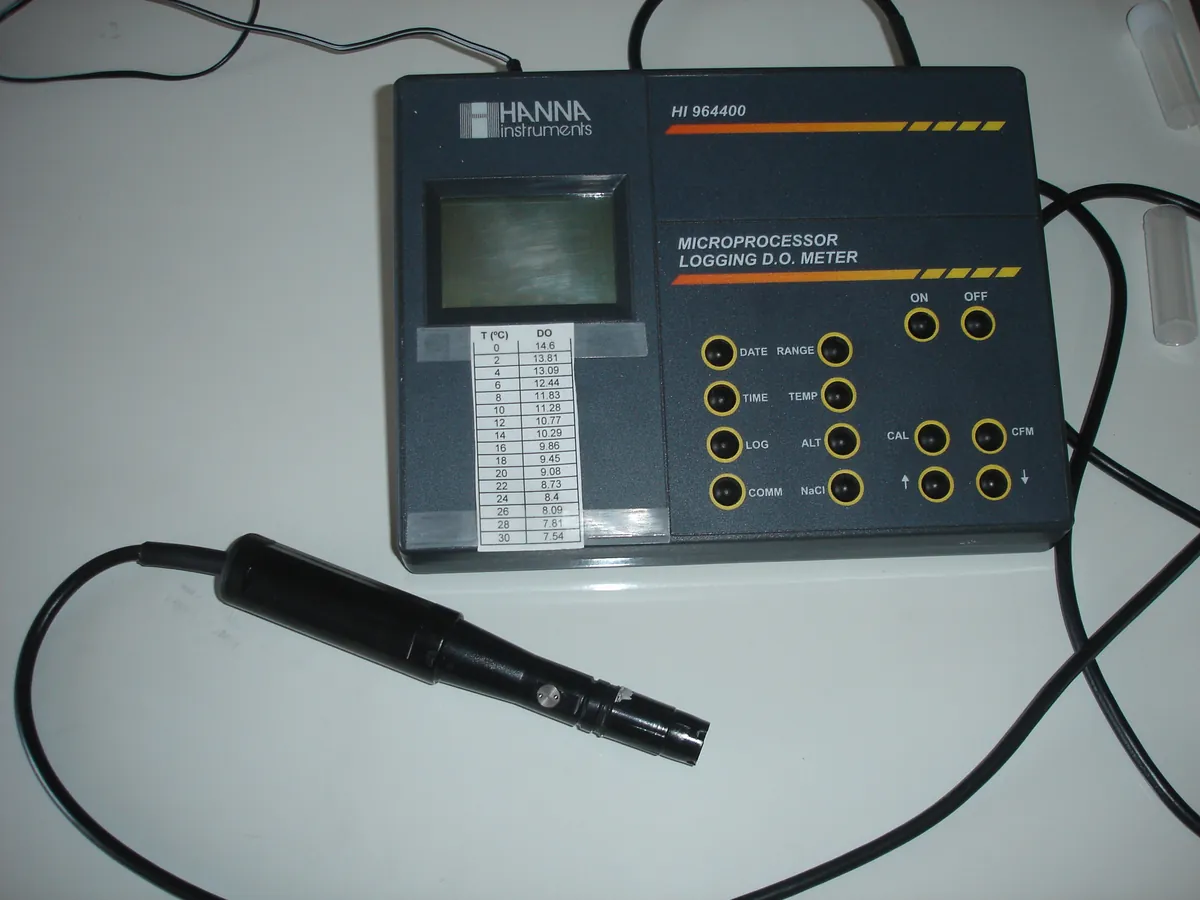
Dissolved Oxygen Meter
Measures the amount of oxygen dissolved in a liquid using an electrochemical or optical (luminescence) sensor. Used for water systems, fermentation, nitrogen-purged formulations and environmental testing.
- Pharmaceutical
- Biotech
- Environmental
- Food & beverage
- Aquaculture
- Power generation
Test your DO meter knowledge
Multiple-choice questions
Pick an answer to see whether you are right and why.
Q1. What happens to the solubility of oxygen in water as temperature rises?
basicQ2. What are the two calibration points of a DO meter?
basicQ3. Why must barometric pressure be entered into a DO meter?
intermediateQ4. Saturation DO at 25 °C and 1013.25 hPa is 8.26 mg/L. What is the expected value at 985 hPa?
intermediateQ5. Readings from a Clark-type sensor fall when the sample is not stirred. Why?
intermediateQ6. What is the working principle of an optical DO sensor?
basic
Viva questions
Think of your answer first, then open it to compare.
1. How do you perform an air calibration of a DO probe?
Place the probe in water-saturated air (calibration sleeve with a little water) at stable temperature, confirm pressure and salinity settings, wait for a stable reading and accept the 100% calibration.
2. Compare electrochemical and optical DO sensors.
Electrochemical (Clark) sensors use a membrane, electrolyte and cathode; they consume oxygen, need stirring, polarisation time and regular membrane changes. Optical sensors use a luminescent dye, do not consume oxygen, need no stirring and less maintenance, but the sensor cap must be replaced periodically.
3. How would you check the residual oxygen in a nitrogen-purged solution without errors from air?
Measure in a closed flow cell or sealed vessel, fill without bubbles, keep air out of the sample path, use a recently zero-checked sensor and let the reading stabilise. Any contact with air raises the reading quickly at low levels.
Keep every DO meter in control: usage logs, calibration and maintenance schedules, and automatic blocking of overdue instruments.