Density meter
Measures the density or specific gravity of a liquid in about a minute, using a vibrating glass U-tube. It replaces the pycnometer for most routine work.
- Pharmaceutical
- Food & beverage
- Spirits & brewing
- Chemicals
- Petrochemicals
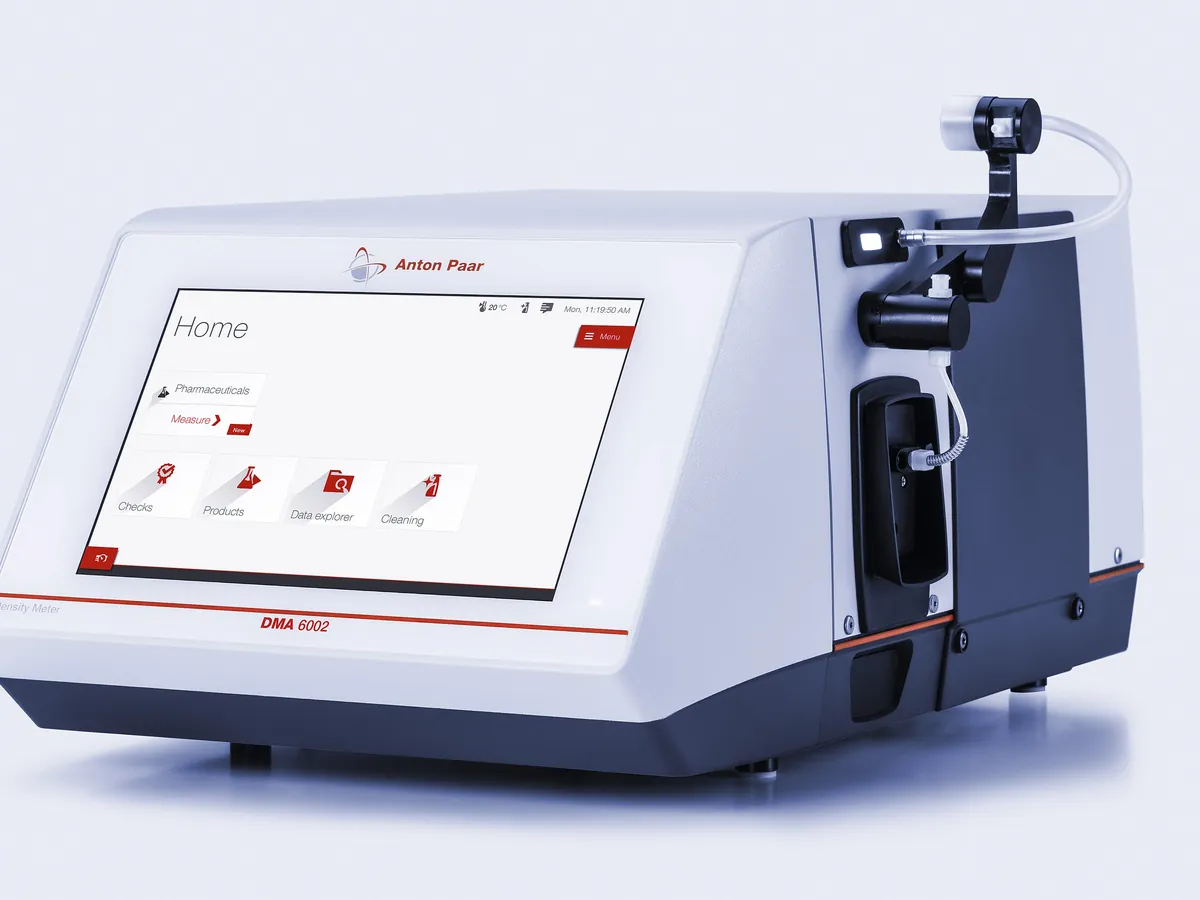
What is Density meter?
Density is mass per unit volume, usually given in g/cm³ (g/mL). Relative density, or specific gravity, compares the density of a sample with that of water at a stated temperature. Pharmacopoeias use density and specific gravity to identify liquids, check the strength of solutions such as ethanol, and control oral liquids and syrups.
The traditional method uses a pycnometer, a glass bottle of known volume weighed empty and full. A digital density meter is much faster. A small volume of sample (about 1–2 mL) is injected into a glass U-tube that vibrates at its natural frequency. The heavier the sample, the slower the tube vibrates, and the instrument calculates density from the period of vibration.
The U-tube is held at a precise temperature, usually 20 °C or 25 °C, by a Peltier element. Modern instruments also correct for the sample's viscosity and use a camera to show bubbles in the tube.
Used for
- Specific gravity or relative density of liquid raw materials and solvents
- Ethanol content of hydro-alcoholic solutions using density tables
- Density of syrups and oral solutions for release and in-process control
- Converting between mass and volume for fill-volume checks
- Concentration of simple binary solutions (for example sugar or salt solutions)
How it works
- 01
Fill
About 1–2 mL of sample is injected by syringe or drawn by a pump into the U-tube, with no bubbles.
- 02
Thermostat
The Peltier block holds the tube at the set temperature, for example 20.00 °C.
- 03
Excite
A magnet and pick-up coil drive the tube to vibrate at its natural frequency.
- 04
Measure period
The instrument measures the period of oscillation very precisely.
- 05
Calculate
Density is calculated from the period using the adjustment constants, with automatic viscosity correction if fitted.
- 06
Report
Density, relative density or concentration is displayed with the temperature and sent to the LIMS.
Advantages
- Fast: a result in 1–2 minutes
- Small sample volume
- High precision, typically 0.0001 g/cm³ or better
- Built-in temperature control and automatic calculations (density, relative density, concentration)
- Less operator dependence than the pycnometer method
Limitations
- Air bubbles in the U-tube give large errors
- Very viscous samples need viscosity correction and are hard to fill
- Samples with particles or gas (suspensions, carbonated liquids) are difficult
- The glass tube can be damaged by hydrofluoric acid or strong alkalis
- Must be checked with air and water regularly because the tube constants drift
1 calibration procedure
Keep every Density meter in control: usage logs, calibration and maintenance schedules, and automatic blocking of overdue instruments.